
Santander and Mastercard execute Europe’s first live payment initiated entirely by an AI agent
Santander and Mastercard pioneer agentic commerce by completing Europe’s first live autonomous payment within a secure, regulated banking infrastructure.
March 3, 2026
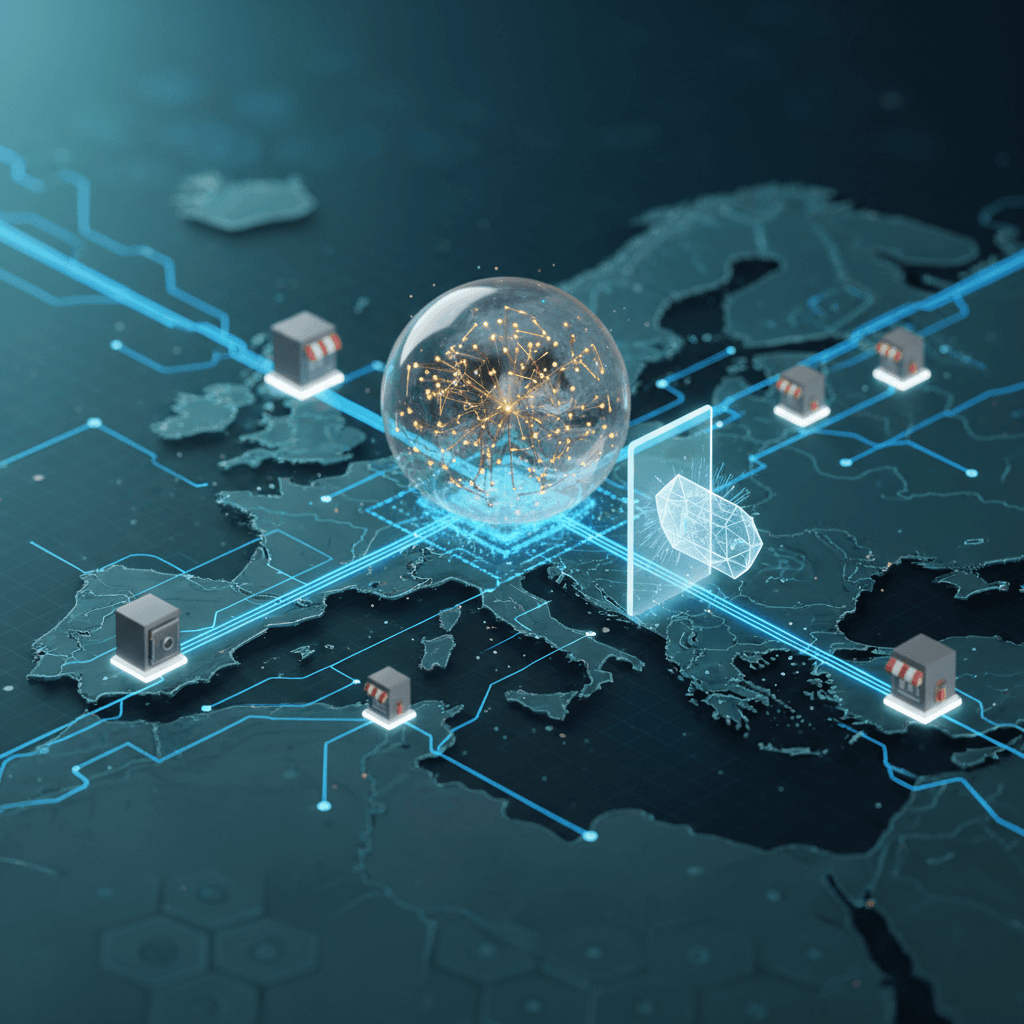
In a significant leap for the evolution of financial services, Banco Santander and Mastercard have successfully executed the first live end-to-end payment in Europe initiated and completed entirely by an artificial intelligence agent.[1][2][3][4][5][6][7][8][9][10] This milestone marks a transition from artificial intelligence serving as a passive analytical tool to an active participant within the highly regulated global banking network. The transaction, conducted within Santander’s live infrastructure, demonstrates that autonomous software systems can now navigate the complexities of identity verification, transaction authorization, and fund settlement without a human entering the final command. By moving the process out of simulated testbeds and into a real-world banking environment, the two financial giants have validated the operational and control frameworks necessary for what is being termed agentic commerce.[3][1][7][5][6][4][9][10]
The technical architecture of this pilot centered on the Mastercard Agent Pay solution, a framework designed to integrate autonomous agents into the existing financial ecosystem as governed, visible participants.[3][7][5][1][6][2][4][9][11] Unlike traditional automated payments or recurring billing systems that follow rigid, pre-programmed rules, the AI agent in this pilot operated with a level of situational autonomy. It was capable of searching for, discovering, and executing a purchase based on a user’s high-level intent rather than a specific manual trigger. The end-to-end orchestration of the transaction was supported by the PayOS platform, which facilitated the necessary handshakes between the bank, the merchant, and the payment network.[3][7] This structural shift is significant because it recognizes the AI agent as a distinct transaction initiator in the payment flow, granting it a digital identity that can be authenticated and tracked through the same rigorous standards applied to human cardholders.
A critical component of the pilot’s success was the implementation of robust security guardrails that ensure autonomous systems do not operate beyond their intended scope. The AI agent functioned within strictly predefined limits and permissions set by the customer and the bank, including specific spending caps and merchant categories. To maintain data integrity and privacy, the system utilized "agentic" payment tokens rather than raw cardholder data. These tokens allow the AI to complete a purchase securely without ever exposing sensitive account information to the merchant or third-party intermediaries. Furthermore, the agent was cryptographically identified as a unique actor, allowing for an auditable trail that distinguishes between human-led and machine-led transactions. This level of transparency is essential for the banking industry, where liability and fraud prevention are paramount. By embedding governance directly into the transaction layer, the pilot proved that innovation does not have to come at the expense of consumer protection or regulatory compliance.
The success of this pilot signals a broader shift in the artificial intelligence industry, moving beyond generative models that produce content toward agentic systems that execute tasks.[7][5] While the last two years have been defined by the rise of Large Language Models capable of writing code and answering complex queries, the next phase of development focuses on "actionable" AI. In the financial sector, this means moving from AI as an advisor to AI as an actor. Industry analysts have long suggested that the true economic value of artificial intelligence lies in its ability to manage end-to-end workflows. By delegating the friction-heavy tasks of procurement and checkout to an autonomous agent, businesses and consumers can regain significant time and resources. For banks, the potential for efficiency is immense, with some projections estimating that autonomous agents could unlock trillions of dollars in global economic value over the next several years by streamlining B2B payments and treasury operations.
The implications for the wider payment industry are vast, particularly regarding the rise of machine-to-machine commerce and the Internet of Things. As more devices and software systems become capable of making independent financial decisions, the traditional user interface of the payment world—the plastic card or the mobile wallet—will increasingly move to the background. In this future, an enterprise resource planning system might autonomously order and pay for industrial supplies when it detects low inventory, or a connected vehicle might negotiate and settle a micro-payment for a charging station without the driver’s intervention. The Santander and Mastercard pilot provides the blueprint for how these interactions can be handled within a regulated framework, ensuring they are interoperable across different banks and merchants while maintaining the scale and trust of the existing global payment rails.[3][4]
As financial institutions across Europe and the globe look to integrate agentic AI, the focus will now shift toward scaling these frameworks and refining the governance models that dictate machine behavior.[3] Recent industry research indicates that while a majority of banking executives are currently exploring or piloting agentic AI, only a fraction believe their organizations are ready for fully autonomous transactional tasks.[12][10] The technical readiness demonstrated by Santander puts them at the forefront of this curve, showing that existing legacy infrastructure can be adapted to support modern, autonomous commerce.[3][10][4][1] However, the path to mass adoption will require continued collaboration between technology providers, financial regulators, and cybersecurity experts to address emerging risks such as algorithmic bias in lending or the potential for agents to be manipulated by sophisticated fraud schemes.
Ultimately, the successful execution of an AI-led payment in a live network marks the beginning of an era of "invisible payments," where the act of transacting becomes a seamless byproduct of digital service.[3] By proving that an AI agent can responsibly manage the lifecycle of a payment—from initiation to settlement—Santander and Mastercard have set a new standard for the digital economy.[3] As these systems become more sophisticated and integrated into everyday business processes, the role of the bank will evolve from being a simple custodian of funds to being a provider of trusted, autonomous financial ecosystems.[3] This pilot is not merely a technical curiosity but a fundamental proof of concept for a world where money moves at the speed of intelligence, managed by agents that never sleep and operate with mathematical precision.