
MWC 2026 transforms theoretical 6G visions into commercial reality as giants launch AI-native networks
MWC 2026 accelerates the 6G timeline, replacing theoretical roadmaps with commercial AI-native hardware and real-world field trial results.
March 3, 2026
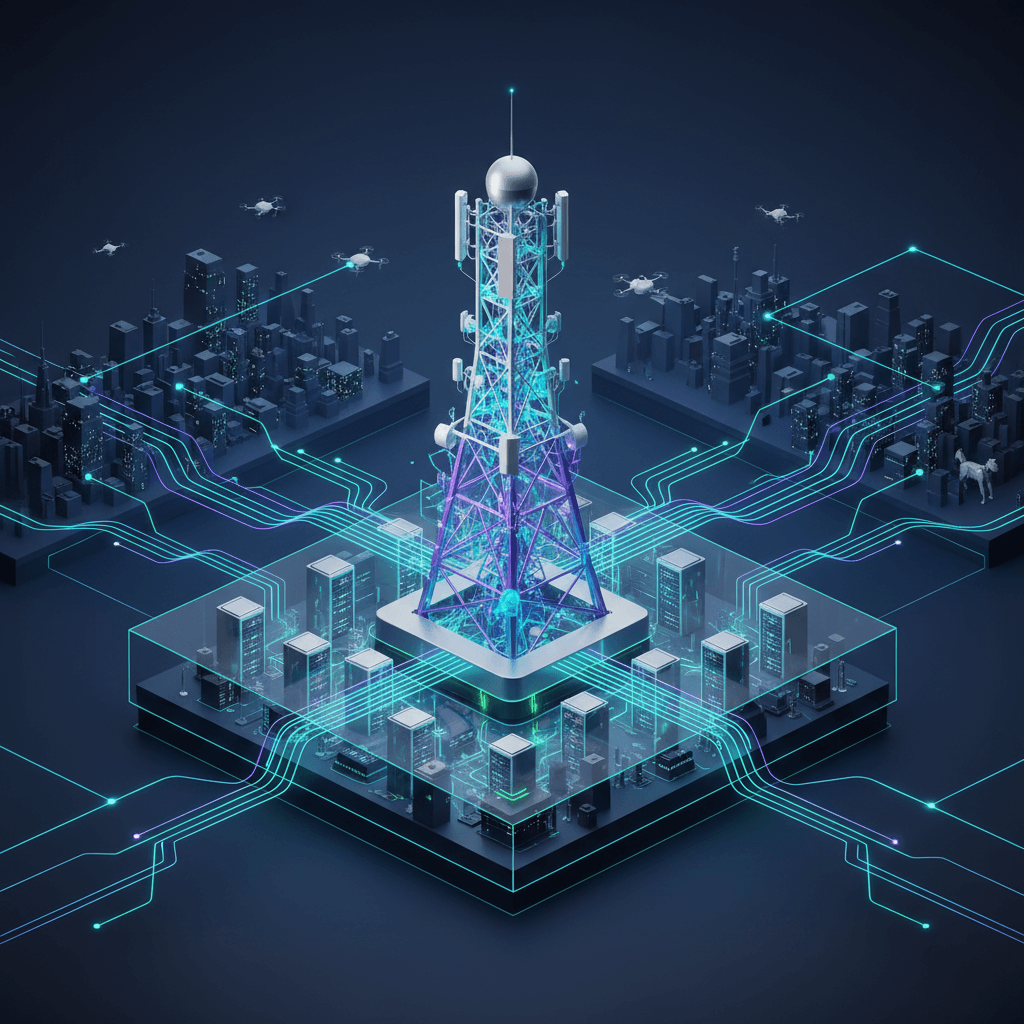
For years, the promise of artificial intelligence-native networks has been a centerpiece of the future-looking keynote speeches at Mobile World Congress. These visions typically framed the shift to AI-centric infrastructure as a cornerstone of the 6G era, still years away from realization. However, MWC 2026 in Barcelona marked a fundamental shift in the industry's trajectory. The discourse moved decisively from theoretical roadmaps to empirical proof, as a flood of announcements from the world’s most prominent telecom vendors, chipmakers, and operators provided the evidence that AI-native networks are already entering the commercial sphere.[1] The event showcased not just visions, but field trial results, commercial hardware launches, and massive industry coalitions that collectively signal a structural reset in how global connectivity is delivered and managed.
The emergence of the Artificial Intelligence Radio Access Network, or AI-RAN, served as the primary proof point of this transformation. At the heart of this shift was a cascade of real-world results that demonstrated AI is no longer a peripheral feature but a foundational element of the network stack.[2] T-Mobile US provided a landmark demonstration by successfully running concurrent AI and RAN processing on a single software-defined platform. This trial, conducted in an over-the-air lab environment using Nokia’s accelerated software and NVIDIA’s hardware, proved that a network can handle high-bandwidth 5G traffic alongside generative AI queries and video captioning tasks without compromising performance. Similarly, SoftBank achieved a technical milestone by demonstrating an industry-first 16-layer massive MIMO system powered by fully software-defined 5G.[1] These results suggest that the traditional reliance on specialized, rigid hardware is rapidly giving way to a flexible, GPU-accelerated architecture capable of optimizing itself in real-time.[3]
Further evidence of commercial readiness came from Southeast Asia, where Indosat Ooredoo Hutchison, in collaboration with Nokia and NVIDIA, achieved the region’s first AI-RAN-powered 5G call.[4] This milestone was not merely a laboratory success but a pre-commercial field validation that showcased a robotic dog being controlled with extreme low latency over a live network. Meanwhile, SynaXG set new performance benchmarks by running 4G and 5G workloads—including millimeter wave bands—alongside agentic AI tasks on a single server.[5][1] These tests yielded a staggering 36 Gbps throughput with latency under 10 milliseconds, providing the carrier-grade reliability that telecom operators require before moving toward large-scale deployment. The cumulative effect of these trials has been to collapse the expected timeline for AI-native infrastructure, with industry reports indicating that over three-quarters of telecom leaders now anticipate a much faster rollout than previously predicted for 5G.
The transition toward AI-native networks is being propelled by an unprecedented level of ecosystem consolidation and strategic alignment among technology giants. NVIDIA emerged as a central architect of this movement at MWC 2026, securing commitments from more than a dozen global heavyweights, including BT Group, Deutsche Telekom, Ericsson, and SK Telecom, to build future networks on open, AI-native software platforms.[1] This coalition is underpinned by the AI-RAN Alliance, which has swelled to over 130 member companies, all working toward a shared reference architecture. Ericsson and Intel also announced a sweeping strategic alliance to accelerate AI-native 6G, focusing on two distinct but complementary vectors: AI for Networks, which uses machine learning to optimize spectral and energy efficiency, and Networks for AI, which provides the high-performance fabric necessary to support the massive data demands of distributed AI applications. This "sensing-compute" convergence aims to turn the network into a distributed "AI factory," where the infrastructure itself becomes as intelligent as the applications running upon it.
The commercialization phase was further cemented by the unveiling of specialized hardware and software suites designed specifically for the telecom sector. Samsung introduced its Network in a Server solution, a fully virtualized edge-AI platform developed with AMD that allows enterprises to adopt AI services like real-time safety monitoring without complex external hardware. On the infrastructure side, companies like QCT and Supermicro launched commercial-off-the-shelf AI-RAN products, some utilizing the latest Blackwell-generation GPUs to handle the immense parallel processing required for modern radio functions. WNC and LITEON also introduced AI-optimized radio units that support both 5G Advanced and early 6G use cases. These product launches indicate that the supply chain for AI-native networking has matured to the point where operators can now purchase and deploy standardized, interoperable building blocks rather than relying on bespoke, proprietary systems.
Perhaps the most significant shift observed at MWC 2026 was the move toward open-source tools and specialized large language models tailored for telecommunications. NVIDIA released its Nemotron Large Telco Model, a 30-billion-parameter system designed to give operators the reasoning capabilities needed to automate complex network operations. In a similar vein, Huawei open-sourced its Agent-to-Agent for Telecom protocol, an orchestration framework aimed at enabling multi-vendor network automation.[6] The GSMA, in partnership with AMD and AT&T, launched the Open Telco AI initiative to provide a portal for shared datasets and benchmarking tools. By making these sophisticated models and protocols available to the broader ecosystem, the industry is lowering the barrier to entry for smaller operators and encouraging a more rapid, collaborative innovation cycle. This shift toward "agentic" AI—systems that can understand operator intent and make autonomous decisions—represents a departure from traditional automation and moves the industry closer to the goal of truly self-managing networks.[1]
The implications for the global telecom industry are profound, particularly regarding energy efficiency and new revenue streams. The concept of the "Zero Bit, Zero Watt" network, championed by Deutsche Telekom, highlights how AI-native architectures can dynamically allocate resources, powering down network components when they are not actively needed to reduce the massive energy footprint of mobile infrastructure. Beyond operational savings, AI-native networks allow operators to move beyond being "dumb pipes" for data. By hosting AI inference at the network edge, telcos can offer differentiated, high-value services to enterprises, such as real-time industrial sensing, autonomous vehicle coordination, and immersive augmented reality experiences. Qualcomm’s demonstrations of 6G prototypes for drone tracking and digital twin synchronization provided a glimpse into this future, where the network serves as a literal nervous system for the physical world.
As MWC 2026 concluded, it was clear that the telecom industry has reached a point of no return. The "6G promise" of AI-native networks has been pulled forward into the present, driven by the immediate needs of 5G Advanced and the explosive growth of generative AI traffic.[4] The transition to a software-defined, intelligent infrastructure is no longer a matter of if, but how quickly operators can integrate these technologies into their existing footprints. The evidence presented in Barcelona—from the high-speed benchmarks of SynaXG to the commercial product lines of Samsung and Nokia—confirms that the era of the intelligent network has arrived. For the AI industry, this provides a massive new playground of distributed compute, while for the telecom sector, it offers a path toward sustainable growth and technological sovereignty in an increasingly automated world. The architectural shift is now a commercial reality, setting the stage for a decade where the network and the intelligence it carries are finally one and the same.