
PyTorch Co-Creator Soumith Chintala Jumps to Thinking Machines as CTO.
PyTorch co-creator Soumith Chintala jumps to Thinking Machines Lab amid intense AI talent war and co-founder exits.
January 15, 2026
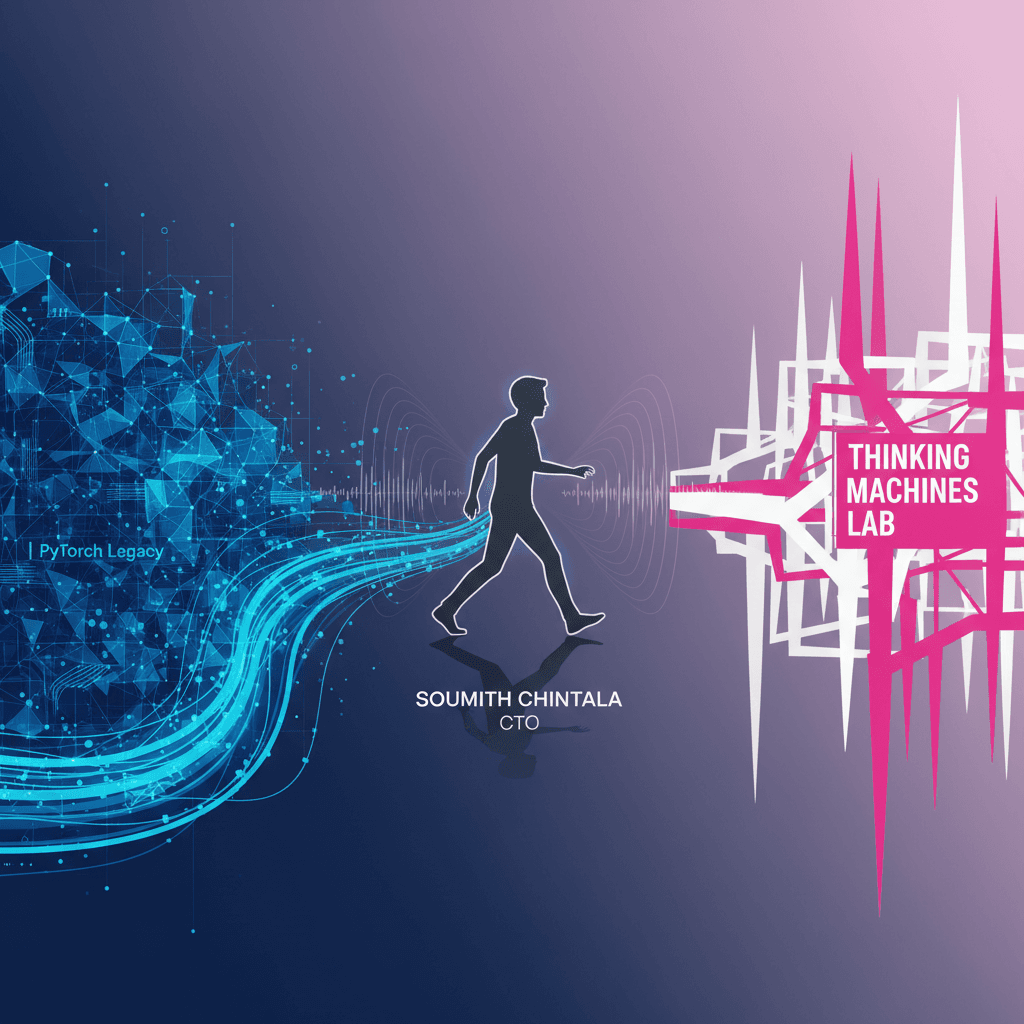
A major shakeup in the fiercely competitive AI talent landscape has culminated in the appointment of Soumith Chintala, a distinguished alumnus of the Vellore Institute of Technology (VIT) and co-creator of the foundational PyTorch framework, as the new Chief Technology Officer of Thinking Machines Lab[1][2][3]. This high-profile leadership transition at the startup, founded by former OpenAI CTO Mira Murati, follows the sudden and significant departure of multiple founding members, underscoring the relentless war for elite researchers in the frontier AI sector[1][4]. Chintala’s move from his established role as a core leader at Meta AI to the technical helm of the nascent, high-value startup signals a major realignment of influence within the industry and places an open-source champion at the heart of one of AI's most ambitious new ventures[5][6][2].
The executive change was necessitated by the swift exit of co-founder and former CTO Barret Zoph, along with fellow co-founder Luke Metz and senior researcher Sam Schoenholz, all of whom departed to rejoin their former employer, OpenAI[1][4]. Murati, who launched Thinking Machines Lab in early 2025 after her own high-profile departure from OpenAI, confirmed the parting of ways with Zoph and immediately announced Chintala’s elevation to the CTO role[1][7][8]. She praised him as a "brilliant and seasoned leader" with a decade of contributions to the AI field, a testament to the new CTO’s standing within the global research community[1][4]. This movement of top-tier talent, which also saw co-founder Andrew Tulloch leave for Meta previously, highlights the extreme fluidity and high-stakes nature of the AI industry's personnel dynamics, where even a company that has secured a massive $2 billion seed funding round—valuing it at a staggering $12 billion—is not immune to leadership turnover[1][4][8].
Chintala’s background positions him as a rare asset in the AI world, bridging the gap between cutting-edge research and widely-adopted, scalable infrastructure[5][6][2]. He completed his undergraduate studies in Information Technology at the Vellore Institute of Technology in India before moving to the United States for his Master of Science in Computer Science at New York University (NYU), where he worked under the mentorship of AI pioneer Yann LeCun[2][9][3]. His most transformative contribution to the field is the co-creation of PyTorch during his eleven-year tenure at Meta’s AI Research (FAIR) lab[2][10]. PyTorch has since become one of the most widely adopted open-source deep learning frameworks globally, used in production at virtually every major AI company and taught in classrooms worldwide, cementing his legacy as an architect of modern AI infrastructure[5][10][11]. His advocacy for open-source software and research, driven by a philosophy that "AI is delicious when it is accessible and open-source," aligns closely with Thinking Machines Lab’s foundational principles[12][2].
Thinking Machines Lab, structured as a public benefit corporation, has positioned itself as a challenger to the current trajectory of frontier AI development, which it views as becoming too concentrated, closed off, and difficult for general application[12][8][13]. The company's mission revolves around building AI systems that are more widely understood, customizable, and generally capable, with a strong focus on open science and "meta-learning"—teaching an AI *how* to learn[14][15][12]. The goal is to move the conversation from a brute-force race for model size toward a smarter focus on efficient learning and deep customization[14][15]. The new CTO’s expertise in building robust, widely-used, and community-driven AI infrastructure is seen as highly complementary to this vision, providing the technical foundation to realize a platform centered on open-source principles[16]. His experience is expected to be instrumental as the company seeks to scale its products, such as Tinker, an API announced previously that facilitates the fine-tuning of large language models[8][6].
The appointment comes at a critical juncture for Thinking Machines Lab and for the broader AI industry[4]. The return of multiple co-founders to OpenAI, an organization from which they had been recruited just months earlier, underscores the intense and sometimes fraught battle for high-level AI talent between startups and established giants[7][4]. For Mira Murati's startup, the challenge now shifts from securing initial funding—a feat achieved with its record-breaking seed round—to establishing stability and execution in the face of internal upheaval[4][8]. Chintala’s acceptance of the CTO role, less than a year after the company’s launch, serves as a powerful vote of confidence from a respected industry veteran[4][5]. His leadership provides an immediate injection of credibility and technical depth, signaling that the company is moving forward with an unwavering commitment to its open science-driven research and product roadmap, despite the early, high-profile departures[17][16]. The move is a significant win for the startup, which must now leverage Chintala's foundational expertise to convert its enormous financial backing and ambitious vision into a concrete, disruptive force in the global AI marketplace[6].
Sources
[2]
[4]
[6]
[11]
[14]
[15]
[17]