
New 2-Megabyte AI Models Map the Chemistry and Culture of Human Cooking
How Kaikaku.AI's tiny two-megabyte Epicure model bridges the gap between traditional recipe wisdom and molecular food chemistry.
May 31, 2026
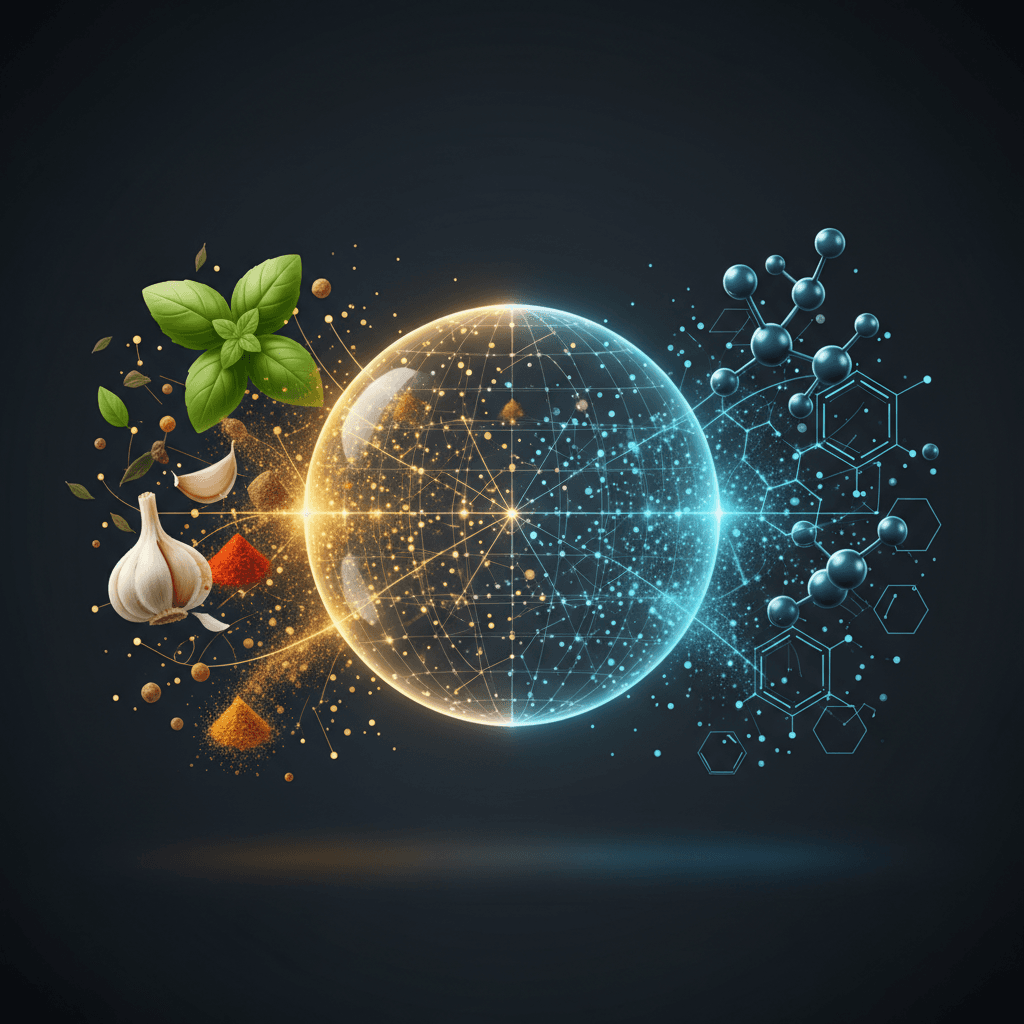
When asking an artificial intelligence system what ingredients best pair with chicken, the answer depends entirely on how the model was trained. If the AI learned from the rich tapestry of human-written recipes, it might suggest garlic, onion, and black pepper. If it learned from the chemical compounds and molecular profiles of ingredients, it might suggest beef or pork. This fundamental division between cultural tradition and molecular science is at the heart of Epicure, a newly released family of AI models developed by the London-based startup Kaikaku.AI[1][2]. By compiling millions of recipes alongside a comprehensive food chemistry database, the developers have created three sibling models that, for the first time, explicitly separate recipe context from chemical affinity[1][2][3]. The breakthrough has profound implications not only for the culinary arts but also for the broader field of domain-specific artificial intelligence[2][3].
The Epicure family is comprised of three distinct models named Cooc, Chem, and Core, each offering a unique lens on how food ingredients interact[3][4]. The first sibling, Cooc, is trained strictly on recipe co-occurrence, mapping what ingredients are cooked together in the wild[3][4][5]. Using this model, typing in basil surfaces traditional Italian pantry companions like parsley, olive oil, and parmesan[3][5]. The second sibling, Chem, completely ignores human recipes and instead walks the molecular paths of the FlavorDB database, which details how ingredients share volatile aroma compounds[6][3][4]. For basil, Chem suggests herbal relatives like oregano, tarragon, and rosemary, which share similar molecular profiles but might not traditionally share a plate[3]. The final sibling, Core, blends both approaches, offering a balanced middle ground[6][3][4]. It uses a mathematical mix of chemical relationships and recipe data, so a query for chicken yields both chemical peers like pork and traditional recipe companions like chicken broth[7][8].
Beyond the culinary creativity these models enable, Epicure represents a massive achievement in computer science and data compression[9][10]. The developers at Kaikaku.AI compressed what they describe as all of human cooking into a file that takes up only about two megabytes of storage space[9][10][11]. Rather than storing millions of recipes or heavy blocks of text, the system stores the learned mathematical coordinates of 1,790 canonical food ingredients across a 300-dimensional vector map[10][7][11]. The training corpus aggregated more than 4.14 million recipes from eleven public databases spanning seven languages—including English, Chinese, Russian, Vietnamese, Spanish, Turkish, Indonesian, German, and Indian-English—and consolidated over 200,000 unique raw ingredient strings[10][12]. By mapping these onto a shared coordinate space, the AI converts messy recipe data into highly structured, incredibly lightweight math, proving that complex domain knowledge can be efficiently distributed without requiring massive hardware[10].
One of the most remarkable discoveries in the Epicure research is how the chemistry-driven model exhibits emergent knowledge that it was never explicitly taught[3][13]. The Chem model was never given data about basic tastes, such as sweet, sour, or bitter, nor did it receive information regarding nutritional macronutrients like proteins or fats[3]. Yet, when evaluated, the purely chemistry-based model was able to classify ingredients along these sensory and nutritional axes more accurately than the models that relied on recipe text[1][3]. The findings suggest that the physical, molecular makeup of an ingredient implicitly carries a structured latent geometry of human-perceived taste and nutrition[3][13]. Furthermore, even though the models were never told which geographic regions or culinary traditions an ingredient belonged to, the coordinate maps naturally grouped ingredients into distinct regional clusters like Mediterranean, East Asian, and Latin American[3][13].
To interact with these coordinate maps, the research team implemented advanced vector mathematics, specifically a mathematical operation called Spherical Linear Interpolation, or SLERP[10][11]. This operator acts as a continuous steering knob, allowing users to rotate an ingredient's coordinates toward a specific culinary or regional axis[10][11]. For example, starting with the vector for rice and rotating it toward a South Asian cuisine direction immediately surfaces turmeric, mustard seed, fenugreek, coriander, and cumin[7][13]. Rotating chicken toward an East Asian axis yields soy sauce, ginger, and sesame oil, while a Tex-Mex rotation brings up tortillas, salsa, and monterey jack[11]. This algebraic approach to cooking allows developers and chefs to programmatically navigate food pairings, finding substitute ingredients across different cultures, or designing entirely new dishes based on controlled variables[14][11].
For both the food and AI industries, the release of Epicure marks a significant milestone[11]. In the culinary sector, Kaikaku.AI is already working on automating repetitive kitchen tasks, including pilot testing food assembly robots in restaurants[15]. Integrating these lightweight, highly sophisticated flavor models with physical robotics could pave the way for automated kitchens that can dynamically adjust recipes, suggest substitutes for allergies, or optimize menus for nutritional efficiency on the fly[16][15][14]. In the AI sector, Epicure stands as a powerful counter-argument to the prevailing trend of bigger is better[9]. As major tech corporations build trillion-parameter large language models that require massive data centers, Epicure demonstrates that hyper-focused, domain-specific embeddings of only two megabytes can achieve extraordinary reasoning capabilities[9][10]. This model of efficient, localized AI could inspire similar lightweight solutions in chemistry, medicine, and materials science.
Ultimately, Epicure reveals that gastronomy is a beautiful intersection of nature and nurture, of biology and culture[11]. By separating the cultural wisdom encoded in millions of human recipes from the hard chemical realities of molecular compounds, the system provides an unprecedented framework for food exploration[1][3]. Whether a professional chef is seeking to invent a radical new flavor pairing that defies tradition, or a software developer is building an automated recipe assistant, Epicure offers a mathematical map of the culinary universe[14]. By proving that taste and nutrition are deeply encoded in the physical structure of ingredients, this AI does not just tell us what goes with chicken; it teaches us why[1].
Sources
[2]
[4]
[6]
[9]
[10]
[11]
[12]
[13]
[14]
[15]
[16]