
Nvidia drives physical AI revolution with open-source world models and humanoid robot platform
Nvidia bridges the digital-physical divide by launching open-source world simulation models and a complete humanoid robot reference design
June 1, 2026
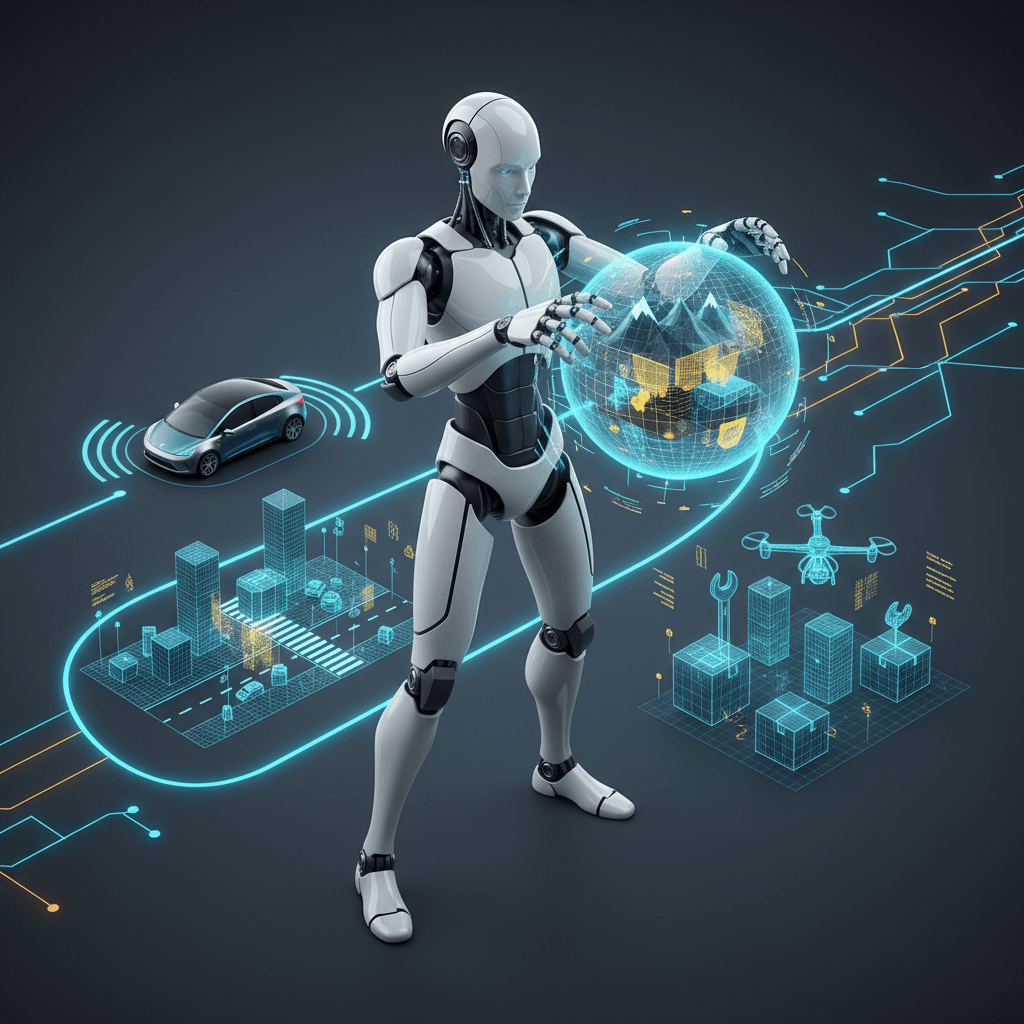
During the annual Computex trade show in Taiwan, Nvidia used its GTC Taipei keynote to signal a major paradigm shift in the artificial intelligence industry, placing its bets heavily on the concept of physical AI. Founder and CEO Jensen Huang presented physical AI as the logical evolution of agentic AI, defining it as intelligent agents equipped with physical sensors and actuators rather than mere screens and keyboards[1][2]. Instead of confining AI to virtual data centers or personal computer applications[2][3], Nvidia's latest strategy aims to bridge the digital and physical divide by providing the essential building blocks for machines to navigate, reason about, and manipulate the real world[4][2]. The centerpieces of this expansive technological push include the new frontier world foundation model known as Cosmos 3, a highly scaled-up autonomous vehicle reasoning model named Alpamayo 2 Super, and the Isaac GR00T Reference Humanoid Robot, which represents the industry's first open reference platform for bipedal robotics[5][6].
At the core of Nvidia’s strategy to master physical interaction is Cosmos 3, an open-source frontier foundation model designed to solve the critical data problem that has historically bottlenecked robotics[5][4][2]. While large language models successfully leveraged decades of human-generated internet text, robots have lacked a comparable repository of first-person perspective data[5][2]. Cosmos 3 addresses this gap by combining physical reasoning, world simulation, and action generation within a single omnimodal model[4][7]. Unlike previous iterations of the Cosmos platform, which required developers to stitch together separate models for world generation, scene understanding, and policy control, Cosmos 3 introduces a unified Mixture-of-Transformers architecture[8]. This allows the model to process highly flexible input-output configurations, spanning language, images, video, audio, and action trajectories, all within a single forward pass[7][8]. Nvidia has released Cosmos 3 in both Nano and Super variants under open-source licenses on Hugging Face and GitHub[4][8]. Alongside the model checkpoints, the company has provided open post-training scripts and synthetic datasets such as SDG-PhyxSim and SDG-RobotSim, which generate physics-accurate video simulations to train robots in a safe virtual environment before they are deployed in physical spaces[4][7][8].
This same world-modeling philosophy is being deployed to reshape the future of autonomous vehicles and robotaxis through the introduction of Alpamayo 2 Super[9][10]. This 32-billion-parameter reasoning-based vision-language-action model represents a threefold increase in scale compared to previous generations, which were limited to ten billion parameters[11][12][10]. This massive scale injection drastically improves the AI's 3D spatial understanding, physical reasoning, and trajectory prediction in complex, real-world driving environments[10]. Furthermore, Alpamayo 2 Super expands its perceptual capabilities from traditional, front-focused cameras to full-surround 360-degree situational awareness, allowing autonomous vehicles to seamlessly negotiate merges, lane changes, and intricate intersections[10]. To support level four robotaxi developers, Nvidia has paired the model with AlpaGym, a high-throughput closed-loop reinforcement learning framework operating in the AlpaSim environment, and OmniDreams, a tool for generating photorealistic, challenging driving scenarios[5][13]. These frameworks ensure that driving brains are rigorously tested against edge cases and compounding errors in simulation, significantly narrowing the reality gap before autonomous vehicles are placed on public roads[5][13].
Beyond virtual simulation and driving models, Nvidia aims to accelerate the physical deployment of bipedal systems by open-sourcing the Isaac GR00T Reference Humanoid Robot, aimed specifically at democratizing academic research[6]. Historically, robotics laboratories have suffered from a fragmented development process, spending months configuring custom-built machines and cobbling together disparate hardware components and proprietary software[6][14]. The new reference design unifies this process by bringing together a complete robotic body and brain[6][14]. The physical chassis is based on the Unitree H2 Plus humanoid robot, standing nearly six feet tall, weighing 150 pounds, and sporting 31 degrees of freedom[15][16]. This is paired with Sharpa Wave tactile five-finger hands, which add 22 degrees of freedom to enable highly dexterous object manipulation, resulting in a total of 75 degrees of freedom across the entire system[15][16]. Providing the computational horsepower is the onboard Jetson Thor compute system, powered by an Nvidia Blackwell GPU that delivers 2,070 teraflops of FP4 AI performance alongside a 14-core Arm CPU and 128 gigabytes of unified memory[6][17]. Academic institutions including the Allen Institute for AI, ETH Zurich, Stanford Robotics Center, and the University of California, San Diego, are slated to adopt this reference design, allowing researchers to skip the tedious hardware integration phase and jump immediately to advancing general-purpose physical intelligence[6][18].
The sweeping announcements at GTC Taipei highlight Nvidia’s ambition to establish itself as the foundational platform for the next wave of physical AI development, transitioning far beyond its traditional roots as a graphics processing unit manufacturer[19]. By open-sourcing highly capable models like Cosmos 3 and Alpamayo 2 Super, and providing an end-to-end humanoid hardware reference design, Nvidia is actively lowering the entry barriers that have historically prevented smaller firms and university laboratories from participating in frontier robotics[20][6][18]. This strategy could effectively standardize the software and hardware stack across the global robotics industry, mirroring the dominance that Nvidia's CUDA platform achieved in deep learning. As the artificial intelligence landscape pivots from digital chatbots toward physical embodiments that can work in factories, navigate city streets, and operate in homes, Nvidia’s integrated approach positions it to capture a multitrillion-dollar economic opportunity[21][2]. By solving the core problems of physical world simulation, tactile manipulation, and end-to-end reasoning, Nvidia is setting the stage for what it terms the big bang of physical AI, shaping how machines will perceive, understand, and interact with the physical world for decades to come[22].
Sources
[1]
[4]
[5]
[6]
[7]
[10]
[12]
[13]
[16]
[17]
[18]
[19]
[21]
[22]