
Internal disputes and financial skepticism paralyze the five hundred billion dollar Stargate AI infrastructure project
Internal disputes and financial skepticism paralyze the $500 billion Stargate project, threatening the massive infrastructure required for future AI.
February 23, 2026
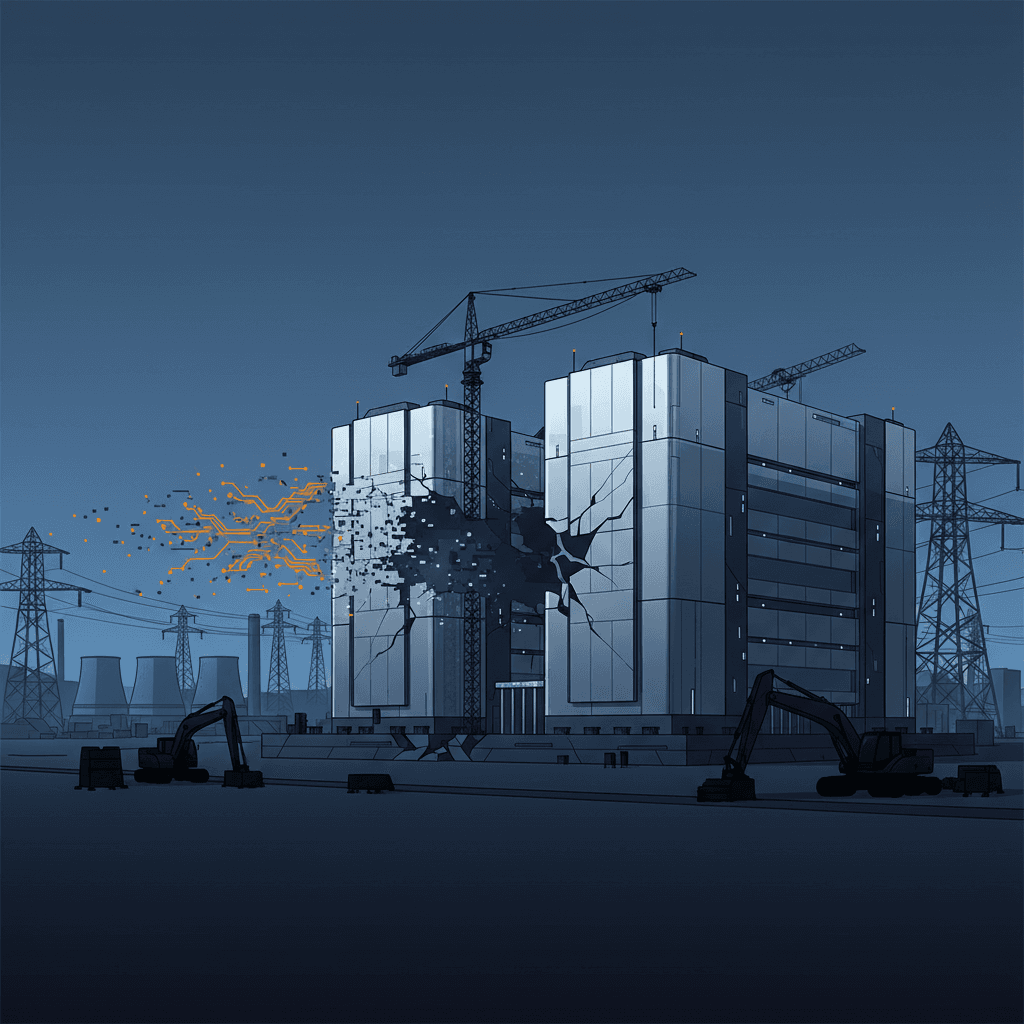
The most ambitious infrastructure project in the history of computing is currently facing a significant state of paralysis as internal disputes and financial skepticism threaten to derail the massive Stargate initiative.[1][2] Conceived as a five hundred billion dollar effort to build the backbone of artificial intelligence in the United States, the project was intended to establish a network of colossal data centers capable of delivering ten gigawatts of computing power.[3][4] However, the collaborative foundation between OpenAI, Oracle, and SoftBank has begun to crack under the weight of unresolved disagreements over operational control, financial responsibility, and the fundamental structure of the partnership.[5][6][4] What was once heralded as the technological equivalent of the Manhattan Project is now mired in a deadlock that has prevented the consortium from hiring staff or breaking ground on most of its proposed facilities.
At the heart of the stall is a fundamental power struggle between the three primary stakeholders, each of whom brings a different necessity to the table but demands a level of influence that the others are unwilling to concede.[4] SoftBank, led by Masayoshi Son, has sought to position itself as the primary financier and chairman of the venture, leveraging its vast capital resources and the expertise of its subsidiaries like SoftBank Energy to own and develop the physical sites. OpenAI, under the leadership of Sam Altman, initially pursued a vision where it would maintain operational control and influence over the design of the facilities to ensure they were optimized for the specific, unprecedented requirements of artificial intelligence training and inference. Oracle, meanwhile, entered the fray as the critical cloud infrastructure partner, intending to be the primary provider of the server environments. This triad has reportedly spent months in a stalemate over who should bear the economic risk of cost overruns and who ultimately owns the data center assets once they are completed.[4][2]
This internal friction has led to a significant strategic retreat for OpenAI, which has been forced to abandon its immediate goal of becoming a self-sufficient infrastructure developer.[6][7][2] Initially, OpenAI executives explored the possibility of bypassing their partners to build and own their own data centers independently.[2][4][6] This pivot was intended to reduce reliance on third-party cloud providers and lower long-term costs. However, this solo ambition hit a wall when faced with the harsh realities of the credit markets. Financial lenders and Wall Street institutions have shown a notable hesitation to provide billions of dollars in debt to a company that, despite its massive valuation and cultural dominance, continues to burn through tens of billions of dollars annually with a business model that remains unproven in the long term. These lenders have expressed concerns about the lack of a clear path to profitability before the end of the decade, viewing the massive capital expenditure required for Stargate as an unacceptable risk without more stable guarantees.
The logistical and economic hurdles extend beyond simple corporate squabbles.[3][2][4][8][1][5] The sheer scale of the energy requirements for the Stargate project—initially targeted at ten gigawatts—has introduced complexities that the current American power grid is ill-equipped to handle. While there were initial plans to utilize emergency declarations and expedited regulatory processes to build dedicated energy plants, the physical reality of constructing such massive power generation capacity has proved daunting. Additionally, shifting economic policies and international trade tensions have complicated the financial modeling for the project.[8] The prospect of rising tariffs on server components, advanced semiconductors, and cooling systems has led analysts to estimate that construction costs could increase by as much as fifteen percent.[1][8] This inflationary pressure on hardware has made the already astronomical five hundred billion dollar price tag even more difficult for investors to digest, particularly as competitors begin to demonstrate that high-performance AI models can be developed with more efficient, less capital-intensive methods.
Faced with these setbacks, the unified Stargate consortium has largely dissolved into a series of bilateral agreements rather than a single, cohesive entity.[5][2] OpenAI has moved to secure its computing needs through a fragmented approach, signing separate deals with Oracle to develop roughly four and a half gigawatts of capacity while simultaneously deepening its reliance on existing cloud giants like Amazon Web Services and Google Cloud.[2][6][5] This shift represents a pragmatism born of necessity; unable to wait for the resolution of the Stargate deadlock, OpenAI is now scrambling to lock in whatever compute capacity is available on the open market. The company has also begun to diversify its hardware supply chain, moving beyond its exclusive dependence on high-end Nvidia chips to explore partnerships with other semiconductor manufacturers and specialized AI accelerator startups.[2]
The consequences of the Stargate stall are already being felt across the broader artificial intelligence industry. OpenAI reportedly missed its goal of securing ten gigawatts of capacity by the end of last year, managing to lock in only about three-quarters of that target through its various secondary partnerships. This shortfall has financial implications, as the company has had to revise its projected spending on computing infrastructure through the end of the decade, with estimates now reaching six hundred billion dollars.[2][9] The delay in building the dedicated Stargate infrastructure means that the timeline for developing the next generation of large-scale models—the systems many believe will lead to artificial general intelligence—is potentially being pushed back. The bottleneck is no longer just a matter of algorithmic breakthroughs, but a question of whether the physical and financial architecture of the world can support the massive appetite for power and silicon that these models demand.
The current situation highlights a growing divide between the optimistic projections of Silicon Valley and the cautious realities of global finance.[10] While tech leaders argue that the race for AI supremacy is a national security imperative that justifies any expense, investors are increasingly scrutinizing the return on investment for these "mega-clusters." The struggle to move Stargate forward suggests that even the most well-funded and high-profile projects can be brought to a halt by the complexities of large-scale industrial development. As OpenAI, Oracle, and SoftBank continue to navigate their fractured relationship, the industry is watching to see if the Stargate vision can be revived or if it will serve as a cautionary tale about the limits of rapid infrastructure expansion in the age of artificial intelligence.
In the near term, the focus has shifted from the grand, centralized vision of Stargate to smaller, more manageable campuses, such as the sites in Texas where ground has actually been broken. These smaller projects represent a scaled-back version of the original ambition, serving as a test case for whether the partners can actually collaborate on a functional level. If these initial sites prove successful, they may provide the blueprint needed to regain the confidence of lenders and resolve the disputes that have left the larger project in limbo. However, the window of opportunity is narrow, as international competition intensifies and the pressure to deliver transformative AI products continues to mount. The fate of the five hundred billion dollar project remains a critical bellwether for the future of the technology, representing either the birth of a new industrial era or a significant overextension of the AI boom.
Sources
[1]
[3]
[6]
[8]
[10]