
Google Deepmind medical AI outperforms GPT-5.4 and matches human doctors in diagnostic trials
Outperforming general AI in diagnostic accuracy, Deepmind’s multimodal co-clinician aims to ease healthcare shortages through specialized, collaborative intelligence.
May 1, 2026
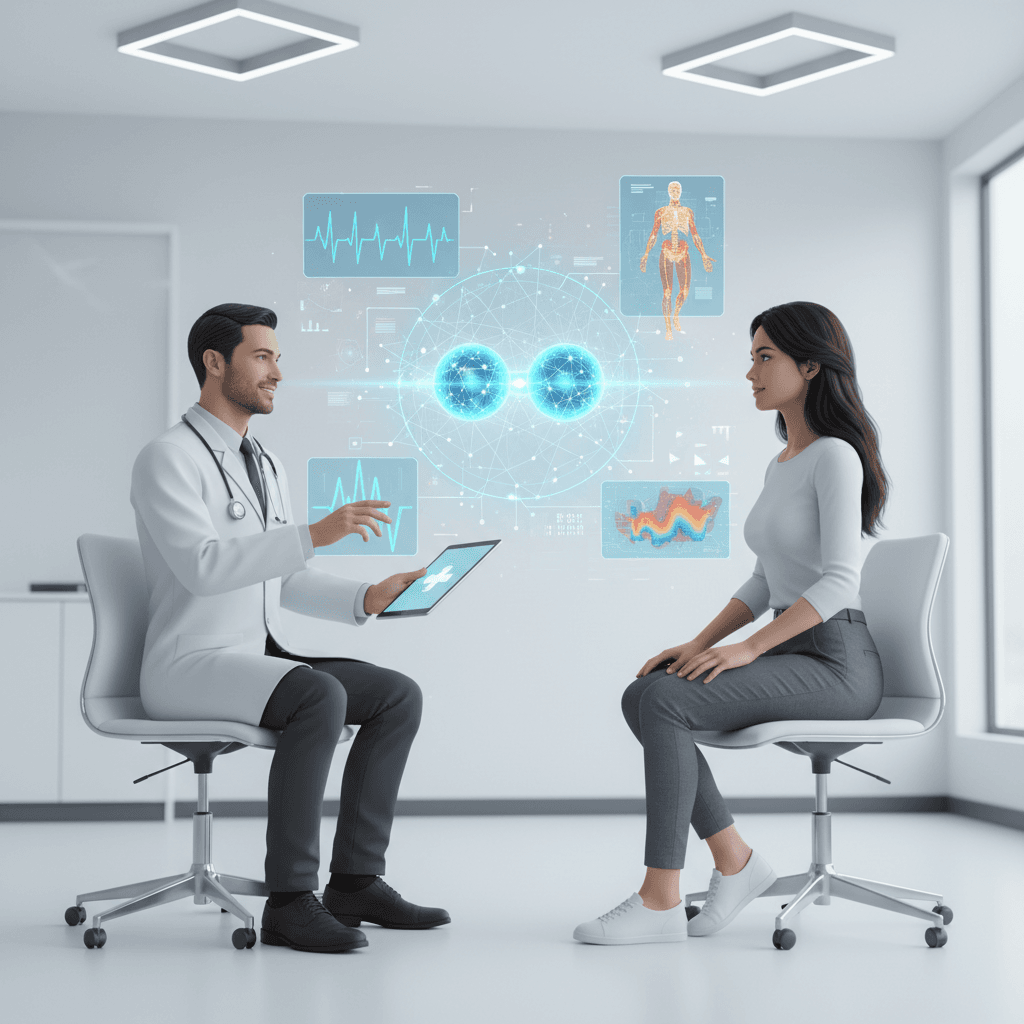
The landscape of digital healthcare has reached a pivotal juncture as Google Deepmind reveals the latest results from its AI co-clinician initiative, a research project aimed at integrating advanced artificial intelligence into the front lines of patient care.[1][2] In a series of rigorous blind evaluations, the new system demonstrated a level of clinical proficiency that surpassed OpenAI’s GPT-5.4 across multiple diagnostic and interpersonal benchmarks. This development represents a significant leap from previous medical language models that focused primarily on passing written examinations. Instead, the AI co-clinician has been designed to navigate the complexities of real-time patient interactions, processing a multimodal stream of data that includes not only text but also live audio and video. While the results suggest a new era of AI-augmented medicine, the research also provides a sober reminder of the enduring value of human expertise. Despite its technical dominance over other general-purpose models, the AI co-clinician still trails experienced physicians in critical areas such as identifying subtle clinical "red flags" and conducting physical examinations that require tactile intuition and long-term diagnostic reasoning.
The core of this research involved a randomized, double-blind study that mimicked the structure of an Objective Structured Clinical Examination, the gold standard for assessing medical students and practitioners. In these simulations, the AI co-clinician was pitted against human primary care physicians and leading general-purpose models, including GPT-5.4. The evaluation utilized a pool of medical residents acting as patients, presenting 140 unique clinical scenarios ranging from routine respiratory infections to complex, multi-systemic chronic conditions. Independent specialist physicians, unaware of whether a response was generated by a human or an AI, rated the interactions based on diagnostic accuracy, empathy, clinical judgment, and the quality of the proposed management plan. The data revealed that Google Deepmind’s system outperformed GPT-5.4 in nearly every category, particularly in maintaining clinical boundaries and providing evidence-based reasoning. Most notably, the AI co-clinician matched or exceeded human performance in 68 of the 140 assessed areas, including triage and the synthesis of complex medical histories.
One of the most significant technical breakthroughs highlighted in the research is the AI co-clinician’s dual-agent architecture, which sets it apart from the singular "black box" approach of most large language models. The system utilizes a "Planner" module that acts as a supervisor, continuously monitoring the conversation and verifying that the "Talker" agent remains within safe clinical and ethical boundaries. This internal check-and-balance system is specifically designed to prevent the hallucinations and erratic behavior often seen in general AI models. Furthermore, the system was tested against the NOHARM safety framework, a specialized metric designed to identify "errors of commission" where incorrect information is provided and "errors of omission" where critical symptoms are ignored.[1] In a set of 98 realistic primary care queries, the AI co-clinician recorded zero critical errors in 97 cases. This level of reliability has proven difficult for general-purpose models like GPT-5.4, which, while highly intelligent, lack the specialized architectural safeguards necessary for clinical-grade safety.
The research also sheds light on the limitations of current consumer-facing AI, particularly the voice modes found in popular chatbots.[3] While many users have begun turning to ChatGPT’s voice mode for advice, the Deepmind study argues that these systems are fundamentally unsuited for serious medical tasks.[3] General-purpose voice AI often lacks the specialized audio-visual reasoning required to interpret a patient’s condition accurately. In contrast, the AI co-clinician is built to analyze live feeds to detect physical symptoms such as a patient’s breathing patterns, the nature of a skin rash, or the specific characteristics of a patient’s gait.[2] Beyond mere speech-to-text, the specialized system evaluates the nuance of a patient’s delivery and physical presence. General voice models also suffer from latency issues and a lack of real-time evidence synthesis, which can lead to dangerously misleading or overly confident advice in a high-stakes consultation setting.
Despite these technological advancements, human physicians remains superior in the most nuanced aspects of medical practice.[2] Experienced doctors excelled in scenarios that required "holistic sensing"—the ability to pick up on subtle non-verbal cues that an AI, limited by its camera's field of view and sensory programming, might miss. Human physicians were also notably better at identifying "red flags," those rare but critical signs that a seemingly minor symptom could be life-threatening. The study suggests that while AI can process vast amounts of medical literature and synthesize data faster than any human, it still lacks the profound clinical intuition built over decades of physical practice. This gap underscores why Google Deepmind is positioning the system as a "co-clinician" rather than a replacement. The goal is to create a "triadic care" model where the AI serves as an assistant to both the doctor and the patient, handling the heavy lifting of data synthesis and documentation so the physician can focus on the final diagnostic decision and the human-to-human connection.
The implications for the global healthcare industry are profound, especially as the world faces a projected shortage of more than 10 million health workers by 2030. Deepmind’s initiative aims to address this crisis by lowering the diagnostic and administrative burden on primary care physicians, who are often overwhelmed by the volume of information they must process during a ten-minute consultation. By surfacing high-quality evidence and drafting preliminary management plans, the AI co-clinician could significantly reduce physician burnout and increase the accessibility of care in underserved regions. However, the path to widespread clinical deployment remains complex. Regulatory bodies, including the FDA, are expected to scrutinize these systems for their ability to maintain safety across diverse patient populations and to ensure that the AI does not inadvertently amplify historical biases found in medical data.
As the AI industry continues its rapid evolution, the success of the AI co-clinician serves as a blueprint for the shift from general-purpose "chat" to specialized, collaborative agents. The fact that a specialized medical model can outperform a flagship general model like GPT-5.4 suggests that the future of AI may lie in domain-specific optimization rather than universal scaling alone. For Google Deepmind, the research represents a move toward "grounded intelligence"—AI that is not only capable of talking about the world but is also capable of seeing, hearing, and reasoning within it alongside human experts. While the AI may not yet be ready to sign off on a prescription or perform a physical exam, its ability to act as a highly capable second pair of eyes and ears marks a transformative moment for the medical field. The challenge ahead will be ensuring that as these systems become more capable, they remain tools that empower doctors and protect patients, maintaining the delicate balance between technical precision and human compassion.