
Gallup poll reveals Americans oppose local AI data centers more than nuclear power plants
Driven by soaring resource demands and utility costs, Americans now oppose local AI data centers more than nuclear plants.
May 14, 2026
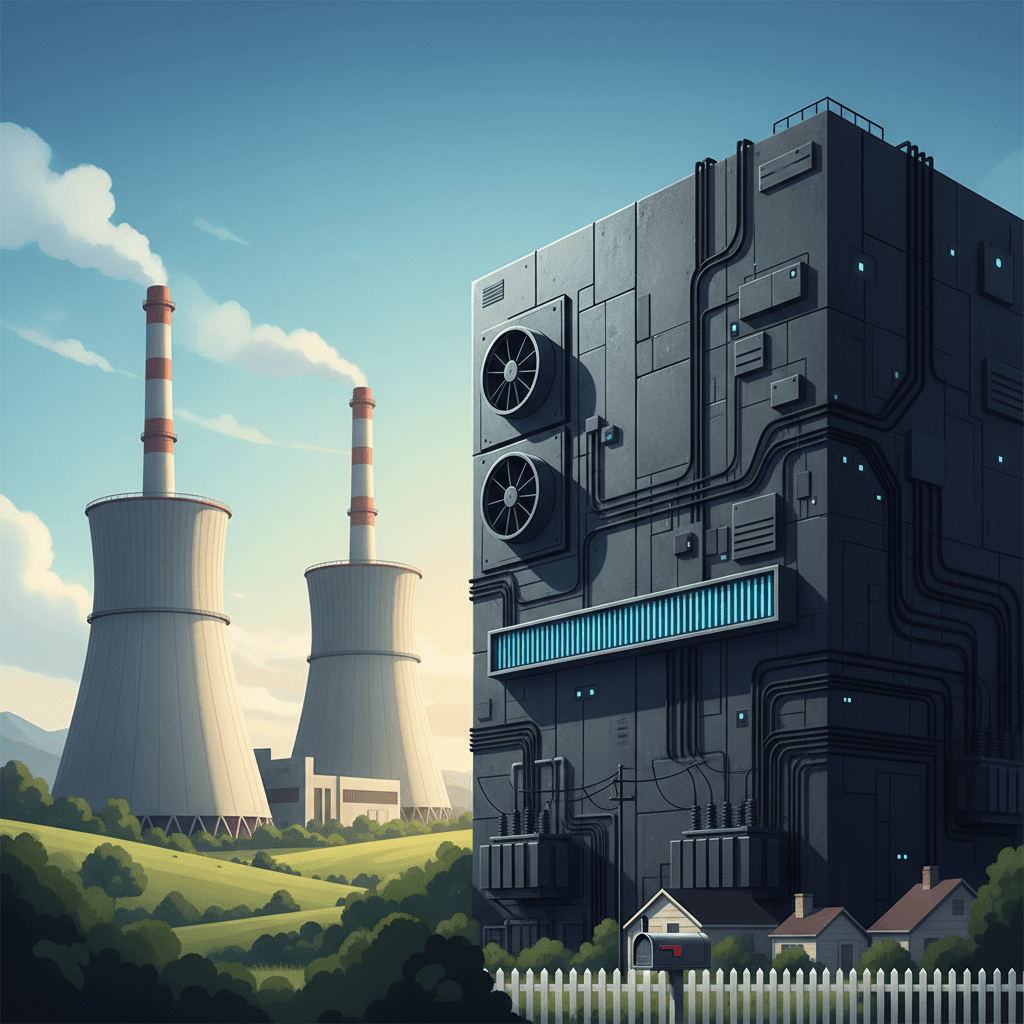
In a striking shift of public sentiment that underscores the growing friction between the digital economy and physical infrastructure, a new Gallup poll has revealed that Americans are now more opposed to living near an artificial intelligence data center than a nuclear power plant.[1][2][3][4][5][6][7] The survey indicates that 71 percent of Americans object to the construction of AI data centers in their local communities, a figure that significantly outpaces the 53 percent who express opposition to a nearby nuclear energy facility.[8][3][4][7][5] This finding represents a significant challenge for the technology industry, which has long marketed the "cloud" as an ethereal, invisible utility, only to find that the massive physical warehouses required to power modern AI are becoming the new focus of "not in my backyard" activism across the United States.
The intensity of this opposition is particularly notable, with nearly half of all respondents—48 percent—stating they are strongly opposed to such projects.[9][3][4][8][10][5] While tech giants like Microsoft, Google, and Meta have historically enjoyed a level of prestige as clean, high-tech employers, the public perception of their physical footprint is darkening. The poll found that opposition cuts across the political spectrum, though it is notably more intense among Democrats, 56 percent of whom are strongly opposed, compared to 39 percent of Republicans.[1][2] This widespread resistance suggests that the rapid build-out of the computing infrastructure necessary for generative AI is no longer viewed as a purely economic boon, but rather as an industrial intrusion with significant environmental and social costs.
At the heart of the public’s concern is the sheer volume of resources required to keep these facilities operational.[2][8] Modern AI data centers are far more resource-intensive than the cloud storage warehouses of the previous decade. A single hyperscale data center can consume as much electricity as 100,000 homes, with some of the largest planned "megacampuses" projected to draw power equivalent to two million households. According to Gallup, half of those who oppose local data center construction cite the excessive use of resources as their primary grievance.[9][1][8][3][4][2][5] Specifically, 18 percent of opponents pointed to the massive water requirements for cooling high-performance servers, while another 18 percent focused on the strain placed on the national energy grid. For many residents, the concern is not just environmental but also financial; approximately 20 percent of opponents fear that the arrival of a massive data center will lead to surging utility bills as local power companies pass on the costs of grid upgrades to residential customers.
The environmental concerns extend beyond resource consumption to include direct local pollution.[8][11] While data centers are often marketed as emissions-free, they rely on massive arrays of diesel backup generators to ensure uninterrupted service during grid failures. These generators are a source of significant anxiety for local communities, as they can emit between 200 and 600 times more nitrogen oxides than a natural gas power plant.[11] Public health advocates have warned that these emissions contribute to respiratory issues and other long-term health problems, particularly in rural or disadvantaged areas where land is often cheaper and data centers are more frequently sited. The Gallup data suggests that 16 percent of opponents specifically cite noise and air pollution as their main reason for rejecting nearby development, reflecting a growing awareness of the industrial reality behind the digital interface.
The disconnect between the technology industry’s promises and the community’s experience is further widened by the perceived lack of economic return.[12] For years, data center developers have secured lucrative tax breaks and public subsidies by promising jobs and economic revitalization. However, the Gallup survey reflects a growing skepticism regarding these benefits.[5][6][4] Unlike a manufacturing plant or a retail hub, a data center is largely autonomous once construction is complete, employing only a handful of specialized technicians and security personnel. Residents are increasingly viewing these facilities as "industrial ghosts" that consume local land, water, and power without providing a proportional number of permanent, high-quality jobs. This sentiment is fueling a wave of political revolt; in recent months, 69 jurisdictions across the United States have enacted moratoriums or outright bans on data center construction. In Archbald, Pennsylvania, public fury over a proposed campus led to the resignation of most of the town council, who were promptly replaced by candidates running on an anti-data center platform.[1]
This rising tide of local activism is creating a strategic dilemma for the AI industry.[1] As the race for computational supremacy between the United States and global competitors intensifies, tech firms are under immense pressure to expand their hardware footprint as quickly as possible. To bypass the "passionate battlegrounds" of municipal public hearings, some hyperscalers have begun pivoting their site selection strategies toward unincorporated rural land where they only need county-level approval.[6] Others are looking at even more unconventional locations, such as at sea or in space, to escape the regulatory and social friction of terrestrial development. However, these are long-term or niche solutions that do not solve the immediate need for terrestrial hubs.
The irony of the Gallup poll's comparison to nuclear energy is not lost on industry analysts. For decades, nuclear power was the ultimate symbol of industrial risk in the American mind. Yet, as the climate crisis has shifted the conversation toward carbon-free energy, nuclear power has seen a rehabilitation of its public image. At the same time, the same tech companies facing local opposition to their data centers are becoming the biggest boosters of the nuclear industry. Microsoft’s recent deal to restart a reactor at Three Mile Island to power its AI operations highlights a strange convergence: the very technology that Americans are now more likely to accept—nuclear power—is being used to fuel the technology they are increasingly rejecting near their homes.
Ultimately, the results of the Gallup poll suggest that the AI industry is entering a new era of public relations and regulatory challenges. The era of the "invisible cloud" is over, replaced by a public that is acutely aware of the land, water, and energy required to generate every line of AI code. For the technology sector to sustain its current pace of growth, it will likely need to move beyond tax-break negotiations and address the fundamental quality-of-life and resource-scarcity concerns that are turning ordinary citizens into activists. Without a significant shift in how these facilities are integrated into the physical and social fabric of their communities, the digital revolution may find its most significant bottleneck is not a lack of chips or capital, but a lack of consent from the people living next door.