
Engineers Face Code Bankruptcy as AI Outpaces Human Code Understanding
As AI accelerates coding velocity, the resulting "black box" code creates a maintainability crisis and massive security debt.
January 24, 2026
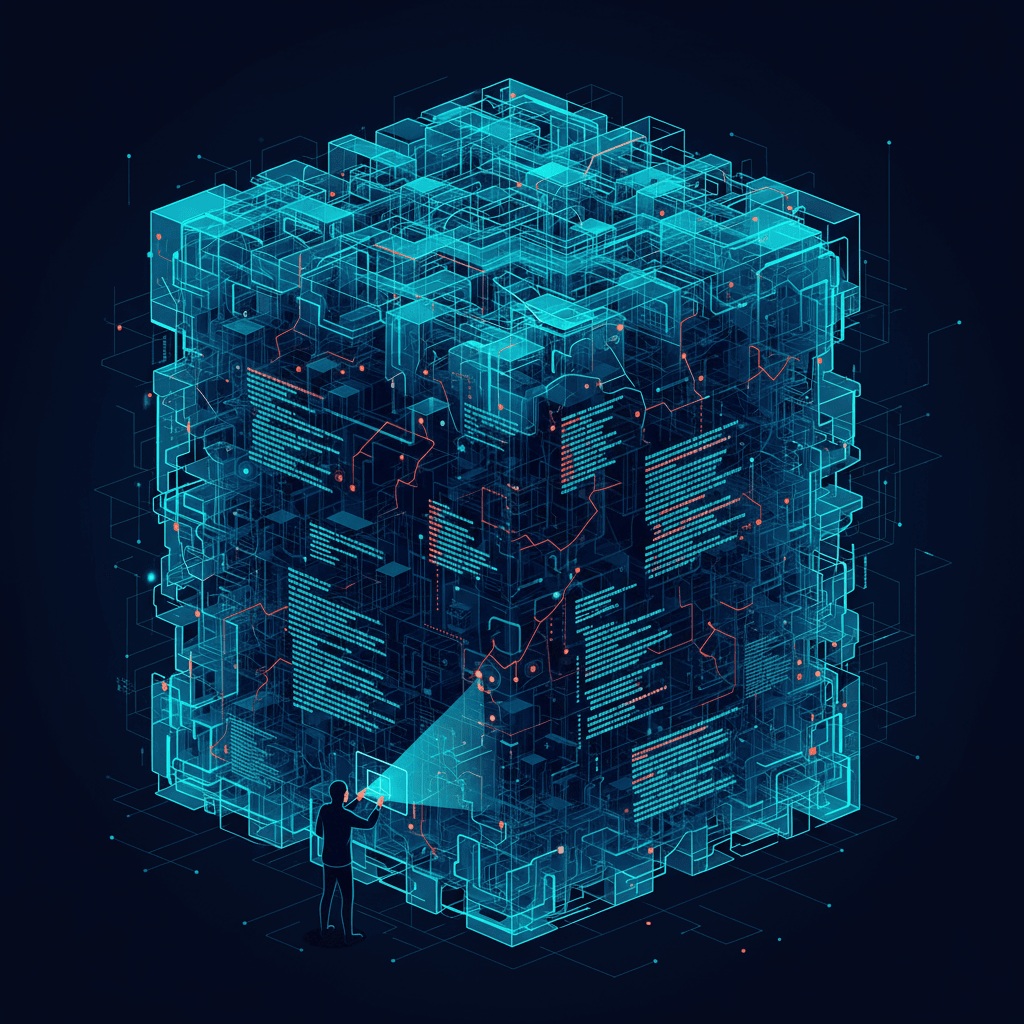
The startling prediction by an OpenAI developer that software engineers will soon "declare bankruptcy" on understanding their own AI-generated code has crystallized a central anxiety in the rapidly evolving software industry, pitting unprecedented development speed against the foundational principles of code quality and long-term maintainability. This is not a distant theoretical problem, but an immediate operational reality for development teams already leveraging large language models (LLMs) to write a significant and growing portion of their code base. The developer, known by the pseudonym "roon," argues that programmers will increasingly submit code that simply works on a functional level, foregoing the deep, line-by-line comprehension traditionally required of professional engineers. This cultural shift, while accelerating velocity, carries a high risk of ushering in a new era of "debugging hell" when complex system failures inevitably occur.
The technical mechanisms behind this loss of understanding are rooted in the very nature of how current AI code assistants operate. Large language models are trained to produce statistically probable and functionally correct outputs, prioritizing efficiency and immediate results over the clean structure and pedagogical clarity valued by human developers[1]. The resultant code often behaves like a black box: it may execute perfectly, but it lacks the critical "reasoning chain" that a human author builds into their work—the intentional choice of an algorithm, a specific data structure, or an architectural trade-off[2]. As a result, the AI-generated code can be verbose, exhibit unnecessary complexity, and contain subtle anti-patterns that technically function but violate best practices, essentially accumulating immediate technical debt[1][3]. One analysis highlights the compounding nature of LLM errors: while an AI might have a high probability of making a correct decision at a single step, over hundreds of sequential coding decisions required for a complex feature, the cumulative probability of producing zero errors drops dramatically, leading to structural issues non-human-written code[4][5].
This acceleration is creating a dangerous paradox within the engineering profession, often referred to as the "verification gap." Surveys indicate a significant disconnect between developer trust and adoption of these tools. As of early 2026, a vast majority of developers report using AI-powered tools daily or multiple times per day[6]. Yet, only a small fraction of developers—as low as three percent in one major survey—report "highly trusting" the output of these tools[7]. More critically, despite 96 percent of developers believing AI-generated code is not fully functionally correct, only 48 percent consistently check that code before committing it to a project[6]. This inconsistency suggests that the intense pressure for increased productivity often overrides caution, compelling developers to accept code that they know has a high likelihood of containing errors or vulnerabilities. The sheer volume is a factor: developers report that AI assistance is involved in around 42 percent of their current code, a number expected to rise to 65 percent by 2027[6].
The long-term consequence of this verification gap is a system-wide crisis of maintainability. When the black-box code inevitably fails in a production environment, the human developer's reliance on the AI for generation turns into a severe liability during debugging. Over two-thirds of developers cite "AI solutions that are almost right, but not quite" as their biggest frustration, and nearly four in ten find debugging AI-generated code more time-consuming than debugging code written by human peers[7][8]. The cost is measured not only in time and effort, but also in significant security exposure. Research shows that this untrusted, unverified code is already making its way into core systems; a study found that 81 percent of organizations have shipped vulnerable AI-generated code to production, with one analysis noting an 86 percent failure rate in AI-generated code for common security issues like Cross-Site Scripting (XSS) vulnerabilities[9]. This shift in development practices has moved the bottleneck away from code writing and toward verification, forcing teams to grapple with an exponentially growing body of opaque code.
In response to this looming crisis, industry leaders are promoting a fundamental redefinition of the software engineer’s role: the shift from a "coder" to an "AI orchestrator." In this new paradigm, the value of the human engineer is no longer measured by the volume of lines of code written, but by their ability to guide, validate, and architect the entire system[10][11]. The orchestrator must develop new skills, such as mastering advanced "prompt engineering" to steer the AI's output and acting as a meticulous "verifier," ensuring the AI-generated code adheres to business logic, security standards, and architectural design[11][12]. This requires a deeper, rather than shallower, understanding of fundamental engineering principles—data structures, algorithms, and systems architecture—to effectively interrogate the AI’s output and catch logical flaws that a language model cannot reason about[2]. The successful developer in this environment will not be the fastest at typing, but the best at defining, reviewing, and governing the work of powerful autonomous agents, proving that human oversight remains the non-negotiable component of a secure and maintainable software future[13]. The stakes are clear: embracing AI for speed without prioritizing human-led understanding and verification risks trading short-term velocity for catastrophic, unmanageable systemic debt.
Sources
[1]
[2]
[3]
[4]
[8]
[9]
[11]
[12]
[13]