
OpenAI Calms Fears, Confirms Users Own All Their AI Output.
OpenAI confirms users keep their inventions, but IP sharing remains a strategy for tailored enterprise partnerships.
January 29, 2026
A wave of concern over the fundamental issue of intellectual property ownership in the age of generative artificial intelligence was recently calmed by a high-level clarification from OpenAI, aiming to reassure its vast base of individual users and creators. The confusion stemmed from remarks made by Chief Financial Officer Sarah Friar concerning a future revenue model based on "IP-based pricing," which sparked immediate speculation that the company planned to claim a royalty or stake in the commercially valuable discoveries made by its users. The clarification, delivered by Product Officer Kevin Weil, distinctly stated that OpenAI has no intention of seeking a share of the inventions, products, or creative work generated by its general user base through its tools, asserting that the earlier comments were broadly misinterpreted.[1]
The initial speculation was fueled by a public discussion of a shift in monetization strategy from traditional subscription and usage fees—often described as "paying for electricity" or tokens—to a model of "outcome-based pricing" or "value sharing."[2][3] Friar had discussed this concept primarily in the context of high-value, enterprise-level industries, citing drug discovery as a key example where OpenAI might enter into a negotiated, explicit licensing or profit-sharing agreement.[4] In such a scenario, for instance, a pharmaceutical company using an advanced, customized OpenAI system for R&D might agree to a "license to the drug that is discovered," effectively giving OpenAI a profit-sharing stake in a quantifiable commercial upside.[4] The company's vision, according to Friar, is to align its financial success with the measurable results achieved by its large-scale enterprise partners, suggesting a future where licensing and IP-based agreements share in the value created, much like the evolution of the internet.[5]
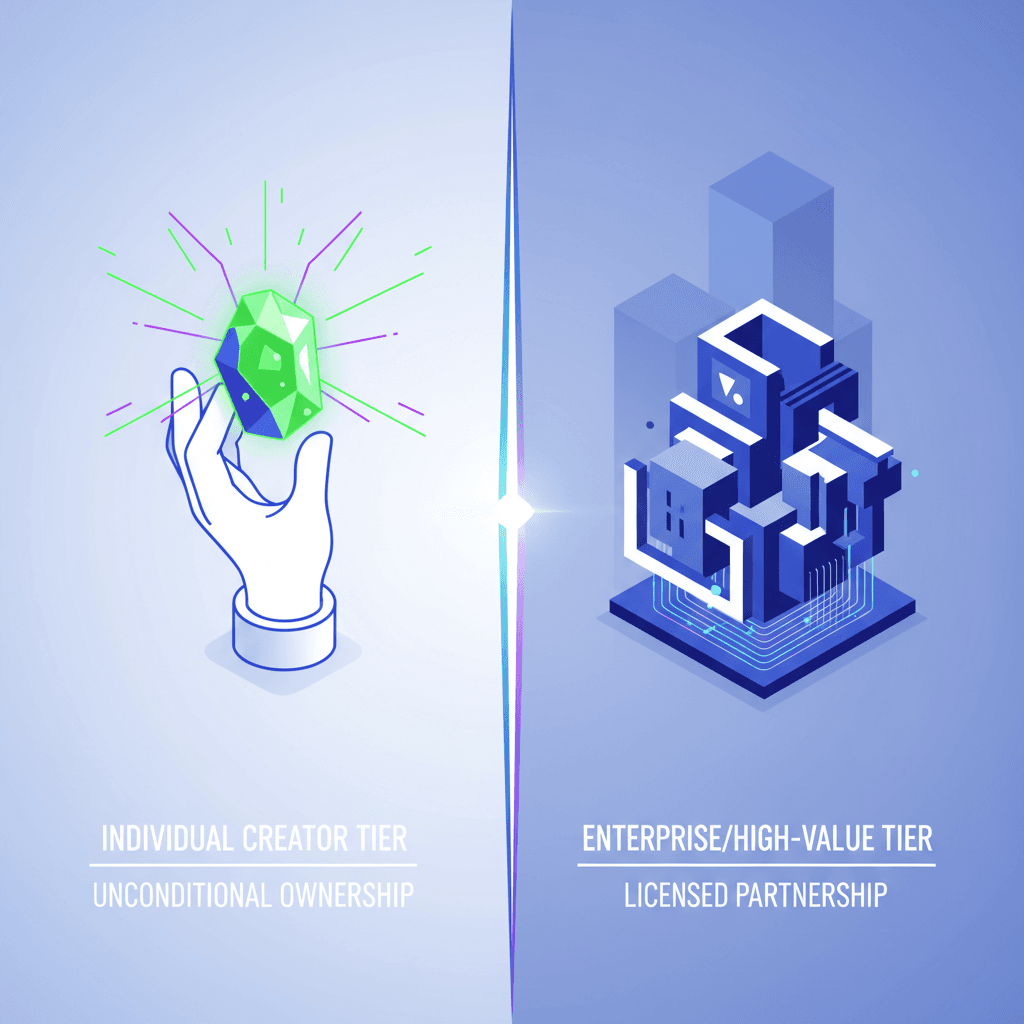
This distinction between the consumer-creator and the large-scale enterprise models is critical to understanding OpenAI’s business strategy and the subsequent need for clarification. For the everyday user, the current terms of service already assign ownership of the "Output"—the content generated by the AI—to the user, who also retains all ownership rights to the "Input" or prompt.[6] Specifically, the terms state that OpenAI "hereby assigns to you all our right, title, and interest, if any, in and to Output," which grants the user the ability to use the content for any purpose, including commercial ones.[6] Furthermore, for standard API customers, OpenAI's services agreement assigns to the customer all its right, title, and interest in and to the Output, and commits not to use customer content to develop or improve the services unless the customer explicitly agrees.[7] This clear, contractual transfer of ownership has been a cornerstone of their user policy, making the idea of claiming a share of individual users' discoveries a significant departure that required swift correction.[8] Weil’s move to unequivocally state that the company is "not planning to take a cut from individual users' inventions, products, or creative work just because they used OpenAI tools" served to ring-fence the consumer experience from the more complex, bespoke enterprise negotiations.[9]
The incident highlights the growing regulatory and commercial complexity surrounding intellectual property in the generative AI space, a central concern for developers and businesses alike. The very nature of AI-generated content and its legal status is still a rapidly evolving area, and any suggestion of a change in ownership rights by a market leader like OpenAI can have a chilling effect on adoption and developer trust. The company is managing a delicate balance: securing the massive capital required to fuel its advanced research and build expensive compute infrastructure, while maintaining the goodwill of the millions of developers and individual creators who drive platform usage and innovation.[5] The clarification suggests a strategy where the complexity of "outcome-based pricing" is reserved for deep, negotiated partnerships—particularly in high-margin sectors like pharmaceuticals and scientific research—where the value proposition of a co-developed, custom AI solution is clear and attributable.[9][3] This two-tiered approach allows OpenAI to pursue its billion-dollar revenue goals through tailored enterprise contracts without alienating the broader ecosystem of small-scale users and application developers.
Ultimately, the confusion and subsequent clarification underscore a major point of friction in the modern AI industry: the need for massive returns to justify the enormous cost of building frontier AI, and the simultaneous need for an open, trust-based platform to foster widespread adoption. OpenAI’s swift public response, distinguishing between a general user’s creative output and a bespoke enterprise value-share agreement, demonstrates an awareness that clarity on IP ownership is paramount to maintaining consumer and developer loyalty. For the wider AI industry, this serves as a benchmark for transparency. As other foundation model providers also explore diversified revenue streams, the market will scrutinize their policies closely, favoring models that clearly and unconditionally assign ownership of output to the user, thereby solidifying the user's role as the sole owner and commercial beneficiary of their own AI-aided work. This distinction will be critical in driving the next phase of practical AI adoption across various economic sectors.[5]