
Nvidia transforms robotics into a compute problem to trigger a ChatGPT moment for physical machines
Nvidia’s simulation-first roadmap bridges the physical data gap, leveraging massive compute to accelerate autonomous transport and sophisticated humanoid machines.
March 16, 2026
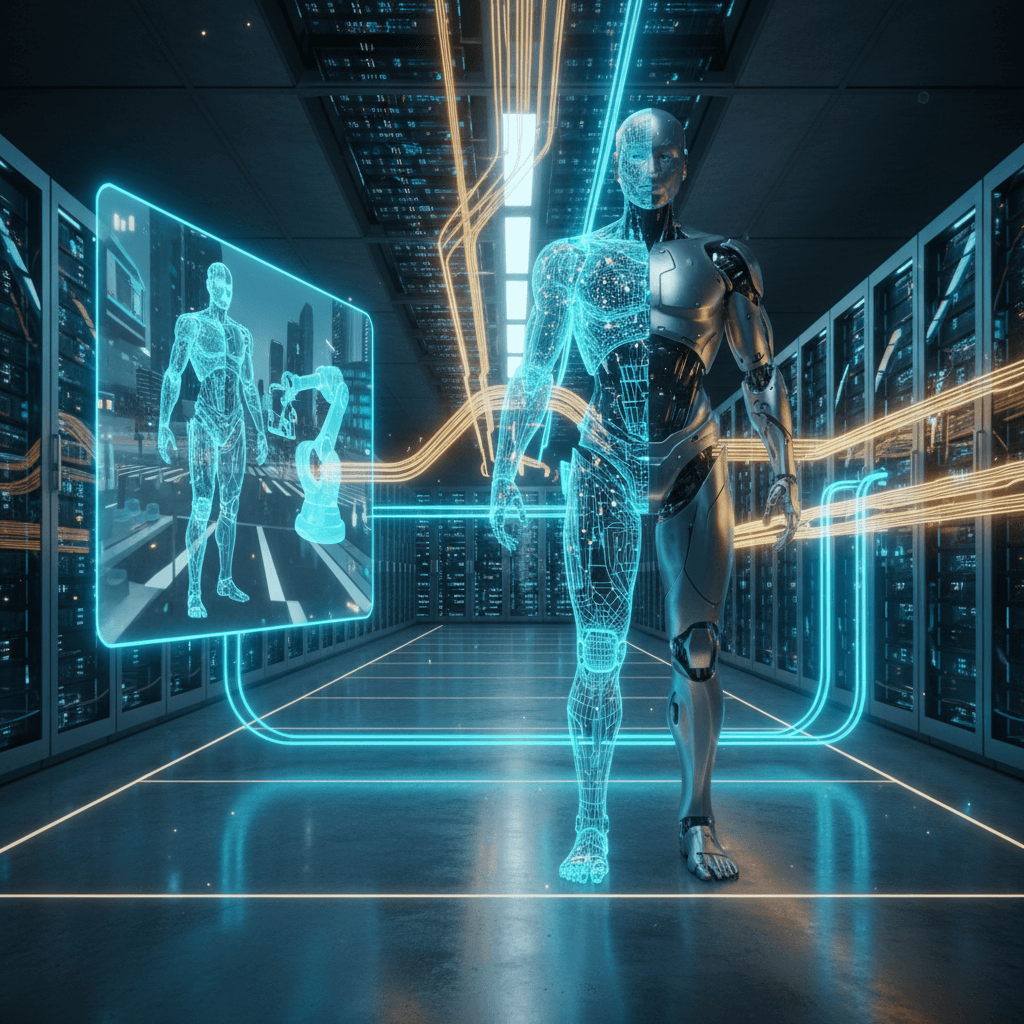
The centerpiece of the global AI industry has shifted from the virtual confines of chatbots and image generators to the gritty, unpredictable complexity of the physical world. At the GTC 2026 conference, Nvidia unveiled a comprehensive roadmap that aims to dismantle the primary barrier to sophisticated robotics: the scarcity of high-quality training data. By introducing a suite of simulation tools and a new architectural blueprint, the company is attempting to pivot the robotics industry away from its traditional reliance on expensive, slow, real-world data collection. The goal is to transform robotics into a compute problem, where raw processing power and sophisticated simulation replace the need for millions of hours of physical trial and error.
Central to this strategy is the Physical AI Data Factory Blueprint, a reference architecture designed to automate the creation and refinement of training data at an unprecedented scale.[1] For years, the robotics field has suffered from what researchers call the big data gap. While large language models have billions of web pages to learn from, robots have historically lacked a similar corpus of physical interactions. Nvidia’s new blueprint, developed in collaboration with cloud providers like Microsoft Azure, seeks to fill this void by using synthetic data generation to create a limitless supply of training scenarios. This approach allows developers to simulate millions of variations of a single task, from a robotic arm picking up a fragile glass to a humanoid robot navigating a crowded hallway, all within a high-fidelity digital twin environment.
The shift toward a simulation-first methodology is underpinned by the release of Cosmos 3, a world foundation model that provides the sensory and physical backbone for these virtual environments. Unlike previous iterations, Cosmos 3 integrates vision-based reasoning with physics-aware world generation, allowing it to predict how the environment will respond to a robot’s actions. This is paired with Isaac Lab 3.0 and the new Newton Physics Engine 1.0, which together enable reinforcement learning at a scale previously reserved for large-scale data centers. By closing the gap between simulation and reality, Nvidia claims that developers can now train complex behaviors in the cloud and deploy them directly to hardware with minimal fine-tuning.
This transformation is already manifesting in significant commercial partnerships that signal a new era for autonomous systems. One of the most prominent announcements involves a massive expansion of Nvidia’s collaboration with Uber.[2] Starting in early 2027, a fleet of autonomous vehicles powered by Nvidia’s Drive platform is scheduled to begin operations in Los Angeles and San Francisco.[3][4] This initiative is expected to expand to 28 cities across four continents by 2028.[3][5][4][6] These vehicles will utilize the Alpamayo 1.5 model, a steerable autonomous driving system that allows for more natural interaction through language-based commands and enhanced reasoning in complex urban environments. The partnership represents a move away from specialized, rigid driving algorithms toward generalized physical AI that can adapt to different city layouts and traffic patterns through continuous simulation-based training.
Beyond the automotive sector, the industrial world is seeing a major hardware and software overhaul. Global manufacturing giants including FANUC, ABB, and KUKA have begun integrating Nvidia’s Isaac frameworks into their core controllers.[7][8][9] By embedding these AI brains directly into industrial robots, these companies are moving away from fixed, pre-programmed routines toward machines that can perceive their surroundings and adjust to variations in real-time.[9] This integration utilizes the Jetson Thor and Blackwell-class infrastructure to handle high-performance inference at the edge, allowing factory floors to become more flexible and autonomous. The move aims to turn the two million industrial robots currently in operation into intelligent agents capable of complex electronics assembly and high-precision logistics without extensive manual reprogramming.
Perhaps the most ambitious aspect of the conference was the progress showcased in the realm of humanoid robotics. Nvidia provided an early access release of GR00T N1.7, its first commercial foundation model for humanoids, while previewing the even more advanced GR00T N2.[7][2] Based on the company’s DreamZero research, GR00T N2 utilizes a world action model architecture that reportedly doubles the success rate of robots in unfamiliar environments compared to existing vision-language-action models.[2] Humanoid pioneers such as Boston Dynamics, Figure, and Agility Robotics are already leveraging this stack to enhance the dexterity and reasoning capabilities of their machines. The focus is no longer on making a robot walk, but on making it understand the functional properties of objects and the social norms of human-centric spaces.
The implications for the broader AI industry are profound, as the move suggests that the infrastructure for the physical world is becoming as standardized as the infrastructure for the cloud. By providing the chips, the simulation environments, and the foundation models, Nvidia is positioning itself as the essential layer beneath every machine that moves. This "three-computer" architecture—training in the data center, simulation in a digital twin, and inference on the device—creates a closed-loop system where every failure in the real world becomes a new simulation scenario to be solved in the virtual one. As compute costs continue to drop relative to the cost of human-led data collection, the bottleneck for robotic capability is no longer the size of a company’s physical fleet, but the efficiency of its simulation pipelines.
The transition from a data problem to a compute problem marks a definitive "ChatGPT moment" for physical machines. Just as generative AI reached a tipping point when compute allowed for the processing of massive datasets, robotics is entering a phase where the ability to simulate the laws of physics at scale is unlocking generalized intelligence. The result is an industry that is moving faster than ever before, with timelines for autonomous transport and humanoid deployment shifting from decades to months. By treating the physical world as a software environment that can be solved with enough iterations and processing power, the boundary between the digital and the physical is effectively being erased.