
Google Gemini Embedding 2 Unifies Five Data Modalities Into A Single Native Vector Space
Merging five data modalities into a scalable vector space to eliminate fragmented pipelines and enable more intuitive AI perception.
March 11, 2026
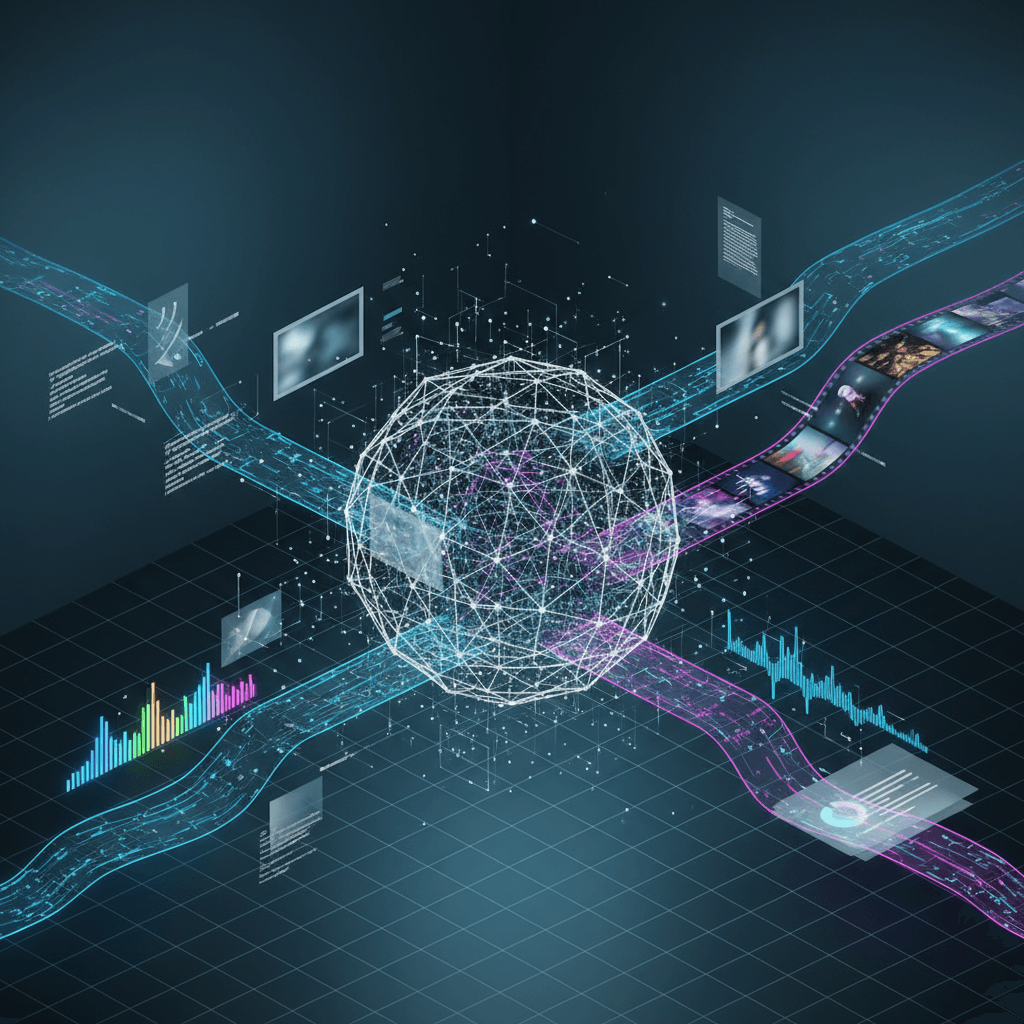
The artificial intelligence landscape has long been defined by a fundamental divide between different forms of data. While large language models have achieved remarkable proficiency in processing text, the mathematical frameworks used to understand images, audio, and video have traditionally operated in isolation.[1] This fragmentation has forced developers to maintain complex, multi-stage pipelines that translate various media into text or align disparate numerical representations to enable cross-modal reasoning. Google has now addressed this systemic challenge with the introduction of Gemini Embedding 2, a breakthrough model that marks the company’s first foray into native multimodal embeddings.[2][3][1][4][5] By mapping text, images, video, audio, and documents into a single, unified vector space, the model eliminates the need for separate encoders and preprocessing steps, signaling a major shift in how machines perceive and categorize the physical and digital worlds.
To understand the significance of this development, one must consider the historical inefficiency of multimodal AI architectures. Until now, building a system capable of searching a video library using a text query typically required several distinct steps: an automated speech recognition model to transcribe the audio, a computer vision model to generate descriptions of the visual frames, and a text embedding model to index those descriptions. Each of these steps introduces potential for data loss, latency, and increased operational costs. Gemini Embedding 2 fundamentally alters this workflow by serving as a single, "natively" multimodal engine.[6][5][4][2][3] It treats a frame of video, a snippet of spoken dialogue, and a written paragraph as semantically equivalent entities within the same high-dimensional coordinate system. This architectural unification means that the mathematical "distance" between a text description and a relevant video clip can be measured directly, allowing for a level of retrieval precision and speed that was previously unattainable.
The technical specifications of Gemini Embedding 2 reveal a model designed for high-volume, real-world data environments.[2] It supports an expansive text context window of up to 8,192 input tokens, making it capable of processing long-form documents and complex codebases.[7][1] Its visual capabilities allow for the ingestion of up to six images per request in standard formats like PNG and JPEG.[7][8][5][9][1] Most notably, the model extends its reach into time-based media, supporting up to 120 seconds of video and 80 seconds of native audio.[1] Unlike legacy systems that rely on intermediate transcriptions, this model ingests raw audio data directly, capturing the semantic intent behind tone, inflection, and ambient sounds that are often lost in text-only conversions. Furthermore, the model can process up to six pages of a PDF document simultaneously, analyzing both the visual layout and the embedded text to ensure that charts, diagrams, and formatting are included in the final semantic representation.
A critical feature that sets this model apart is its support for interleaved multimodal inputs.[2][8][9][7][1] In practical terms, this allows developers to submit a single request containing a mixture of data types, such as a photograph paired with a descriptive caption. By processing these together, the model can capture the nuanced relationships between different media types, understanding how a specific image alters or reinforces the meaning of a surrounding text. This capability is essential for managing the types of datasets encountered in modern enterprise environments, where information is rarely confined to a single format.[1] By recognizing the contextual interplay between a visual chart and the text that explains it, Gemini Embedding 2 provides a more holistic understanding of data than models that treat each modality as an independent stream.[7]
Efficiency and scalability remain primary concerns for enterprises deploying AI at scale, and Google has addressed these through the implementation of Matryoshka Representation Learning. This technique, named after the famous Russian nesting dolls, allows the model to learn high-dimensional embeddings that contain smaller, "nested" versions of themselves. While the model generates a 3,072-dimensional vector by default, developers can dynamically scale this output down to 1,536 or 768 dimensions without the need for retraining.[2][8] This flexibility allows organizations to strike a precise balance between retrieval accuracy and infrastructure costs. For instance, a company might use full-sized vectors for high-precision legal discovery while opting for smaller, more efficient vectors for a real-time recommendation engine where speed is prioritized over granular detail. Benchmarks indicate that even at lower dimensions, the model maintains a high level of semantic integrity, outperforming many specialized single-modality models.
The implications for Retrieval-Augmented Generation (RAG) are particularly profound. RAG has become the industry standard for grounding AI outputs in factual data, but it has largely been restricted to text-based archives. With Gemini Embedding 2, the "knowledge base" available to an AI agent expands dramatically. A RAG pipeline can now index a corporate library containing video presentations, podcast episodes, and image-heavy technical manuals in a single unified index. When a user asks a question, the system can retrieve the most relevant evidence regardless of whether it resides in a spreadsheet or a two-minute video clip. This capability effectively bridges the gap between how humans perceive the world—through a simultaneous stream of sight and sound—and how AI systems process information, paving the way for more intuitive and capable digital assistants.
Beyond search and retrieval, the unification of vector spaces opens up new possibilities for data clustering and sentiment analysis across mixed media.[5][8][9] Marketing teams, for example, could use the model to analyze global brand sentiment by clustering social media posts that include diverse inputs like user-recorded videos, photos of products, and multilingual text reviews. Because the model supports over 100 languages and processes various media types in a single mathematical space, it can identify cross-cultural and cross-modal trends that would be invisible to siloed systems. This holistic view of data allows for more sophisticated analytics, enabling organizations to find hidden patterns in complex, heterogeneous datasets that were previously too fragmented to analyze effectively.
As the AI industry moves toward more agentic and autonomous systems, the demand for models that can navigate the "messiness" of real-world information will only increase. Gemini Embedding 2 represents a foundational step in this direction, moving away from the era of specialized, narrow encoders and toward a future of general-purpose semantic understanding.[2] While the transition to this new model requires developers to re-embed existing datasets due to the incompatibility of different vector spaces, the long-term benefits of a simplified, more accurate pipeline are significant. By consolidating five different data modalities into one unified framework, Google has not only streamlined the developer workflow but has also established a new performance standard for how AI perceives the complexity of human information.[2] This evolution marks a significant milestone in the journey toward artificial intelligence that can see, hear, and read the world with the same integrated context that humans take for granted.