
Google DeepMind unveils Gemini 1.6 to equip industrial robots with sophisticated embodied reasoning capabilities
New advancements in embodied reasoning enable robots to interpret industrial instruments and navigate complex physical environments with human-like precision.
April 17, 2026
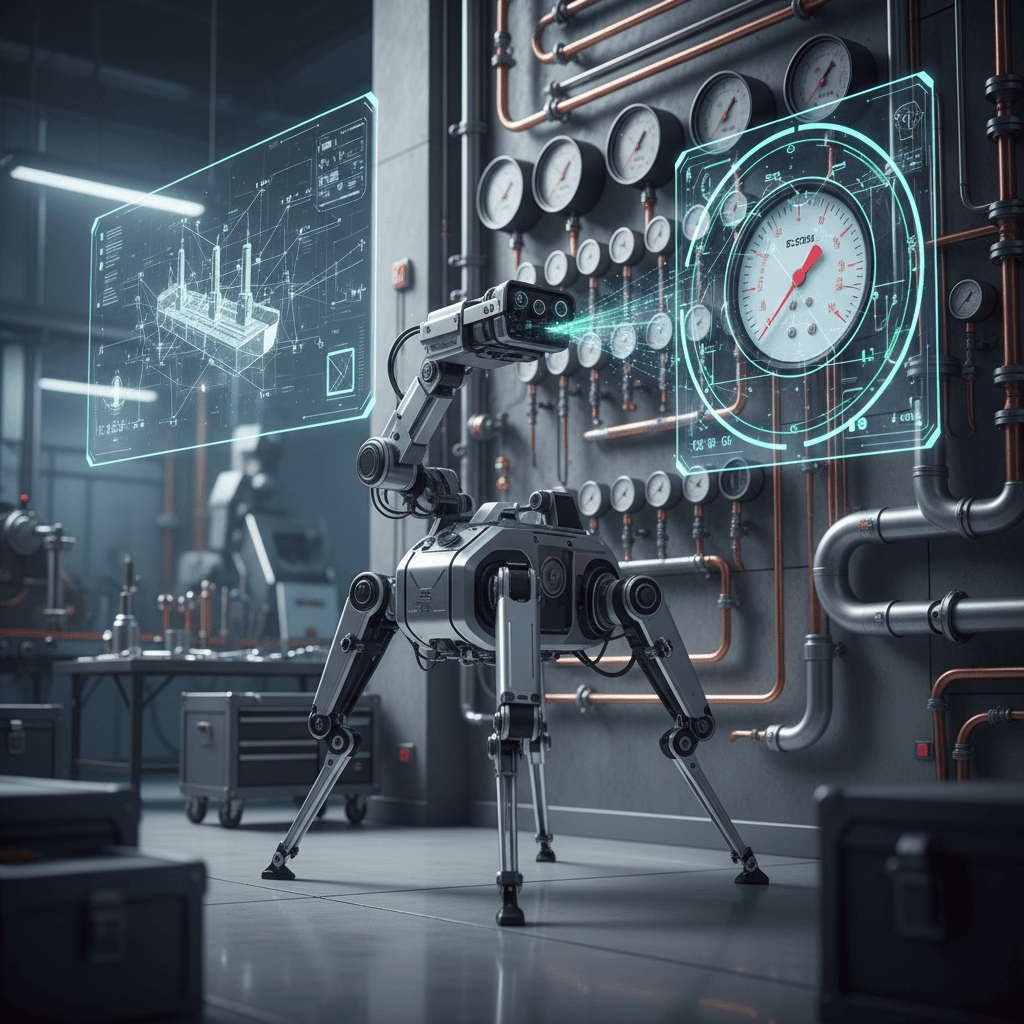
The evolution of artificial intelligence has long promised a future where machines move beyond repetitive industrial tasks to navigate the messy, unpredictable realities of the physical world. Google DeepMind has taken a significant step toward this vision with the release of Gemini Robotics-ER 1.6, a specialized embodied reasoning model designed to function as a sophisticated high-level brain for robotic systems.[1][2] By focusing on the cognitive gap between digital intelligence and physical execution, this update introduces substantial advancements in spatial reasoning, multi-view perception, and a novel capability for interpreting complex industrial instruments.[2][3][4][1] Unlike traditional robotics software that relies on rigid scripts, this model enables robots to observe, plan, and verify their actions with a degree of precision that closely mimics human situational awareness.
At the heart of this release is the concept of embodied reasoning, which distinguishes between the ability to process text or images and the ability to understand how those inputs relate to physical constraints. Gemini Robotics-ER 1.6 acts as a decision-making hub that does not directly control motor functions but instead provides the strategic logic required for complex missions.[5] In a typical deployment, this model sits atop a dual-model stack where it handles high-level task decomposition and environmental analysis, while a secondary vision-language-action model manages the low-level mechanics of movement and manipulation.[1] This separation of concerns allows the robot to "think" about a problem—such as finding a specific tool in a cluttered workshop—before the physical components begin to move, reducing errors and increasing the efficiency of autonomous operations.
One of the most technically impressive features of the new model is its highly specialized instrument-reading capability, developed in close collaboration with Boston Dynamics.[6][1][4] For years, autonomous inspection robots like the quadrupedal Spot have been able to navigate industrial facilities, but they often struggled to interpret the very data they were sent to collect. Reading an analog pressure gauge, a vertical liquid level in a sight glass, or a flickering digital readout requires more than simple object recognition; it requires an understanding of geometry, perspective, and mathematical intervals.[6] Gemini Robotics-ER 1.6 utilizes a process called agentic vision to solve this problem.[3][6][1][5][4][7] When a robot encounters a gauge, the model autonomously triggers a series of intermediate steps: it zooms into the relevant area to resolve fine details, identifies key points such as the needle and tick marks, and executes internal code to calculate the precise value based on the dial’s proportions.[6][3][1][5]
The performance gains in this area are stark.[5] In benchmarking tests, the previous iteration of the model achieved a success rate of only 23% on instrument-reading tasks, while the current version with agentic vision enabled reached a 93% success rate.[4][6][5][8] This leap in accuracy transforms a robot from a mobile camera into a functional inspector capable of making real-time decisions based on the data it sees. For example, if a pressure gauge exceeds a safe threshold, a robot equipped with this reasoning model can identify the hazard and follow a chain-of-thought process to alert human supervisors or execute a programmed safety protocol. This capability has immediate implications for the energy, manufacturing, and chemical sectors, where thousands of analog sensors still require manual monitoring.
Beyond reading gauges, the model significantly improves spatial logic through a sophisticated pointing-based system.[4][3][9] Rather than just drawing a box around an object, the model uses precise coordinate points to identify grasp locations, map movement trajectories, and count items within a scene. This refinement helps mitigate one of the most persistent issues in robotics: hallucinations. Previous models might "see" an object that isn't there or fail to recognize that two identical tools are separate entities. The 1.6 update shows a marked improvement in its ability to decline a request if an object is missing and to accurately count and localize multiple objects in high-density environments.[6][4] This precision is foundational for tasks that require delicate manipulation, such as sorting small components or navigating through a lab filled with fragile glassware.
Another critical advancement involves multi-view success detection, which addresses the fundamental question of how a robot knows it has actually finished a job.[1][6][4][2] Real-world environments are rarely static, and a robot’s primary camera might be blocked by its own arm or a shifting obstacle. Gemini Robotics-ER 1.6 is designed to synthesize information from multiple camera streams simultaneously, such as an overhead security feed and a wrist-mounted camera on the robot’s gripper. By cross-referencing these viewpoints, the model can confirm task completion even in occluded or dynamically changing scenes.[4][6][3] This ability to self-verify is the engine of true autonomy; it allows the robot to decide whether to move on to the next step or retry a failed action without requiring a human operator to intervene and reset the system.[4]
Safety remains a paramount concern as robots move into shared human spaces, and the new model incorporates enhanced reasoning for physical constraints. Google DeepMind has integrated safety directly into the model’s spatial outputs, tested against a benchmark known as ASIMOV.[5] This system evaluates the model’s ability to adhere to safety instructions and recognize hazards based on real-world injury reports.[3][5] The model demonstrates a superior capacity to follow complex physical restrictions, such as refusing to lift an object that exceeds its weight limit or identifying and avoiding hazardous spills. On adversarial prompts designed to trick the AI into making unsafe decisions, Gemini Robotics-ER 1.6 outperformed all previous generations, reflecting a move toward "baked-in" safety rather than superficial guardrails.[5]
The broader implications for the AI and robotics industry are profound. We are witnessing a shift away from "robotics-as-programming" and toward "robotics-as-reasoning."[10] By providing a model that can natively call tools, perform its own web searches for information, and execute code to solve visual puzzles, Google DeepMind is lowering the barrier for general-purpose automation. Developers can now leverage the Gemini API to build specialized agents that understand the physical world with a level of nuance previously reserved for human workers. As these models become more efficient and capable of running on-device, the distance between digital intent and physical reality will continue to shrink.
In conclusion, Gemini Robotics-ER 1.6 represents a maturation of embodied AI that prioritizes cognitive depth over simple motor response. By mastering the ability to read industrial instruments and reason across multiple visual perspectives, it provides a blueprint for robots that are not just mobile but truly observant.[3] As these systems move from research labs into the field, the ability to plan complex tasks, detect success autonomously, and adhere to rigorous safety standards will be the defining characteristics of the next generation of physical agents. The fusion of high-level reasoning with reliable hardware marks the beginning of an era where robots can finally navigate the complexities of our world with a sharper, more capable brain.