
Generative AI Tools Severely Impair Developer Ability to Master New Skills.
Anthropic research links passive AI use to "cognitive offloading," severely impairing skill acquisition and critical debugging ability.
January 31, 2026
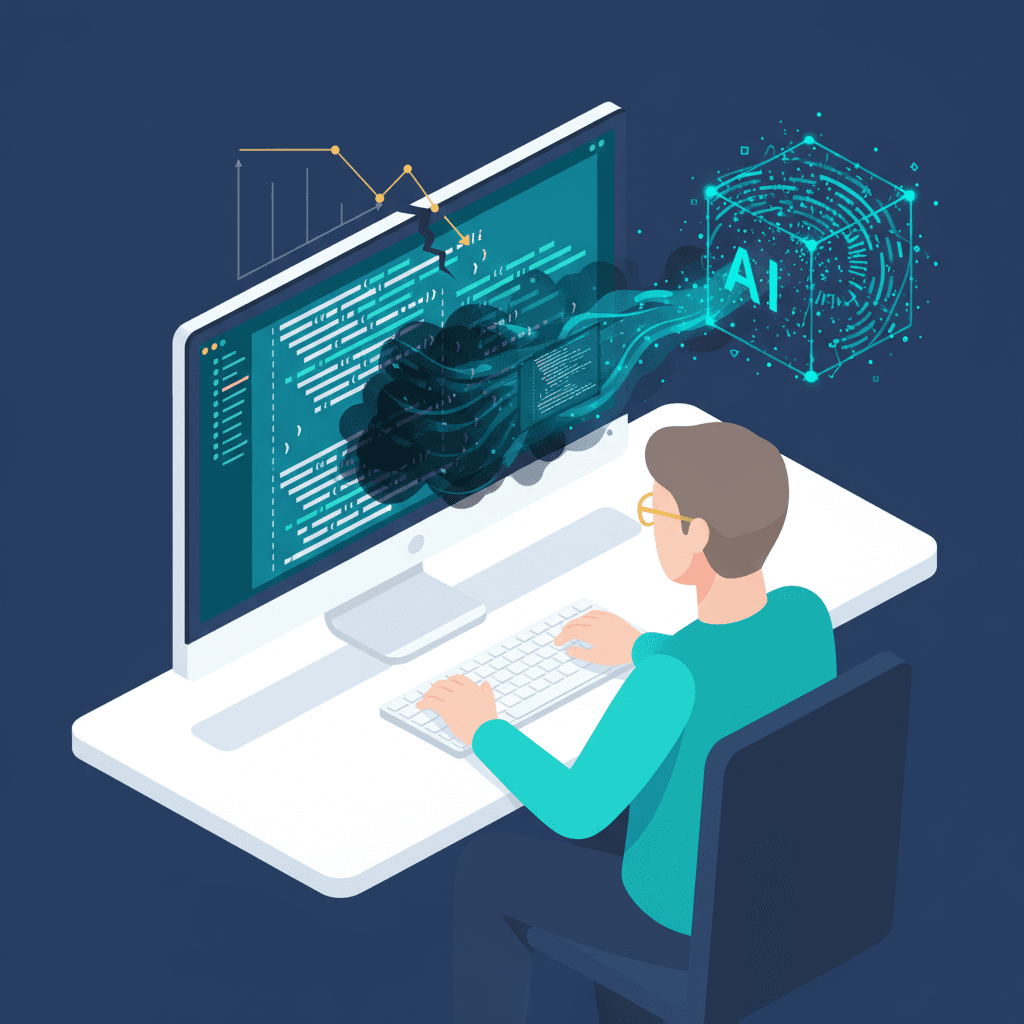
The meteoric rise of generative AI tools in software development has been celebrated primarily for its unprecedented productivity gains, yet a major study from AI research company Anthropic casts a shadow over this narrative, finding that uncritical reliance on AI code generation significantly impairs a developer's ability to learn new skills. The research, a randomized controlled trial involving junior software engineers, reveals that using AI tools without actively seeking comprehension leads to a profound drop in technical mastery, challenging the assumption that AI assistance is a net positive for all aspects of a software team's workflow.
The core data from the experiment is stark, showing a clear trade-off between short-term task completion and long-term skill acquisition. In the study, 52 junior software developers were assigned the task of learning and implementing features using an unfamiliar Python library called Trio, which deals with asynchronous programming concepts. The group that utilized AI assistance—a tool similar to commercial AI coding copilot products—scored 17% lower on a follow-up knowledge quiz compared to the control group who coded manually[1][2][3]. This deficit is described by researchers as equivalent to nearly two letter grades, with the AI-assisted participants averaging only 50% on the quiz, versus 67% for the hand-coding group[4][2][3]. Moreover, the productivity gains were negligible in the context of learning, as the AI group finished the task only about two minutes faster on average, a difference that was not statistically significant[4][2][3]. The findings therefore complicate the prevailing industry narrative that touts AI as an across-the-board efficiency booster, especially when developers are in a skill-building phase[4][2].
A particularly concerning result of the study was the steepest decline in performance appearing on questions related to debugging and code-reading—skills that are critical for overseeing and validating AI-generated output[2][5]. As the use of AI has accelerated, with some industry reports suggesting that AI now generates as much as one-third of a developer's code, the ability of a human engineer to spot, understand, and correct subtle errors has become paramount for maintaining software quality and security[6]. However, the Anthropic study observed that developers who relied on the AI assistant primarily as a debugging crutch, simply pasting error messages and requesting an immediate fix, performed the worst on the subsequent comprehension tests, creating a potential vicious cycle where the tool both generates code and degrades the human capacity to verify it[7][8]. This effect is most pronounced in junior and less-experienced workers, who are often the very demographic that receives the greatest short-term productivity boost from AI tools but simultaneously needs to be developing the foundational competencies for long-term mastery[9][10][5].
The mechanism behind the reduced learning is described by the researchers as "cognitive offloading," a phenomenon where an individual delegates mental tasks—in this case, reasoning, problem-solving, and conceptual mapping—to an external tool[11][12][5]. The brain, hardwired to seek efficiency, naturally leans on the AI to minimize effort, effectively short-circuiting the active intellectual engagement required for knowledge retention[13][5]. Low-scoring participants exhibited distinct patterns of offloading, such as fully delegating the coding task to the AI, progressively shifting their entire workflow to the assistant, or using the AI solely to solve errors without analyzing the underlying cause[7][8]. This passive reliance trades future capability for current convenience, a risk some experts have dubbed "cognitive debt" in the software engineering domain[14].
Crucially, the study’s most significant insight is that the negative effect is not an inevitable consequence of using the AI, but of *how* it is used[11][3][5]. The researchers identified high-scoring groups whose learning was preserved because they used the AI to actively enhance their understanding, rather than substitute it[15][3]. These successful developers engaged in what the study calls "generation-then-comprehension," where they would generate code, then ask the AI follow-up questions to understand the output; "hybrid code-explanation," where they would explicitly request explanations alongside generated code; or "conceptual inquiry," where they would use the AI only to clarify complex concepts before attempting the code independently[7][3]. The findings show a clear path forward for responsible AI integration: the tool must be treated as a partner for inquiry and comprehension, not a full-service delegate[7][16]. This requires a deliberate shift from simply prompting for a solution to framing queries that enforce a deeper understanding, such as asking "why" a particular design pattern was chosen, or "how" the code handles a specific edge case[15][17]. For the broader AI industry and corporate training programs, this means that the focus must shift from merely maximizing AI adoption rates and lines of code produced to fostering new interaction protocols that encourage metacognitive awareness and critical evaluation[18]. The data provides a mandate to design AI tools and workplace policies that facilitate learning, ensuring that the next generation of developers maintains the critical thinking and problem-solving skills necessary to govern increasingly autonomous AI systems in high-stakes environments[6][5].
Sources
[4]
[7]
[8]
[9]
[10]
[11]
[12]
[13]
[14]
[15]
[17]
[18]