
Figure AI Unifies Robot Control: Single Neural Network Achieves Autonomous Dexterity.
Figure AI replaced 109,000 lines of hand-coded logic with a unified neural network for seamless autonomous physical labor.
January 28, 2026
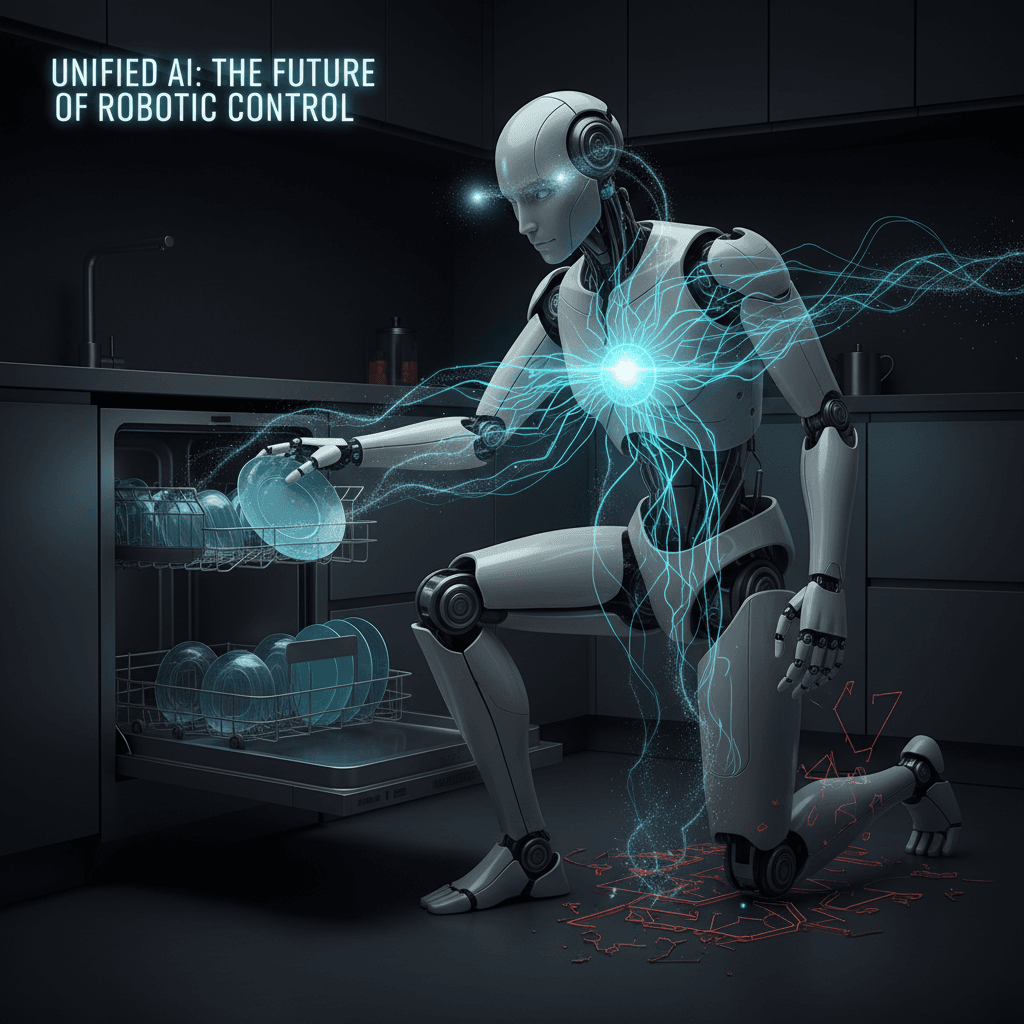
The race to create a truly general-purpose humanoid robot capable of operating autonomously in complex human environments reached a critical milestone following a recent demonstration from Figure AI. The California-based company showcased its latest system, Helix 02, powering a robot through a complete, unassisted kitchen task, the most notable aspect of which was the fluidity and whole-body coordination used to unload and reload a dishwasher. This seemingly mundane chore, performed by the robot across a full-sized kitchen, has emerged as a new benchmark in the field, not because of the task itself, but because of the underlying technical architecture that enabled it.[1][2][3]
The central breakthrough presented by Figure AI founder Brett Adcock is the use of a single, unified neural network to control the robot’s entire body.[4][5] This approach, branded internally as System 0, fundamentally replaces the traditional robotics paradigm where locomotion, manipulation, and balance are managed by separate, hand-written controllers connected by brittle state machines.[4][5] For decades, the continuous interplay between a robot's movement and its handling of objects—termed loco-manipulation—has been one of the field’s most stubborn engineering challenges. When a robot takes a step, its balance shifts, which immediately affects its ability to grasp an object, and vice-versa. Helix 02 bypasses this complexity by having a single learning system make instantaneous decisions for the entire physical structure—legs, torso, arms, head, and even individual fingers—based on real-time sensory data.[4][5]
The technical details underscore the magnitude of this shift from classic programming to a deep learning-based system. Figure AI announced that the new learned whole-body controller, System 0, which utilizes a 10-million-parameter neural network, successfully replaced 109,504 lines of hand-engineered C++ code that had previously governed the robot's fundamental movements.[1][5] This single neural system was trained on a vast dataset, reportedly over 1,000 hours of human motion data combined with simulation-to-real reinforcement learning.[5] This heavy reliance on large-scale data and learning, rather than painstaking human-coded rules for every scenario, provides the robot with a stability and naturalness of motion that has been notoriously difficult to achieve. It allows the robot to seamlessly integrate actions like walking across the room to a counter, bending and balancing to pick up a utensil, and then returning to place it in the dishwasher, all within one continuous, autonomous behavior.[4][3] The entire system connects all onboard sensors, including vision, touch (tactile sensing), and proprioception, directly to every actuator through this unified network, allowing for highly adaptive and dexterous performance.[5][2]
The demonstration itself was a four-minute, end-to-end task that Figure AI claims represents "the longest horizon, most complex task completed autonomously by a humanoid robot to date," running without any human intervention or programmed resets.[1][5][3] The robot, utilizing the Helix 02 system on a Figure humanoid platform, executed 61 consecutive actions to complete the dishwasher cycle.[1] The process involved carefully grasping different types of dishes—plates, glasses, and cutlery—unloading them from the dishwasher, navigating across the kitchen to a cabinet, correctly stacking the cleaned items, and finally reloading any remaining dirty items and starting the machine.[1][2] The subtle, continuous adjustments the robot made to its balance and hip positioning—the titular 'putting its hip into it'—while performing these varied grasping and placement actions highlights the effective unification of its control systems. The robot's ability to maintain its equilibrium and adjust its grip on fragile items, a capability enhanced by embedded tactile sensing and palm cameras, showcases the high degree of precision required for tasks in cluttered, non-industrial environments like a home kitchen.[5]
This technical pivot from hand-coded logic to a single, powerful learned system carries profound implications for the broader artificial intelligence industry and the commercialization of humanoid robots. By adopting a general-purpose architecture—a Vision-Language-Action (VLA) model known as Helix—Figure AI is positioning its robots as scalable intelligent agents, rather than highly specialized tools.[6][7] The company's vision is that this unified system can learn new capabilities and tasks incrementally with the addition of new data, without the need for new algorithms or special-case engineering.[6] This versatility is key to moving humanoid robots out of controlled laboratories and into the messy, unpredictable real world, whether in a consumer home or a commercial warehouse. The advancements place Figure AI firmly in the competitive vanguard of companies pursuing general-purpose AI embedded in a physical form, vying for leadership against major players such as Tesla’s Optimus and competitors like Boston Dynamics.[8] The focus is rapidly shifting from showing off dramatic, singular movements like flips or jumps to demonstrating sustained, complex, useful labor—the necessary bridge to unlock commercial viability and realize the long-held promise of human-robot integration. The development of a unified, learned control system signals a fundamental change in how robots acquire new skills, suggesting the pathway to autonomous physical labor is now one of data scaling, not endless manual programming.
Sources
[1]
[3]
[6]
[8]