
Enterprise AI Shifts: Autonomous Agents Replace Chatbots in Production Boom
Enterprises shift from experimental GenAI to autonomous agents that plan, reason, and execute production workflows.
January 27, 2026
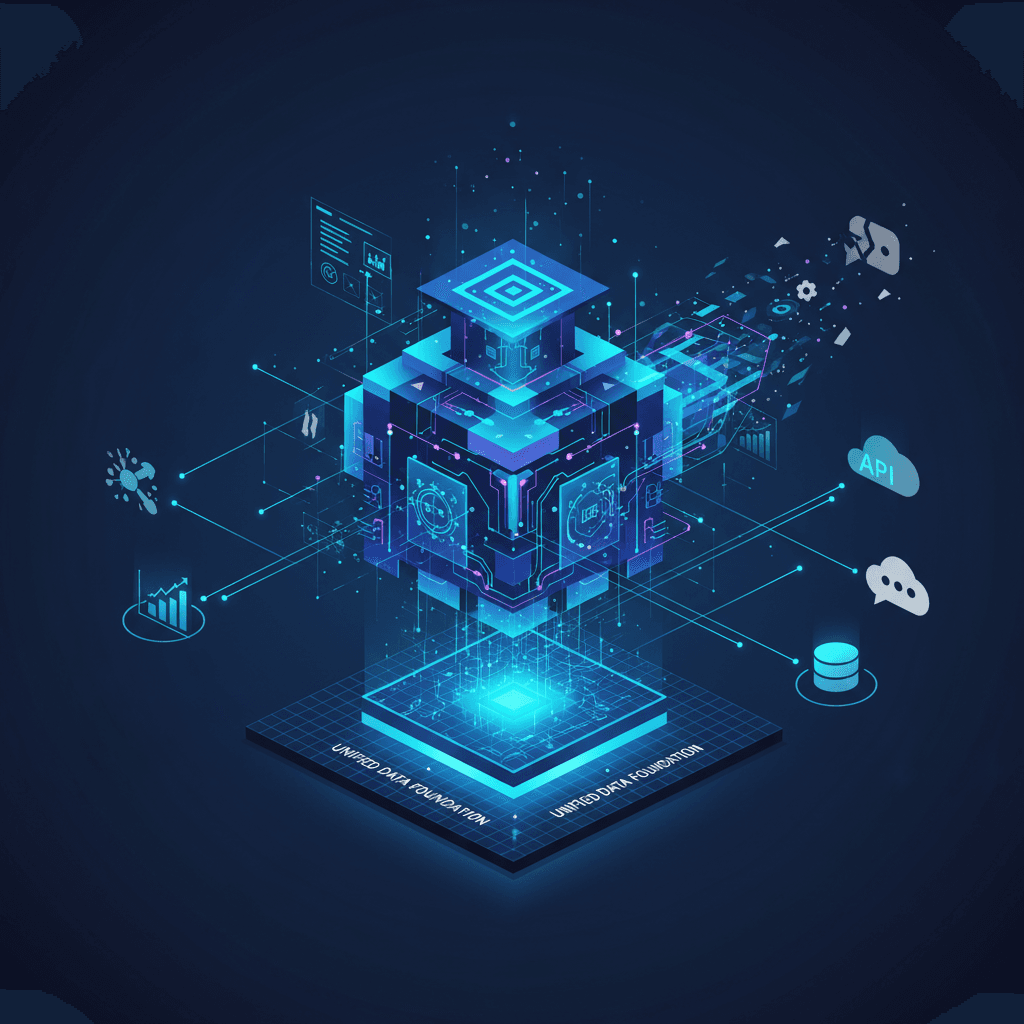
The enterprise adoption of artificial intelligence is undergoing a fundamental and dramatic transition, shifting decisively away from simple, isolated generative AI applications toward sophisticated, goal-oriented agentic systems that orchestrate intelligent workflows across an organization. Databricks telemetry indicates the market has reached a crucial inflection point where the initial, often disappointing, wave of generative AI experimentation—characterized by standalone chatbots and pilot programs with limited operational utility—is giving way to a phase of widespread production deployment and measurable business value. This new paradigm is defined by compound AI systems capable of autonomous action, requiring a unified, governed data foundation to realize true business transformation, thereby creating an urgent imperative for technology leaders to adapt their architectural strategy.
The first generation of generative AI tools, primarily focused on single-turn prompt-and-response interactions, promised a business revolution but frequently resulted in stalled projects and a managerial burden of high expectations with low returns. While useful for content generation or simple Q&A, these stateless, non-autonomous systems struggled to integrate into complex, multi-step business processes, often operating in isolated silos that failed to address core enterprise challenges. This has led to a major change in focus for organizations, moving from building models that simply *generate* content to building autonomous *agents* that can reason, plan, and execute multi-step business goals. Agentic AI systems are fundamentally distinct from their predecessors because they possess autonomy, enabling them to decompose a complex objective into a series of logical sub-tasks, plan the sequence of actions, utilize various external tools or APIs, and even self-correct or revise their plan when conditions change or an action fails.[1] These systems leverage components like long-term memory, multi-step reasoning, and action planning to execute complex workflows in dynamic environments, positioning them as proactive problem-solvers rather than passive, predictive models.[2]
The evidence for this agentic shift is rooted in striking quantitative data emerging from customer platforms. According to anonymized and aggregated telemetry from Databricks' global customer base, organizations are moving beyond the experimentation phase at an unprecedented rate, a clear signal that the technology has matured past the proof-of-concept stage. The data reveals that 11 times more AI models were put into production compared to the previous year.[3][4] Furthermore, the volume of AI models registered for production use saw an increase of 1,018%, significantly outpacing the still-growing but less dramatic 134% growth in experimental models.[4] This ratio indicates that companies have become dramatically more efficient at translating laboratory research into operational technology, with a sharp drop in the ratio of experiments logged for every model registered.[3] This explosion of production activity is directly correlated with the rise of systems that can autonomously operationalize knowledge. Key enabling technologies for these compound AI systems have also experienced massive uptake, notably Retrieval-Augmented Generation (RAG) applications, which are foundational for agents to access and act upon proprietary business data. Vector databases, which support RAG, saw a year-over-year growth of 377%, underscoring the industry-wide focus on grounding generative AI in enterprise-specific knowledge for reliable, actionable results.[3]
This transition to autonomous agentic systems is having profound implications for enterprise data architecture and the AI talent landscape. For AI systems to act autonomously and reliably, they must operate on a single source of truth that is fresh, governed, and high-quality, eliminating the data silos that fragmented and derailed earlier generative AI efforts. Databricks argues that a unified Data Intelligence Platform is a strategic necessity, serving as an "AI factory" that seamlessly integrates data engineering, analytics, and AI model lifecycle management into a single, governed environment.[5] The success of agentic workflows, which may involve a customer service agent updating a Business Intelligence dashboard or booking follow-up actions, is entirely dependent on this integrated data layer. The shift also highlights a widening gap between AI leaders who invested early in robust data infrastructure and governance frameworks and their less prepared peers, as the former are now realizing compounding returns on their foundational investments.[3]
From a development and operations standpoint, the move to agentic AI introduces a new set of essential skills and development paradigms. The increased complexity of managing autonomous agents that perform multi-step tasks necessitates rigorous and continuous quality assurance. This has given rise to the concept of 'eval-driven development,' where sophisticated evaluation frameworks, often using AI-assisted judges and synthetic data, are critical for ensuring agent output quality and reliability.[6] The role of the data engineer is also evolving, with the traditional ETL (Extract, Transform, Load) process being supplanted by EAL (Extract, Agent-based Adjustment, Load), where the AI agent itself takes responsibility for the adjustment and loading of data.[6] To ease the path to production, new toolsets like Databricks' Agent Bricks are emerging, which abstract away much of the underlying complexity, shifting agent development from a procedural, code-intensive paradigm to a declarative, low-code interface where developers define the desired *goal* rather than meticulously coding every step.[5][7] This enables enterprise teams to rapidly move from concept to complex, production-ready intelligent agents in days, refocusing effort from infrastructure management to solving complex business problems with autonomous intelligence. The successful deployment of agentic systems, therefore, hinges not just on algorithmic innovation but on a comprehensive strategy for data integrity, governance, and a new generation of tooling designed for multi-step, action-driven AI.[8]