
BMW deploys first humanoid robots at Leipzig plant to pioneer physical AI in manufacturing
BMW integrates AEON humanoid robots in Leipzig to automate arduous assembly tasks and combat labor shortages through physical AI.
March 13, 2026
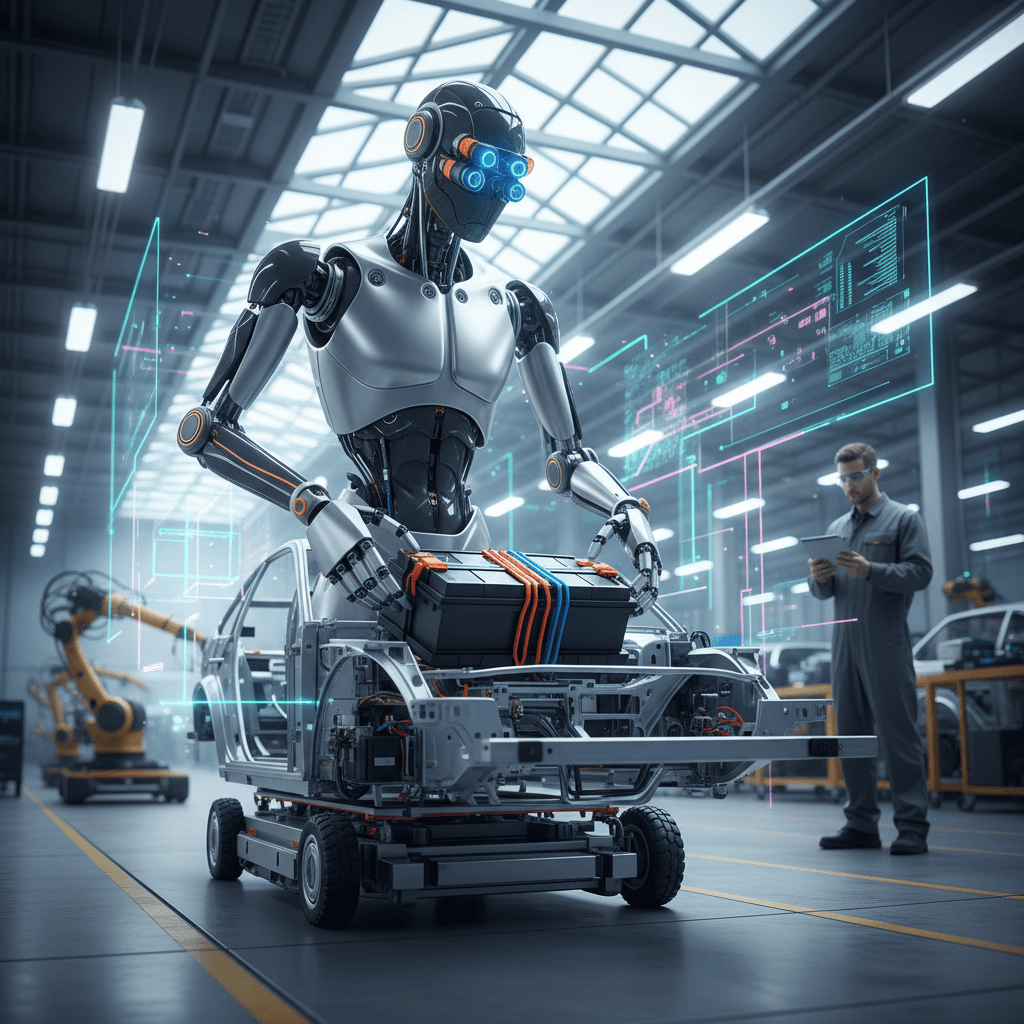
The modern automotive factory has long been a sanctuary for automation, but the rigid, stationary robotic arms of the past are increasingly giving way to a more agile and intelligent breed of worker. At the BMW Group plant in Leipzig, Germany, this evolution has reached a significant milestone with the introduction of humanoid robots onto the production floor for the first time in a European facility.[1][2][3][4][5][6][7] This pilot project marks a pivot toward what industry experts call physical artificial intelligence, where digital intelligence is no longer confined to computer screens but is embodied in machines capable of navigating and interacting with complex, human-centric environments. As the automotive industry grapples with shifting labor demographics and the increasing complexity of electric vehicle manufacturing, BMW’s deployment of the AEON humanoid robot represents more than just a technical trial; it is a signal of a broader industrial transformation that factories across the continent are monitoring with intense scrutiny.[4]
The AEON humanoid, developed by Zurich-based Hexagon Robotics, introduces a pragmatic design philosophy that distinguishes it from many of its bipedal contemporaries.[5] Standing 165 centimeters tall and weighing approximately 60 kilograms, AEON is built for industrial utility rather than human-like mimicry.[8][9][10][4] While many high-profile humanoid projects focus on the mechanical challenge of walking on two legs, Hexagon opted for a wheeled base for AEON to prioritize stability and energy efficiency in the structured environment of a car factory. This design choice allows the robot to glide across flat factory floors at speeds of up to 2.5 meters per second, a pace that far exceeds most walking robots and ensures it can keep up with the rigorous rhythm of series production. The robot's upper body maintains a humanoid form with 34 degrees of freedom, enabling it to reach, lift, and manipulate objects with a dexterity that traditional automation cannot match. Integrated with an advanced sensor suite comprising 22 different sensors—including 12 cameras, LiDAR, and specialized metrology scanners—AEON is capable of sub-millimeter precision, a necessity for the high-stakes assembly of automotive components.
In the bustling halls of the Leipzig plant, AEON has been assigned tasks that represent some of the most monotonous and ergonomically challenging roles for human workers. The pilot focuses heavily on the assembly of high-voltage batteries for BMW’s growing fleet of electric vehicles, as well as the manufacturing of exterior components. These roles often require workers to handle heavy energy modules or work in physically demanding positions for extended periods. By deploying humanoid robots here, BMW aims to relieve its human staff of these arduous duties, allowing them to shift their focus toward quality control, process oversight, and more complex problem-solving. One of the standout features of the AEON system is its ability to perform hot-swappable battery changes in under 30 seconds, ensuring that the machine remains operational throughout multiple shifts with minimal downtime.[11] This level of endurance is a critical component of BMW’s iFACTORY strategy, which seeks to create a production network that is lean, green, and fully digitized.[11]
The deployment in Leipzig is part of a sophisticated, two-pronged strategy for physical AI that BMW is executing on a global scale. While the German pilot utilizes the wheeled AEON robot, a parallel project at the company’s Spartanburg facility in the United States recently concluded a successful 10-month trial with the bipedal Figure 02 robot. These dual tracks allow BMW to A/B test different robotic architectures across different manufacturing contexts.[4] The Spartanburg trial demonstrated that humanoid robots could successfully assist in the production of over 30,000 vehicles, proving the reliability of the software and the safety of human-robot collaboration. By bringing this technology to its home turf in Germany, BMW is leveraging the lessons learned in the US to accelerate its European integration. The initiative is overseen by a newly established Centre of Competence for Physical AI in Production, a specialized unit tasked with evaluating technology partners and scaling these solutions across BMW’s global manufacturing footprint.[2] The strategic importance of this shift is underscored by the fact that the leadership championing these initiatives is ascending to the highest levels of the company, signaling that AI-driven robotics is now a permanent pillar of the firm’s operational identity.
From a broader AI industry perspective, the Leipzig pilot highlights the rapid maturation of "embodied AI" and the software stacks required to support it. AEON’s intelligence is powered by a combination of NVIDIA’s Jetson Orin onboard computers and the Isaac platform, which allows the robot to be trained in highly realistic virtual simulations before ever stepping onto the physical factory floor.[3] This simulation-first approach, known as digital twin technology, enables the robot to master complex locomotion and manipulation skills in a fraction of the time required by traditional programming. Through imitation learning and neural network training, the robot can adapt to variations in its environment, such as a misplaced part or a change in lighting, without requiring a human programmer to rewrite its code. This flexibility is the "holy grail" of industrial automation, as it allows machines to handle the high variety and low volume production cycles that define modern luxury car manufacturing.
The implications for the European workforce and the continent's manufacturing competitiveness are profound. Germany is currently facing a dual challenge: a critical shortage of skilled labor and a rapidly aging population.[12] Estimates suggest that the German manufacturing sector could face millions of unfilled positions over the next decade as a generation of experienced workers enters retirement. In this context, humanoid robots are not seen by industry leaders as a replacement for humans, but rather as a necessary supplement to maintain industrial output and keep production facilities from moving to lower-cost regions. By automating the "3D" jobs—those that are dull, dirty, or dangerous—European factories hope to remain competitive against global rivals while providing more ergonomic and technology-focused roles for their remaining human employees. The success of the Leipzig project could set a standard for other European manufacturers, from aerospace to electronics, who are all seeking ways to integrate physical AI into their existing workflows.
As the pilot project at the Leipzig plant moves toward full-scale integration, the focus will shift from technical feasibility to economic scalability. The coming months will involve rigorous testing to ensure that AEON can operate safely and predictably alongside human colleagues in the high-pressure environment of series production. The automotive industry has always been a bellwether for technological change, and BMW’s commitment to humanoid robotics suggests that the boundary between digital intelligence and physical labor is permanently blurring. If these machines can prove their value in the demanding world of car assembly, it is only a matter of time before they become a common sight across the global industrial landscape. For now, all eyes remain on Leipzig, where a wheeled machine with a human torso is quietly rewriting the playbook for the future of work.