
Anthropic debuts scheduled autonomous agents to manage complex professional workflows while users sleep
Moving beyond reactive chatbots, Anthropic’s Cowork app introduces autonomous agents capable of managing complex, scheduled desktop workflows independently.
February 26, 2026
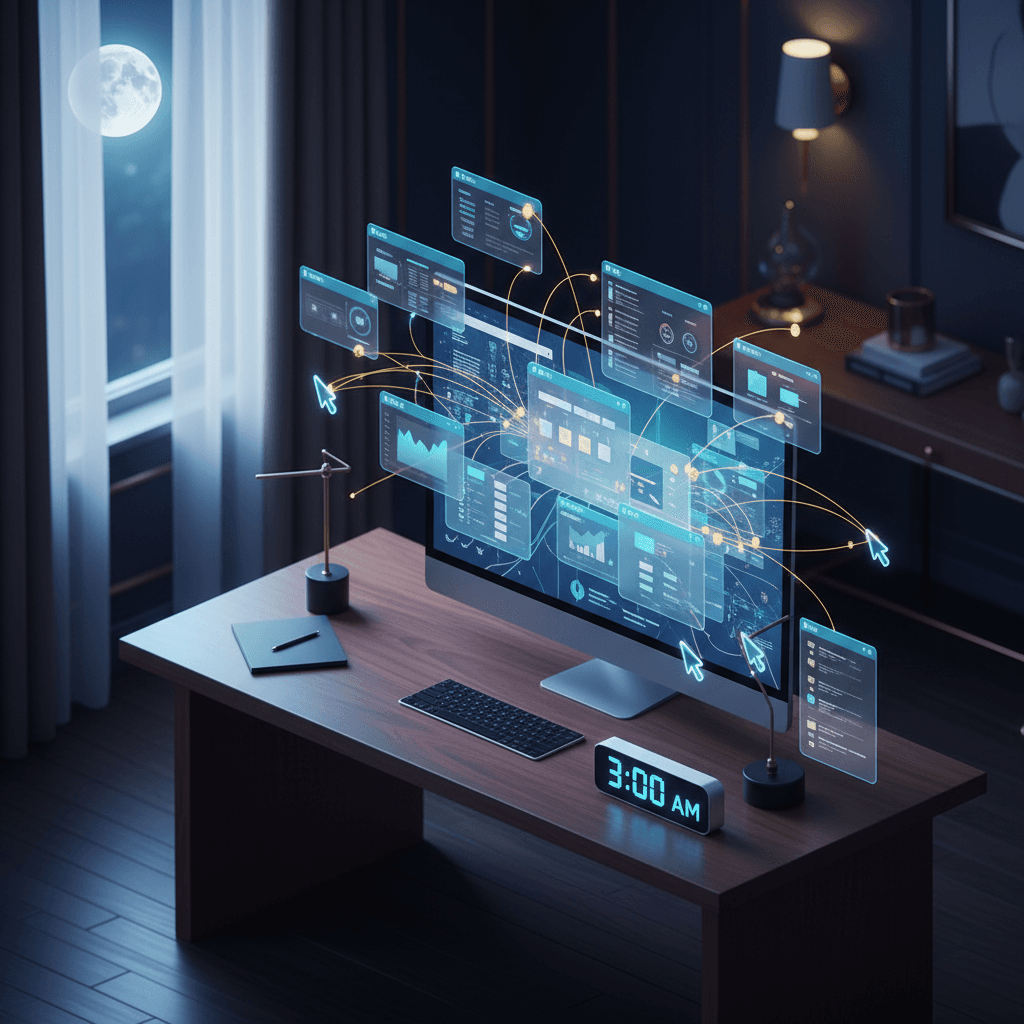
The transition from passive chatbots to active autonomous agents represents the next significant frontier in artificial intelligence, a shift that Anthropic is aggressively pursuing with its latest updates to the Cowork desktop application. While artificial intelligence has long been valued for its ability to summarize text or generate code upon request, the latest iteration of the Cowork platform marks a move toward true proactive agency. By introducing the ability to run scheduled and recurring tasks, the assistant effectively transforms from a reactive interface into a persistent digital employee capable of managing complex workflows without direct human supervision.[1] This evolution allows users to delegate repetitive, multi-step processes to an AI that can navigate the operating system, interact with various software applications, and complete assignments according to a set cadence, effectively maintaining productivity during off-hours or while the user is focused on higher-level strategic work.[2]
At the heart of this update is a sophisticated scheduling engine that enables the automation of workflows that previously required manual initiation.[3] Users can now establish a recurring schedule for specific agentic tasks, choosing intervals such as hourly, daily, or weekly.[4][2] This functionality is particularly transformative for administrative and data-heavy roles where the daily routine involves "shelf-work"—tasks that are predictable yet time-consuming. For instance, an AI agent can be programmed to perform a daily morning briefing by scanning unread Slack messages, summarizing urgent emails, and cross-referencing calendar events to prepare a concise report for the user's start of the day. Beyond simple summarization, the Cowork app can execute more complex operational tasks like organizing disorganized local folders, reconciling invoices against bank statements via connected financial tools, or compiling weekly research reports by browsing the web for industry trends and competitor updates. Because these tasks are stored as instructions with a defined cadence, they eliminate the need for the user to re-prompt the system for every execution, shifting the human's role from a "operator" to a "supervisor."
Technically, the Cowork app builds upon the "Computer Use" foundations originally released as a developer beta, but it now packages these capabilities into a more accessible interface for non-technical professionals. The system operates by essentially "seeing" the screen and interacting with it as a human would, using mouse movements, clicks, and keyboard inputs to navigate between windows and web tabs. To facilitate these actions across different platforms, Anthropic has integrated a system of "Connectors" and "Plugins" that link the AI to external services such as Notion, Google Drive, Stripe, and Gmail. This integration allows the agent to move data seamlessly between local files and cloud-based applications. For example, a scheduled task could involve the agent opening a local spreadsheet, extracting data, logging into a web-based reporting portal, and entering that information into the appropriate fields. This "files-first" philosophy distinguishes the Cowork app from purely web-based automation tools, as it possesses the unique ability to read, edit, and organize local documents directly on the user's hard drive within a secure, sandboxed environment.
Despite the high level of autonomy, the current architecture of the Cowork app maintains a critical dependency on the user’s hardware, highlighting a current limitation in the "agentic" landscape. Because the application processes tasks locally to ensure a higher degree of privacy and direct file access, it requires the host computer to be awake and the desktop application to be running to execute scheduled events. If a computer is in sleep mode or powered off when a task is slated to run, the agent will skip the execution and catch up once the system becomes active again.[4] This local-first approach is a deliberate security choice by Anthropic, ensuring that the AI’s actions are contained within a virtual machine environment on the user's machine rather than running unmonitored in a remote cloud server. This sandboxing is designed to prevent the AI from making unauthorized changes to sensitive system settings while still allowing it enough permission to manipulate specified folders and authorized applications. Furthermore, the system is designed with a "safety-first" hierarchy, often requiring explicit user permission before taking potentially destructive actions, such as permanently deleting files or executing financial transactions.
The introduction of scheduled autonomy in a mainstream desktop application places Anthropic in a direct competitive trajectory with other industry giants, such as OpenAI and its "Operator" initiative. The industry is currently witnessing what some analysts describe as the "Agent Wars," where the primary metric of success is shifting from model reasoning scores to "actionability." While competitors have focused heavily on web-based concierge services—such as booking flights or shopping online—Anthropic’s Cowork appears to be positioning itself as a "Deep Work Partner" focused on the enterprise and the professional desktop environment. This focus on local file manipulation and multi-step document synthesis suggests a future where AI does not just inhabit a browser tab but serves as a foundational layer of the operating system itself. This has significant implications for the software-as-a-service industry; as AI agents become more capable of navigating any user interface, the need for specialized "middleware" or integration-heavy software may diminish, as the AI can simply use the existing human-facing interfaces of any application to move data and complete tasks.[5]
Looking forward, the broader implications for the workforce and the nature of digital labor are profound. As these agentic tools transition from research previews to stable enterprise features, the standard working day may be redefined by a "hybrid" model of human-AI collaboration. The ability for an AI to work "while you sleep" essentially extends the productive capacity of an individual or a small team without requiring additional headcount, allowing for 24/7 operations on data processing and research tasks. However, this also necessitates a new set of skills for employees, who must learn to "debug" autonomous workflows and set appropriate boundaries for their digital coworkers. The challenge for developers will be to bridge the gap between local execution and cloud reliability while maintaining the stringent privacy standards that corporate users demand. As the Cowork app continues to evolve, it serves as a primary case study for how the AI industry is moving past the "chat" era and into a world where intelligence is measured by its ability to reliably act on our behalf.