
Anthropic Data Confirms: Workers Augment Tasks, Enterprises Seek Automation.
Data confirms AI is a force multiplier for human capability, splitting the economy between augmentation and automation.
January 23, 2026
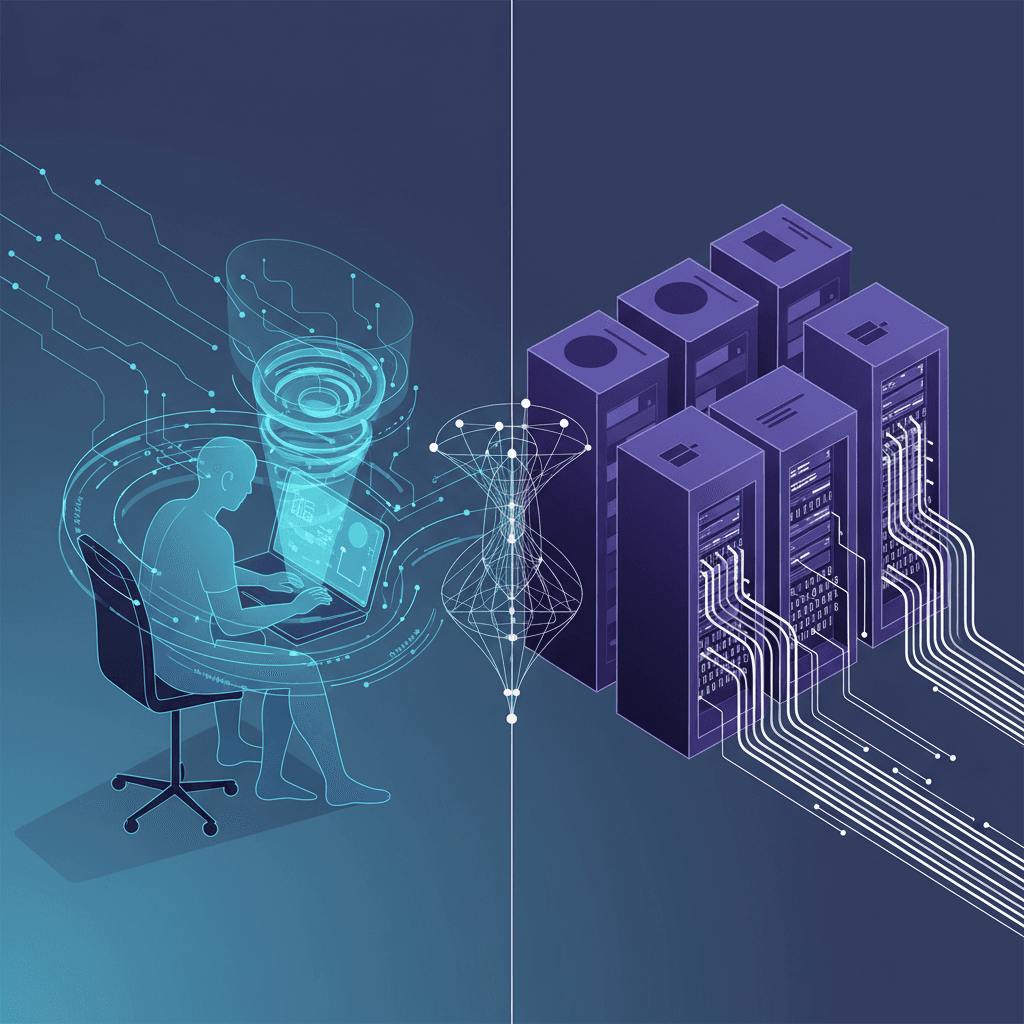
Anthropic’s latest Economic Index report provides an unprecedented, data-driven picture of how large language models are being integrated into the global economy, moving beyond theoretical speculation to empirical observation. The analysis, based on a massive dataset of one million consumer interactions on Claude.ai and one million enterprise API calls from November 2025, details a two-speed adoption model characterized by a fundamental split between individual augmentation and corporate automation. This observed usage data offers profound insights into the immediate future of work, productivity, and the distribution of economic gains from artificial intelligence.[1]
The most striking revelation from the data is the dichotomy between how individual users and corporate clients utilize the AI model, Claude. For the consumer base on Claude.ai, the dominant mode of interaction has shifted toward "augmentation," where the user and the AI work collaboratively. The report finds that augmented conversations, where the user learns, iterates on a task, or receives feedback, have edged out full automation, accounting for 52% of all sampled consumer interactions.[2][3] This collaborative model is reflected in the nature of consumer-initiated tasks, which tend to be more lengthy. On average, a successful Claude.ai conversation involves 15 minutes of human time with the AI, and the task itself is estimated to take a human 3.1 hours to complete alone, suggesting users are bringing complex, high-value tasks to the model for partnership. The multi-turn, back-and-forth nature of this engagement also appears to yield better outcomes, as the consumer platform recorded a task success rate of 67%.[2] This consumer trend suggests that for many individuals, the immediate value of AI lies in enhancing their capabilities and serving as an intellectual sparring partner, rather than simply delegating work. The shift toward augmentation is also attributed, in part, to product changes preceding the analysis, such as the introduction of file creation and persistent memory capabilities.[2]
In stark contrast, Anthropic's enterprise API traffic paints a picture of aggressive, programmatic delegation, with approximately three-quarters of these interactions classified as "automation."[3] API usage is overwhelmingly work-related, making up 74% of calls, and is highly directive, indicating businesses are primarily using the model to offload routine, high-volume operations. These tasks are notably shorter, averaging only five minutes of interaction and an estimated human time of 1.7 hours to complete alone, and register a lower success rate of 49%.[2] The occupational focus of the API calls is also much more concentrated, with a dominant 52% of tasks falling under Computer and Mathematical professions, consistent with programmatic workflows like code generation and data processing. Office and Administrative tasks also show a higher prevalence in the API traffic, reflecting the deployment of AI for routine business functions that are easily delegated.[2] This clear division suggests that while individuals are discovering new, complex ways to work with AI, enterprises are focused on extracting immediate, measurable efficiency gains through the wholesale substitution of human effort in well-defined areas.
Despite the impressive range of capabilities inherent in frontier large language models, the usage remains highly concentrated across both consumer and enterprise segments. The report shows that even with over 3,000 unique work tasks identified on Claude.ai, the top ten most prevalent tasks account for 24% of all sampled conversations.[4][5] This concentration has actually increased over time, indicating a growing specialization in AI's most effective use cases. The single most common task among consumers is "modifying software to correct errors," which alone represented 6% of usage.[4] More broadly, tasks related to Computer and Mathematical occupations dominate, constituting about a third of all conversations on the consumer-facing Claude.ai and nearly half of the firm-based API traffic. This indicates that the largest early economic benefits of AI are being realized in technical, knowledge-based fields where the tasks are well-suited to the model's core strengths.
The geographic distribution of AI adoption reveals a nuanced pattern of global divergence and domestic convergence. Worldwide, the report notes that unequal adoption remains strongly correlated with GDP per capita, finding that a one percent increase in GDP per capita associates with about a 0.7% increase in Claude usage per capita.[3] The leading countries in overall Claude.ai use are the US, India, Japan, the UK, and South Korea, which reinforces the risk that AI may widen international economic gaps as wealthy nations accelerate their productivity gains.[3] However, the picture within the United States is dramatically different. While usage is currently concentrated, with the top five US states accounting for nearly half of all usage, the data shows signs of rapid regional convergence in adoption. The pace of diffusion is projected to equalize usage per capita across the country in two to five years, a pace estimated to be roughly ten times faster than the spread of previous economically consequential technologies from the 20th century.[2][3] This accelerated domestic diffusion is largely attributed to the nature of AI itself, which requires minimal physical infrastructure beyond internet access, making advanced capabilities instantly available to knowledge workers across all regions.
Finally, the Economic Index offers a revised outlook on AI's macroeconomic impact and a key insight into the future of human-AI collaboration. Anthropic has adjusted its prediction for US labor productivity growth, now expecting AI to drive growth by 1.0% to 1.2% annually over the next decade.[6] This estimate, while more conservative than some earlier, more optimistic forecasts, is significant, as it is sufficient to return the US productivity growth rate to the levels seen during the late 1990s internet boom. This prediction is based solely on the model's capabilities captured in the November 2025 data, suggesting a potential for even greater gains as models continue to improve. A crucial finding underpinning this economic impact is the strong correlation between human and AI sophistication. The analysis found a near-perfect correlation (r = 0.925 globally) between the sophistication of a user's prompt—measured by the education level required to understand it—and the sophistication of the model's response.[7] This suggests that AI does not automatically deskill users but instead acts as a force multiplier for human capability; the value derived from the technology is directly shaped by the expertise and clarity of the human engaging with it. The data collectively positions Anthropic's platform as an engine for both immediate enterprise efficiency and a fundamental, collaborative shift in the future of work.[1]