
Americans adopt AI in record numbers as trust plummets and job anxiety surges
Record AI usage meets plummeting trust as Americans fear for their jobs and demand greater transparency and regulation
April 6, 2026
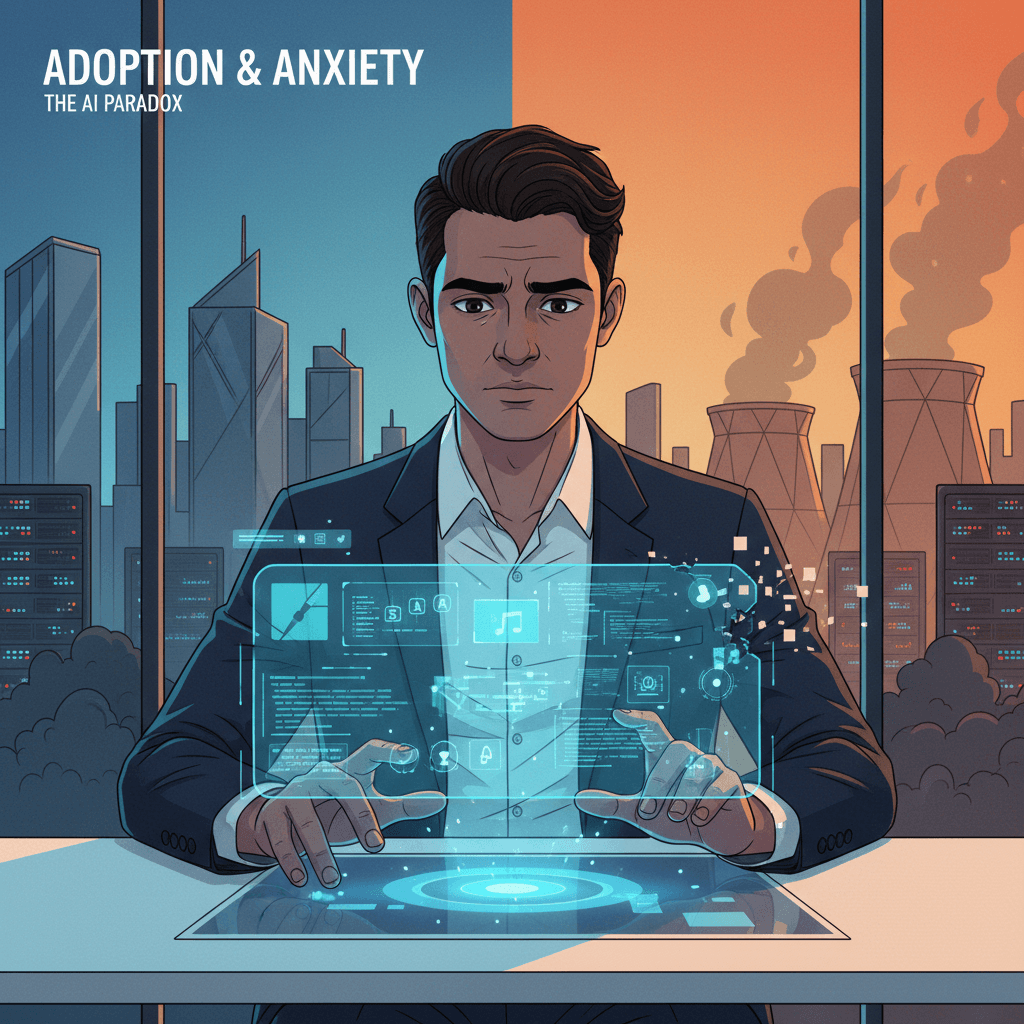
The integration of artificial intelligence into the daily lives of Americans has reached a significant milestone, yet this surge in adoption is being met with an equally powerful wave of public skepticism.[1][2][3][4][5][6][7][8][9] According to a comprehensive new national poll from Quinnipiac University, a striking paradox has emerged where more people than ever are utilizing AI tools for research, work, and personal projects, while simultaneously reporting record-low levels of trust in the technology.[5][7][8][1][2][4][10][6] The survey of nearly 1,400 adults reveals a nation that is increasingly dependent on automated systems but profoundly uneasy about the long-term consequences of that dependency.[10] As AI transitions from a futuristic novelty to a routine utility, the widening gap between usage and confidence suggests that the technology industry faces a critical turning point in its relationship with the public.[10][3][2]
The data highlights a sharp increase in the practical application of AI across various domains.[11][3][9][7][8][6] Roughly 51 percent of Americans now report using AI tools to research topics they are curious about, a significant jump from 37 percent just one year ago.[1][7][8][12] Use cases such as data analysis, image generation, and assistance with school or work projects have also seen double-digit growth.[7][1] This normalization of AI is further evidenced by the shrinking number of "never-users," which has dropped to 27 percent from 33 percent in the previous year.[3][2][10][4] However, this growing familiarity has not translated into belief in the technology’s accuracy.[3][4] The poll found that only 21 percent of respondents trust AI-generated information most or almost all of the time.[1][10][2][6][12][9][7][5] Instead, a massive 76 percent of the population remains skeptical, trusting the outputs only some of the time or hardly ever.[1][5][3][10][2][6][4][12] This "trust but verify" attitude indicates that while Americans value the efficiency of AI, they are deeply wary of its reliability and potential for misinformation.
Nowhere is this skepticism more pronounced than in the outlook for the American labor market, where anxiety over automation is reaching a fever pitch. Seven in ten Americans now believe that advancements in artificial intelligence will lead to a decrease in the total number of job opportunities, an increase from 56 percent in the previous year's survey.[4] This concern is particularly acute among younger generations who are entering or preparing for the workforce. Generation Z, despite having the highest level of familiarity and "fluency" with AI tools, holds the bleakest outlook for their professional futures.[7] An overwhelming 81 percent of Gen Z respondents expect AI to reduce the number of jobs available, reflecting a fear that entry-level roles and creative positions are being systematically eroded. This generational divide creates a unique contradiction: the very demographic most capable of wielding these tools is also the most convinced that those tools will ultimately undermine their career prospects.[10][3][6] Furthermore, the human element remains a non-negotiable preference for most; four out of five Americans stated they would refuse a job where their direct supervisor was an AI program responsible for assigning tasks and schedules.[8]
Beyond the workplace, the poll reveals growing alarm over the physical and social infrastructure required to sustain the AI boom. For the first time, public sentiment has turned sharply against the expansion of the hardware that powers these systems. Roughly 65 percent of Americans expressed opposition to the construction of new AI data centers in their local communities, citing concerns over high electricity costs, massive water usage, and the strain on local resources.[2][10] This suggests that the "cloud" is no longer seen as an invisible, consequence-free utility but as a resource-intensive industry that competes with citizens for basic needs. At the same time, the public is calling for much stricter oversight of how these systems are deployed and governed.[10] Approximately 74 percent of respondents believe the government is not doing enough to regulate the use of AI, and 76 percent feel that private businesses are failing to be transparent about their internal use of the technology.[1][4] This consensus spans across political and demographic lines, signaling a mandate for more rigorous ethical standards and legal frameworks.
The implications for the artificial intelligence industry are profound and may force a shift in how tech giants approach product development and marketing. For years, the narrative from Silicon Valley has focused on the "magic" and "limitless potential" of AI, assuming that widespread adoption would naturally lead to public acceptance. The Quinnipiac findings suggest the opposite: the more the public sees of AI, the more concerned they become.[7] The industry's current trajectory, characterized by a rapid "move fast and break things" release cycle, appears to be colliding with a public that is increasingly viewing AI as a source of more harm than good.[3][7][10][1][6] In fact, 55 percent of Americans now believe AI will negatively impact their day-to-day lives, compared to just 34 percent who see a positive outcome.[6][1][8] To bridge this divide, experts suggest that companies must move beyond mere performance metrics and focus on building verifiable trust, ensuring human-in-the-loop oversight, and addressing the specific economic anxieties of the younger workforce.
Ultimately, the Quinnipiac poll serves as a stark warning to both developers and policymakers. While the technological momentum of artificial intelligence is currently undeniable, it is being built on a foundation of public hesitation rather than enthusiasm.[3][1][2][5][4][7][10][6] The rising "fluency" of the American public has given them a front-row seat to the limitations and risks of the technology, leading to a sophisticated form of skepticism that cannot be easily dismissed by marketing campaigns. As AI becomes further embedded in education, healthcare, and the military, the demand for transparency and accountability will only grow. The central challenge for the next decade will not be whether AI can perform complex tasks, but whether it can do so in a way that aligns with human values and economic security. Without a fundamental shift in how trust is established, the very people who use AI every day may become the strongest voices calling for its limitation.
Sources
[1]
[2]
[5]
[6]
[9]
[11]
[12]