
AI and proof assistants dismantle the lone genius archetype to revolutionize mathematics
AI and proof assistants are replacing the solitary genius, ushering mathematics into a collaborative era of industrial-scale discovery.
May 30, 2026
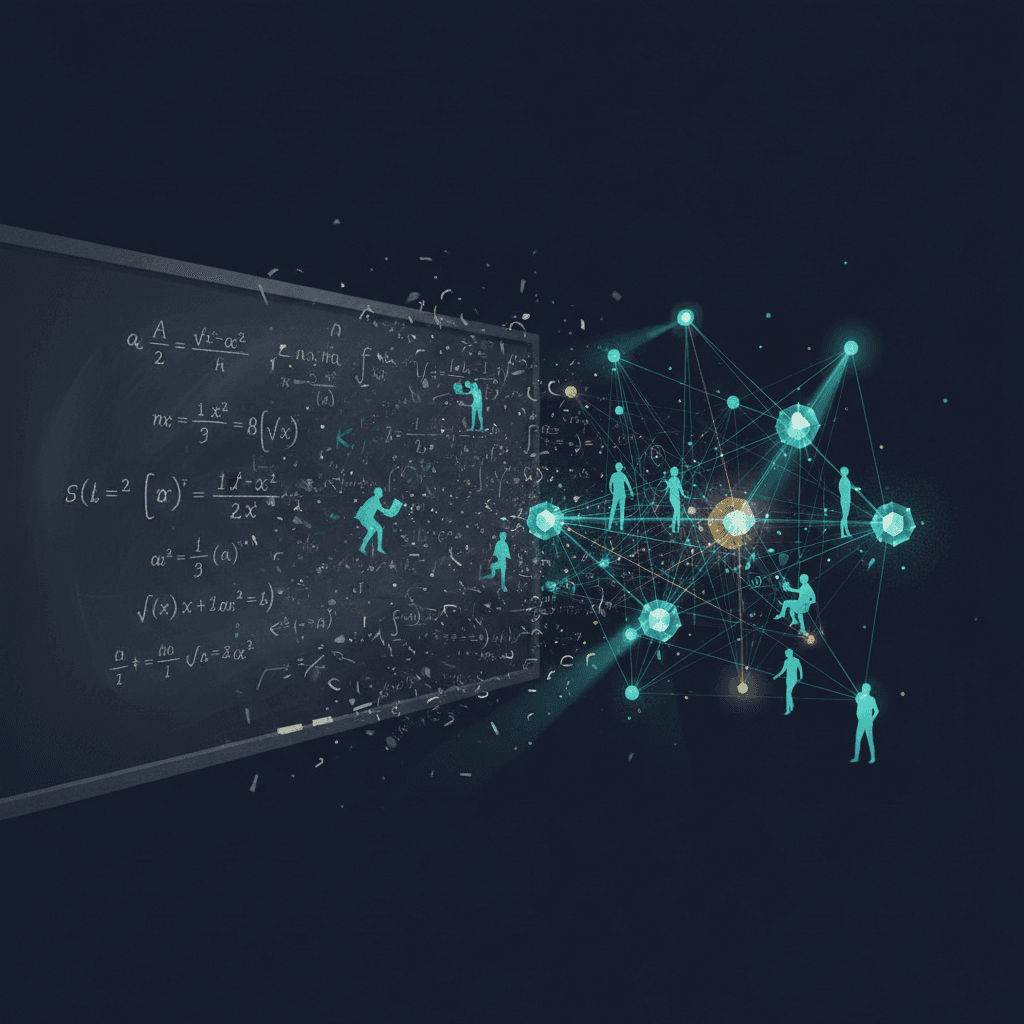
For centuries, the archetype of the mathematician has been the lone genius, a solitary figure working tirelessly at a blackboard to unlock the universe’s deepest secrets[1][2]. This highly centralized approach meant that mathematical research projects were almost exclusively conducted by individuals or very small groups of experts, rarely exceeding five co-authors[3][4]. Because math relies on an unbroken chain of absolute logic, every participant had to manually read, understand, and verify every single step of a proof to ensure its accuracy[3][4]. However, Terence Tao, a Fields Medal-winning mathematician and professor at the University of California, Los Angeles, argues that artificial intelligence is poised to dismantle this historic structure[1][5]. According to Tao, the integration of advanced machine learning models and formal proof assistants is bringing a systematic division of labor to the discipline of mathematics for the first time in history, paving the way for a highly collaborative era of industrial mathematics[1][6][7].
Historically, mathematics remained structurally resistant to the kind of specialized division of labor seen in other scientific fields like experimental physics or molecular biology[6][8]. In those disciplines, large teams can divvy up tasks, with some scientists specializing in project management, others in data collection, and others in running physical experiments[6]. In mathematics, this was virtually impossible because there was no automated compiler to check if a small sub-task or lemma was correct in isolation[6]. If a mathematician delegated a calculation or a proof component, they still had to spend massive amounts of time manually verifying that the contributor had not introduced a subtle, catastrophic error[3]. Tao explains that this forced every individual researcher to be an all-in-one practitioner, mastering every phase of a project from initial hypothesis generation and strategic planning to tedious calculation, verification, and paper writing[6][8].
This bottleneck is now dissolving due to the rise of formal verification languages and artificial intelligence[1][9]. Computer proof assistants, most notably Lean, act as mathematical compilers that can instantly and indefatigably verify whether a piece of digitized mathematical code is logically sound[4]. By pairing Lean with artificial intelligence systems, researchers can construct a digital blueprint of a complex proof[10][4]. In this new workflow, a senior mathematician can map out the overarching strategy and divide the proof into dozens of independent, localized lemmas[11][4]. Because Lean can mathematically guarantee the validity of each component, contributors do not need to understand the entire project to write code for a specific section[10][4]. This approach was recently put to the test in Tao’s Equational Theories Project, a massive online collaboration that sought to map the implications of nearly five thousand equational laws of magmas[12][13]. The project successfully resolved more than twenty-two million edges of a complex implication graph[14][15]. The effort combined the work of human mathematicians, automated theorem provers, and artificial intelligence tools, resulting in a collaborative paper with dozens of co-authors that proved a division of labor in pure mathematics is not only possible but highly productive[14][16].
For the artificial intelligence industry, Tao’s insights mark a significant shift in how frontier models are evaluated and deployed[11]. For years, the industry focused on creating all-knowing, human-like general intelligences capable of answering complex queries in a single step[17][18]. However, large language models often hallucinate, generating mathematical proofs that sound incredibly plausible but contain fatal errors[5][10][11]. Under Tao’s proposed division of labor, the artificial intelligence industry is pivoting toward a proposer-verifier framework[19]. In this paradigm, artificial intelligence models do not need to be infallible oracles; instead, they function as high-speed proposers that can generate thousands of ideas, draft code, and suggest proof strategies[20][11]. These outputs are then immediately checked by automated verifiers like Lean[1][4]. This loop was recently highlighted in a fireside chat between Tao and Mark Chen, the chief researcher at OpenAI[6]. During the discussion, they noted how quickly artificial intelligence models have graduated from being inefficient graduate students to winning top honors in international mathematical competitions[6][21]. The future of artificial intelligence in science lies not in standalone chatbot interfaces, but in deep integrations where reinforcement learning models are coupled directly with formal verification environments to systematically solve open problems[22][21].
Despite the rapid automation of routine calculations and proof writing, Tao stresses that human mathematicians remain completely indispensable[23]. While artificial intelligence can efficiently explore a vast landscape of options, humans possess the unique capacity for inspired guesses and macro-level heuristics[22][23]. To illustrate this, Tao compares artificial-intelligence-driven mathematics to Johannes Kepler’s historic discovery of the laws of planetary motion[22][24]. Kepler spent years testing wild, speculative hypotheses based on Tycho Brahe’s massive, precise datasets, eventually refining his theories until they matched reality[25][24]. Artificial intelligence can act as the high-temperature engine generating thousands of hypotheses, but humans must guide the search, formulate the initial questions, and interpret the final results[24]. This shift also carries profound implications for education[5]. Tao argues that traditional homework has become obsolete because artificial intelligence can instantly solve standard mathematical exercises[5]. He suggests that the modern educational model must be completely reinvented to focus on validation rather than memorization[5]. The core survival skill for the next generation of students will not be knowing how to generate an answer, but knowing how to detect when a highly convincing machine-generated answer is subtly wrong[5][26].
Ultimately, the transition toward industrial mathematics represents a fundamental evolution in human thought[1][17]. By automating the mechanical and tedious aspects of verification and literature search, artificial intelligence allows researchers to focus on the creative frontiers of the discipline[27]. The long-standing tradition of the isolated genius is giving way to a global, interconnected repository of verified logic, where humans and machines collaborate in a structured pipeline[1][4]. As these verification loops tighten and collaboration platforms mature, the mathematical community is unlocking a scale of discovery that was once entirely unimaginable[1][4]. This hybrid future ensures that while the speed of mathematical exploration accelerates exponentially, the discipline remains firmly tethered to absolute, verifiable truth[2].
Sources
[1]
[2]
[5]
[6]
[7]
[10]
[11]
[12]
[13]
[14]
[15]
[16]
[17]
[18]
[19]
[20]
[21]
[22]
[23]
[24]
[25]
[26]
[27]