
AI and Automation Force Top Indian IT Firms to Freeze Net Hiring.
AI adoption and productivity goals accelerate the end of the IT sector's traditional volume-based hiring model.
January 19, 2026
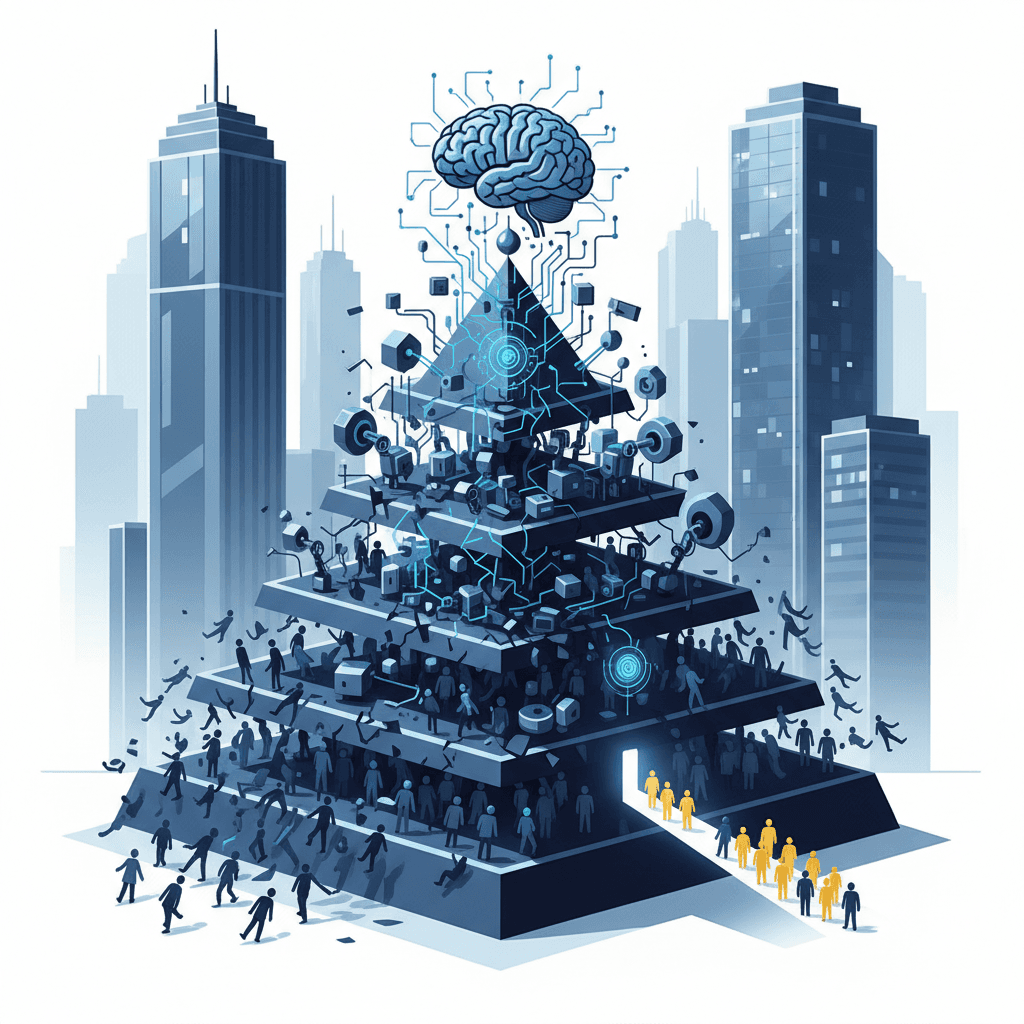
A seismic shift in the employment paradigm of India’s technology sector has been underscored by a near-complete freeze in net hiring across the country’s largest IT services companies. The top five Indian IT firms collectively added a minuscule 17 net employees in the first nine months of the current financial year, a staggering statistic that signals a profound structural change, not merely a cyclical downturn. This figure stands in stark contrast to the 17,764 net additions recorded by the same group of companies during the corresponding period last year, highlighting how the industry's traditional volume-based growth model is rapidly giving way to a leaner, productivity-focused operational strategy. The dramatic slowdown is the result of converging forces: a cautious global economic environment, a pullback in client discretionary spending, and, most consequentially, the accelerating integration of Artificial Intelligence and automation into core delivery models.[1][2]
The seemingly flat overall headcount masks significant and divergent workforce movements within the individual industry giants. Tata Consultancy Services (TCS), the sector’s largest employer, was the primary detractor, shedding a net 25,816 employees over the nine-month period. This massive reduction was part of a planned restructuring and talent optimization effort, with a notable focus on trimming the workforce at the mid-level and senior executive layers to address skill mismatches and realign the organisation for future needs.[1][2] This substantial exodus at the industry bellwether effectively neutralized the hiring efforts of its peers. In contrast, other major players recorded net additions, albeit at a significantly slower pace than in previous high-growth cycles. Infosys added 13,456 employees, while Wipro contributed 9,740. HCLTech also increased its workforce by 1,885, and Tech Mahindra added 752 employees, with some of these figures being propped up by recent acquisitions that offset organic reductions.[1][2] The combined positive net additions of the other four firms were barely enough to counter the scale of TCS’s workforce contraction, resulting in the final, negligible industry-wide net addition figure. This breakdown confirms that the headline number of 17 is not an industry-wide freeze, but rather an aggressive talent reshaping strategy led by the largest firm, offset by cautious, targeted hiring elsewhere.[1][2]
Industry experts point to the current global macro-economic climate as the immediate catalyst for this deep hiring restraint. Clients in key Western markets, facing their own economic uncertainties, have pulled back on large, discretionary IT projects, instead prioritizing cost-optimization and higher efficiency from their existing technology partnerships. This has led to an increased utilization of the existing employee base across many IT firms, with some reporting utilization rates in the mid-80s, which further diminishes the immediate requirement for new hires.[3] Furthermore, the pressure to deliver higher productivity with fewer resources has been amplified by the maturation of non-linear growth strategies. For years, the Indian IT sector’s growth was powered by the 'pyramid model,' where expansion in headcount directly drove revenue. The current trend suggests a fundamental move away from this historic reliance on large-scale labour arbitrage.[1][4][2] This structural re-alignment indicates that revenue growth is increasingly becoming decoupled from headcount growth, a long-term goal for the industry that is now being rapidly accelerated by market conditions and technology.[4]
The most significant long-term driver of this shift, with profound implications for the Indian IT industry, is the rapidly advancing role of Artificial Intelligence and automation. The adoption of AI-led delivery models is enabling firms to handle low- to medium-complexity tasks with significantly fewer personnel, essentially automating a large segment of the work traditionally performed by entry-level and junior employees.[5][6][3] This technological pivot is fundamentally reshaping the kind of talent the industry needs. The mass-hiring model for generalist roles is being replaced by a laser focus on lateral hiring of domain specialists and professionals with advanced, future-relevant skills in areas like Generative AI, machine learning, cloud computing, cybersecurity, and full-stack development.[5][7][8][9] The industry is not stopping hiring entirely; rather, it is executing a massive skill transformation. Companies are focusing their limited hiring quotas on campus recruitment for freshers who can be trained on these cutting-edge digital and AI technologies, even while simultaneously reducing their overall mid-level workforce that possesses legacy skills. This dual-pronged strategy ensures they retain a young, cost-effective talent pool ready for the future, while eliminating roles that are most susceptible to automation.[7][3]
The immediate consequences of this hiring slowdown are being felt most acutely by freshers and new graduates. The once-dependable pipeline of large-scale campus placements is constrained, leading to widespread anxiety among students entering the job market, with some already-extended offer letters being delayed or revoked.[1][3] Despite the overall muted numbers, there remains a persistent, high demand for specialized AI and digital talent, a fact underscored by global technology firms continuing to ramp up their own hiring for AI and cloud roles in India, even as their Indian counterparts scale back.[8] Ultimately, the anemic net hiring figure of 17 across the top firms is more than just a quarterly financial anomaly; it is a clear, stark indicator that the Indian IT services sector has entered a new era. The future of growth is no longer about maximizing the number of employees, but about optimizing their skills and leveraging AI-driven productivity gains, compelling the entire ecosystem, from universities to incumbent professionals, to rapidly re-skill and adapt to the new digital-first, AI-augmented reality.