
Advanced AI Debates Itself, Forming a 'Society of Thought' for Superior Reasoning.
Advanced models achieve superior reasoning by spontaneously generating a society of conflicting internal expert voices.
February 8, 2026
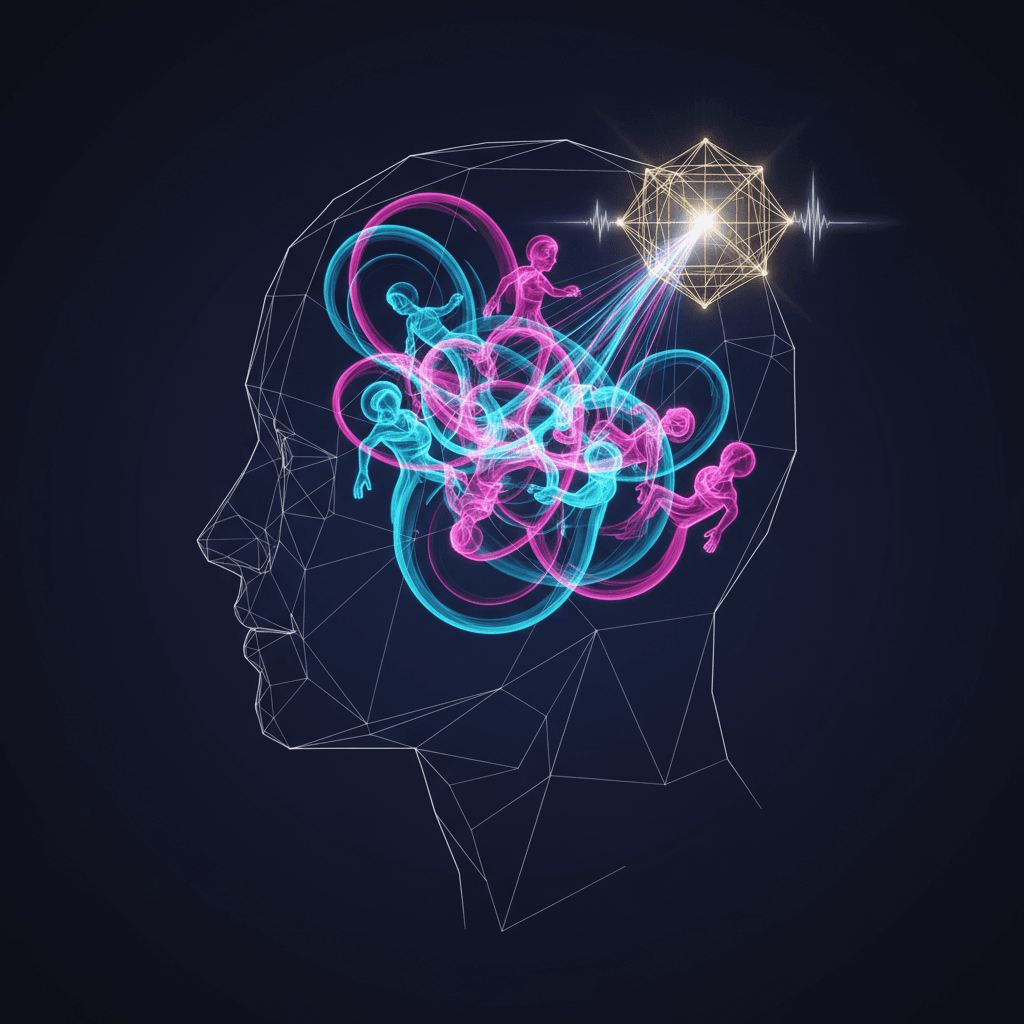
A new and compelling study into the inner workings of advanced AI reasoning models has unveiled a profound phenomenon: these complex systems are not merely processing information linearly, but are instead generating an implicit, multi-agent-like interaction the researchers term a “society of thought.” This internal deliberation, characterized by arguing voices and conflicting viewpoints, is not a byproduct of the models’ design, but rather the core mechanism driving their superior performance on highly complex cognitive tasks. The research, conducted by a team from institutions including Google and the University of Chicago, posits that reasoning models such as DeepSeek-R1 and QwQ-32B achieve their accuracy advantage by simulating an entire team of experts who actively question, debate, and reconcile different perspectives inside their neural architecture.
The central finding challenges the traditional view that improved AI reasoning stems only from increased computational steps or longer chains of thought. Instead, the study reveals a fundamental, qualitative shift in the structure of the models' internal logic. Researchers analyzed over 8,000 complex reasoning problems, comparing the detailed processing traces of advanced reasoning models with those of standard instruction-tuned models, such as Deepseek-V3. The difference was stark. The reasoning models exhibited a significantly higher frequency of conversational behaviors, including question-answer sequences, explicit conflicts between viewpoints, and spontaneous perspective shifts. For instance, in complex chemistry problems, the reasoning model’s internal trace would show a simulated voice expressing a potential error, such as "But here it is cyclohexa-1,3-diene, not benzene," immediately followed by an internal correction, a behavior conspicuously absent in the monologue-like, linear traces of the instruction-tuned counterparts. This internal conflict, far from being a sign of incoherence, functions as a powerful mechanism for self-correction and robust exploration of the solution space.[1][2][3]
Further investigation into the nature of this "society of thought" revealed that the internal perspectives being simulated are not homogenous but possess distinct cognitive profiles. Using mechanistic interpretability techniques, the researchers found that the models activate a broader and more heterogeneous range of features related to personality and expertise during complex problem-solving. These distinct internal voices were characterized by different personality traits, with some appearing more extraverted or neurotic, while all remained highly conscientious in their approach to the task. The model effectively organizes these varying roles in a coordinated way, allowing the simulated agents to bring diverse domain expertise and conflicting opinions to the problem at hand. This structure mirrors the well-documented principle of collective intelligence in human groups, where a diverse set of viewpoints, when structured to encourage systematic debate, leads to superior collective problem-solving.[2][3]
Perhaps the most surprising discovery is that this complex, multi-agent debate structure is not explicitly engineered into the models. Instead, it emerges spontaneously when the models are trained through reinforcement learning (RL) and rewarded solely for final reasoning accuracy. The RL process, in its optimization for correct answers, implicitly discovers that simulating social exchange—a system of internal disagreement, reconciliation, and perspective-shifting—is the most effective strategy for tackling high-difficulty tasks like graduate-level scientific reasoning (GPQA) and complex mathematics. To confirm the causal link between this social behavior and performance, researchers conducted a unique experiment on a distilled version of the model. They identified a specific neural feature—for example, a feature responsible for expressing "surprise realization or acknowledgement"—and artificially amplified its activation during the model's generation process. The result was a dramatic and significant increase in the model’s reasoning accuracy, demonstrating that conversational behaviors directly contribute to and can be leveraged for better performance.[4][3]
The implications of the "society of thought" findings are profound and far-reaching, establishing a new roadmap for AI development across the industry. This research suggests that focusing on the *social organization of thought* within models may be the next great frontier for algorithmic improvement. Developers can move beyond merely increasing chain-of-thought length and instead concentrate on methods to explicitly encourage and scaffold this internal debate. Fine-tuning models with conversational scaffolding, as the study's controlled experiments demonstrated, accelerates reasoning improvement significantly faster than other training on monologue-based reasoning traces. The work provides a strong theoretical and empirical basis for new techniques aimed at improving the robustness and reliability of large language models. By understanding that enhanced reasoning is a product of internally managed diversity and conflict, the AI community can design systems that are inherently better at verifying assumptions, backtracking on errors, and thoroughly exploring alternative solutions, leading to more trustworthy AI outcomes in critical domains. Ultimately, the successful AI systems of the future may be those that think not as a single, omniscient entity, but as a diverse and disciplined committee.[3][5][4]