
US allows NVIDIA H200 AI chip sales to China, secures revenue share.
US recalibrates export controls, permitting NVIDIA's H200 AI chip sales to China with 25% revenue for the government.
December 9, 2025
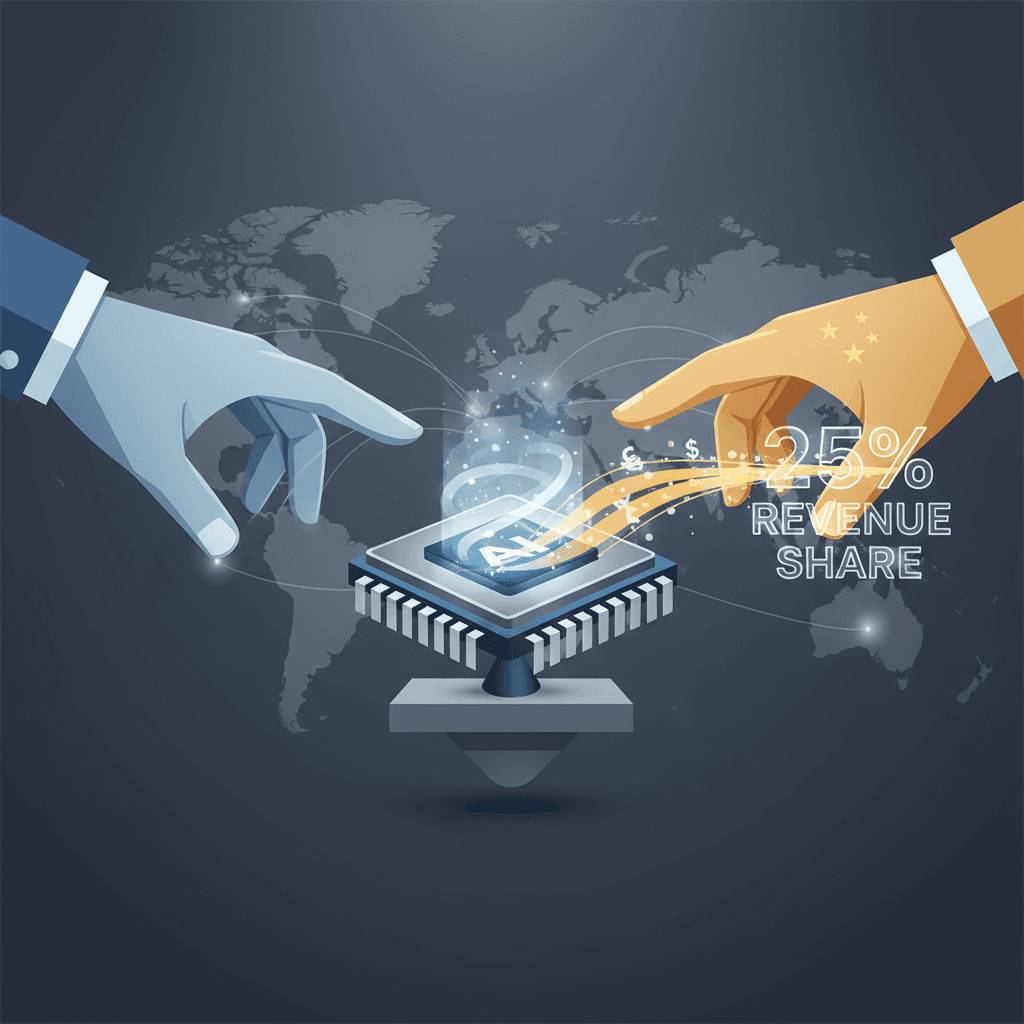
In a significant policy shift, the United States will permit NVIDIA to export its powerful H200 artificial intelligence chips to approved customers in China, signaling a potential recalibration of technology export controls.[1][2][3][4] The arrangement, announced by President Donald Trump, includes a stipulation that the U.S. government will receive 25% of the revenue from the chip sales.[1][5][6][3][7] This decision marks a pivotal moment in the ongoing technology rivalry between the two nations, partially reopening the lucrative Chinese market to NVIDIA's high-performance hardware while attempting to balance economic interests with national security concerns.[6][8][9] The move allows American chip companies to compete more effectively in a critical global market and support domestic manufacturing and jobs.[1][2]
The approval specifically applies to NVIDIA's H200 Tensor Core GPU, a highly capable processor based on the "Hopper" architecture.[5] While not NVIDIA's absolute top-tier product—a position held by the newer "Blackwell" and forthcoming "Rubin" generation chips which remain restricted—the H200 represents a substantial leap in performance over the downgraded chips previously designed for the Chinese market, such as the H20.[5][7][10] The H200 is noted for significant improvements over its predecessor, the H100, particularly in memory capacity and bandwidth, featuring 141 GB of next-generation HBM3e memory and a bandwidth of 4.8 TB/s.[11][12][13] These specifications are crucial for training and running the increasingly large and complex models driving the generative AI boom.[11] In performance benchmarks, the H200 has demonstrated considerable speedups, nearly doubling the inference performance of the H100 on large language models.[14][15] This approval effectively raises the performance ceiling for AI accelerators available to Chinese technology firms.[16]
The policy shift is seen by some as a pragmatic response to the realities of the global semiconductor market and the limitations of previous export control strategies.[16][7] The tighter restrictions imposed since 2022 were intended to slow China's progress in advanced AI and supercomputing on national security grounds.[17][18] However, these controls also significantly impacted revenue for American firms like NVIDIA, which saw its business in China curtailed.[19] There was growing concern that an overly restrictive stance could inadvertently accelerate China's push for technological self-reliance, strengthening domestic competitors like Huawei.[5][6][4] The new policy allows vetted commercial customers access to advanced U.S. technology, potentially slowing the development of domestic Chinese alternatives while keeping the most cutting-edge chips out of reach.[2][6] This approach is viewed as a middle path, aiming to prevent China's market from completely shifting to homegrown hardware.[7]
The implications of this decision are multifaceted, affecting market dynamics, supply chains, and the geopolitical landscape. For NVIDIA, the approval could restore access to a market that once accounted for a significant portion of its revenue.[10][4] The 25% fee, which will reportedly be collected as an import tax when the chips are brought from Taiwan to the U.S. for inspection before being re-exported, represents a novel mechanism for managed trade.[6][3] However, the success of this strategy is not guaranteed. It remains to be seen whether Chinese technology giants, who had begun exploring domestic alternatives like Huawei's Ascend 910B chip, will readily re-embrace U.S. technology, especially given the premium cost and the lingering political uncertainties.[16][20][21] Beijing's own industrial policies and national security concerns will play a crucial role in the reception of the H200 chips.[16]
Ultimately, this policy adjustment reflects the intricate balancing act facing the U.S. government: hindering a strategic rival's military-technological advancement without crippling its own industry leaders or accelerating the very technological decoupling it seeks to manage. The decision to allow H200 exports to China under strict conditions is a significant departure from prior policy, creating a new, albeit complex, framework for competition in the critical field of artificial intelligence. It signals a potential willingness to apply export controls with more flexibility, using licensing and revenue-sharing to maintain a degree of control while allowing U.S. industry to compete globally. The long-term effects on AI development in both the U.S. and China, and on the broader global tech ecosystem, will be closely watched by industry and governments alike.
Sources
[5]
[11]
[13]
[14]
[15]
[16]
[17]
[18]
[19]
[20]
[21]