
Unconventional AI Secures $475M to Build Brain-Inspired Computers, Solve AI's Energy Crisis
Naveen Rao's $475M venture is building a new brain-inspired computer to prevent AI's looming energy bottleneck.
December 9, 2025
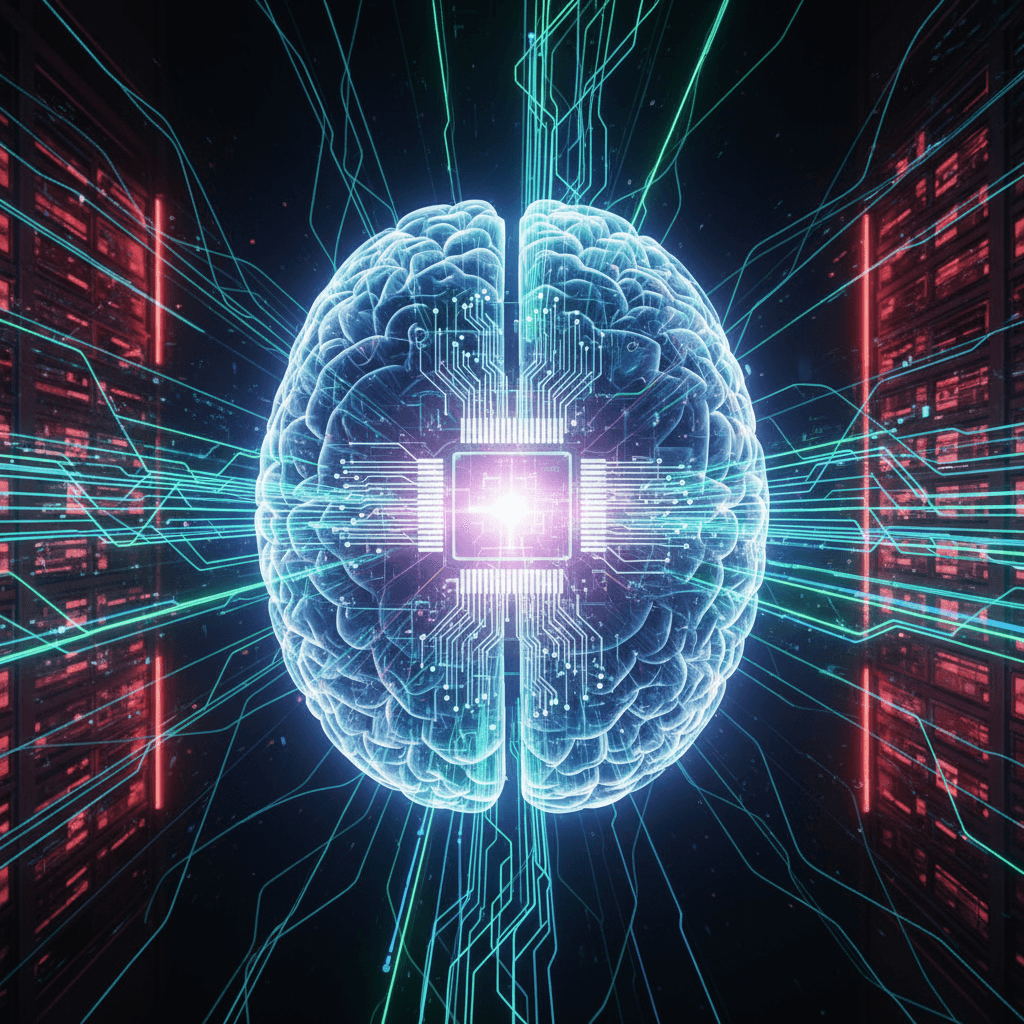
A new entrant has dramatically emerged from stealth in the artificial intelligence sector, armed with a staggering $475 million in seed funding to tackle what it sees as an existential threat to AI's continued growth: energy consumption. Unconventional AI, founded by serial entrepreneur and former Databricks AI chief Naveen Rao, is embarking on an audacious mission to build a new type of computer.[1][2] This novel hardware and software system will be inspired by the principles of biological intelligence, aiming for "biology-scale" efficiency to prevent a looming energy bottleneck predicted to stifle AI advancement.[2] The company's massive initial funding round, co-led by Andreessen Horowitz and Lightspeed Venture Partners with participation from notable investors like Jeff Bezos, values the two-month-old startup at a remarkable $4.5 billion, signaling immense confidence in Rao's vision and track record.[1][2]
At the heart of Unconventional AI's strategy is a fundamental rethinking of computation from first principles.[2] The company argues that the exponential demand for AI compute is on a collision course with the linear growth of global energy production.[2] Projections cited by the startup suggest that at current rates, AI's energy needs could become constrained by the world's total energy supply within the next three to four years.[2][3] This looming crisis, they contend, cannot be solved by incremental improvements to existing hardware architectures, which have remained largely unchanged for decades and are profoundly inefficient for AI workloads.[3][4] The inspiration for a new path comes from nature's most efficient computer: the human brain, which performs complex tasks on a mere 20 watts of power.[2][3][4] Unconventional AI aims to create a "new substrate for intelligence" that mirrors this biological efficiency, a goal Rao has dubbed "Brain Scale Efficiency without the biological baggage!"[5][6]
The company's technical approach veers sharply from the current digital, deterministic paradigm dominated by GPUs.[2][7] Today's neural networks are run on layers of abstraction built on top of analog circuitry designed to behave digitally, a process that creates significant inefficiencies.[2][7] Unconventional AI proposes to bypass these layers by building silicon circuits that directly harness their inherent physical, non-linear dynamics, much like biological neurons do.[2][3][7] This involves creating a software layer that interfaces directly with the physics of the silicon, effectively running neural networks on the physical properties of the hardware itself rather than simulating them.[4][7] This concept, which shares principles with neuromorphic and analog computing, seeks to achieve efficiency gains far beyond what is possible with conventional digital architectures.[8][9][4][10] The goal is to develop an end-to-end intelligence solution, complete with custom silicon and server infrastructure.[5][6]
The immense investor confidence in such a pre-product, high-risk venture is largely credited to its founder, Naveen Rao.[11][5] Rao has a proven history of building and successfully exiting transformative AI companies.[11][5][6] He co-founded Nervana Systems, a machine learning platform acquired by Intel in 2016 for over $400 million, and later founded MosaicML, which focused on training large models and was bought by Databricks in 2023 for $1.3 billion.[11][5][6] His deep background, which combines a PhD in neuroscience with expertise in computer engineering, positions him uniquely to lead this ambitious undertaking.[11][12] Rao is joined by a strong founding team including MeeLan Lee, an expert in analog circuit design from Google, Qualcomm, and Intel, as well as Sara Achour from Stanford and Michael Carbin from MIT, both leading researchers in programming novel computing substrates.[3][4] This collective expertise is considered purpose-built for the complex challenge of redesigning computing from the ground up.[3]
The emergence of Unconventional AI signifies a pivotal moment for the industry, highlighting a growing consensus that current hardware solutions are unsustainable for the future of artificial intelligence.[13] The dominant Von Neumann architecture, which separates memory and processing, creates a "memory wall" bottleneck and consumes vast amounts of energy simply moving data.[14][15] As AI models grow exponentially, these inefficiencies become more acute, making the development of more efficient hardware a critical necessity.[11][16] While specific timelines are still in development, Rao has indicated that this is a long-term research effort, though the company may begin releasing some of its findings sooner rather than later.[12] Unconventional AI's mission to develop a new computational paradigm represents a high-stakes, long-term bet that could either redefine the infrastructure of the entire AI economy or become a cautionary tale of ambition. For now, with nearly half a billion dollars in the bank and a team of renowned experts, it is one of the most significant and closely watched ventures aiming to build the future of computing.
Sources
[3]
[4]
[7]
[8]
[9]
[10]
[12]
[13]
[14]
[15]