
Tamil Nadu Partners to Drive AI Deep Tech Growth Beyond Major Cities.
Tamil Nadu decentralizes deep tech, partnering to fuel AI and climate startups in Tier-2 and Tier-3 cities.
January 20, 2026
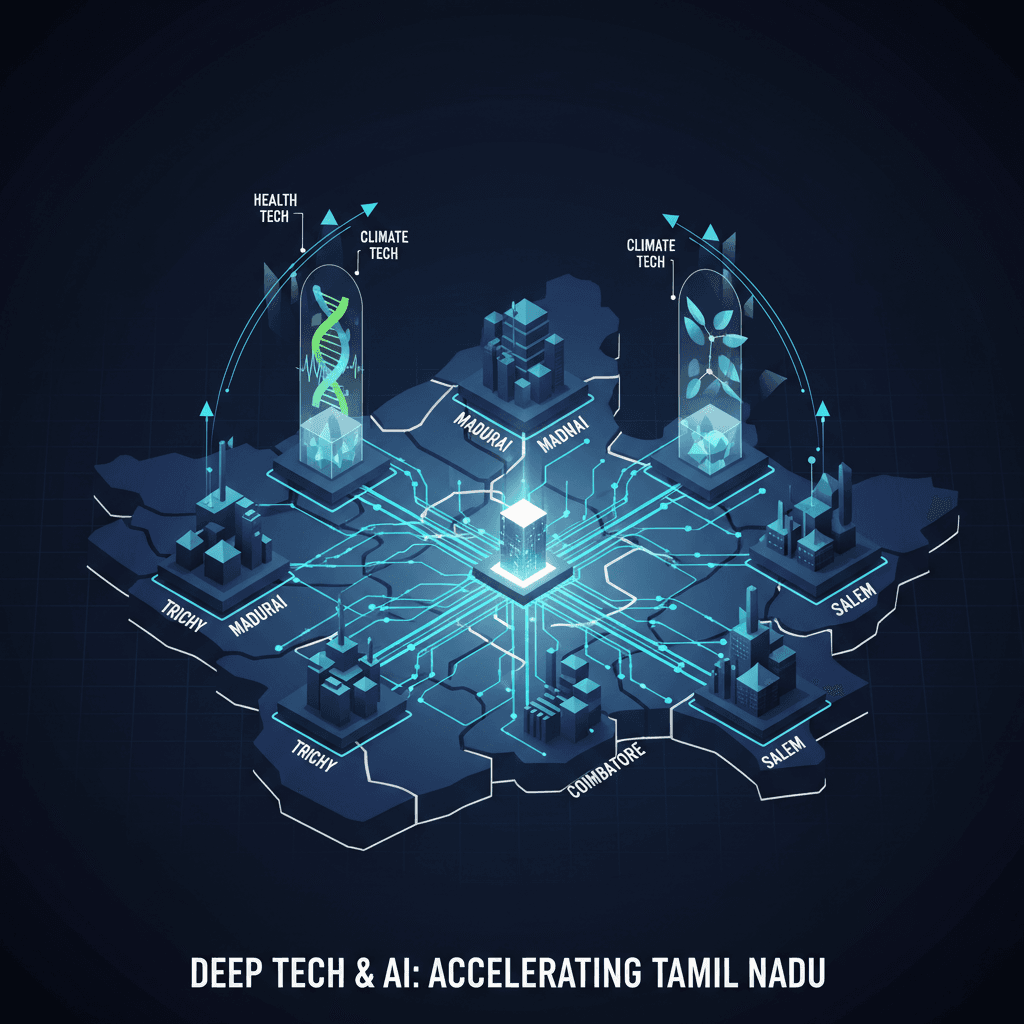
The Government of Tamil Nadu's technology arm, the Tamil Nadu Technology Innovation Hub (iTNT), has partnered with deep-tech enablement network SanchiConnect to spearhead the growth of science-led startups across the state's Tier-2 and Tier-3 cities. This strategic collaboration is a direct extension of the state's ambitious Deep Tech Startup Policy (2025-26), which aims to decentralize the innovation ecosystem beyond the major metropolitan areas and foster inclusive economic growth. The initiative is explicitly designed to build a sustainable pipeline for innovation in critical sectors, including climate technology and health tech, which are areas ripe for disruption through advanced applications of Artificial Intelligence.
This joint endeavor is poised to address the critical 'lab-to-market' challenge faced by intellectual property (IP)-intensive ventures by leveraging SanchiConnect's proven track record in accelerating deep-tech startups and connecting them with a global network of investors and corporates. The state's Deep Tech Startup Policy has set a clear target: to support 100 deep tech startups and mobilize INR 100 crore in public and private investments over a five-year period, with iTNT acting as the nodal agency for implementation.[1][2] The partnership with SanchiConnect is a crucial mechanism for realizing this vision, bringing an established acceleration framework to regions like Tiruchirappalli (Trichy) and Madurai, where iTNT is already establishing regional hubs to empower local talent.[3][4]
The Imperative of Decentralization and AI's Role
The focus on Tier-2 and Tier-3 cities is not merely a geographic expansion but a strategic move to tap into a rapidly growing pool of tech-savvy talent and access research institutions outside of Chennai. The state government’s commitment to decentralization is evident in the establishment of the Tiruchi Regional Hub of iTNT, with a similar facility planned for Madurai, directly supporting the central and southern districts of Tamil Nadu.[3] This localization strategy is vital for deep-tech, as it allows startups to develop solutions that are precisely tailored to local challenges, such as regional logistics, agricultural sustainability, and localized healthcare access—all areas where AI can provide a transformative advantage. For instance, a number of existing deep-tech startups in Tier-2 cities in Tamil Nadu are already developing products in healthcare deep-tech and AI-enabled IoT solutions for energy efficiency, proving the foundational capacity is already present.[5]
Artificial Intelligence and Machine Learning (AI/ML) form the technological bedrock of the entire deep-tech policy. SanchiConnect, which has a history of successfully accelerating AI-driven industrial analytics and logistics optimization startups, is uniquely positioned to inject this expertise into the Tier-2/3 ecosystem.[6][7] The partnership aims to facilitate the transfer of knowledge in advanced technologies such as AI/ML, robotics, and advanced materials from academic research labs—particularly within the Anna University Regional Campuses and other regional institutions that have signed MoUs with iTNT—directly into commercial ventures.[3][8] This alignment will help local innovators build proprietary Intellectual Property (IP), moving them up the value chain from software services to science-led product creation. This push for IP creation is a central pillar of the Deep Tech Startup Policy, which seeks to facilitate a 25% growth in annual patent filings by deep tech startups in the state.[9]
Bridging the Funding and Market Access Gap
Deep-tech ventures, unlike conventional startups, require longer development cycles and higher initial capital due to their scientific and engineering complexity.[1] The partnership between SanchiConnect and the state government is designed to overcome this high-risk funding hurdle. SanchiConnect operates a formidable deep-tech enablement network that connects over 3,000 startups with a pool of investors, having facilitated significant capital deployment in the past.[6][10] By integrating its network with iTNT’s ecosystem, the partnership effectively creates a direct bridge for Tier-2 and Tier-3 startups to access institutional funding and corporate customers. The Tamil Nadu Deep Tech Startup Policy complements this by proposing a "Government as Early Adopter Programme" with an annual allocation to fund pilot projects and proof-of-concept deployments, which directly addresses a primary pain point for deep-tech companies: securing their first customer.[11]
SanchiConnect’s role extends to providing intensive technical mentorship and a structured acceleration framework. This hands-on support is vital for startups in secondary cities, where access to experienced mentors with global market knowledge can be limited. The joint initiative will likely mirror SanchiConnect’s successful models by offering tailored go-to-market strategies, connecting founders with industry leaders, and providing access to state-of-the-art infrastructure. The ultimate goal is to nurture companies with core IP that can scale globally, transforming local innovations into international market disruptors, a key objective for Tamil Nadu as it targets becoming a $1 trillion economy.[9][8]
Long-Term Vision for an Inclusive Deep Tech Ecosystem
The collaboration between SanchiConnect and iTNT represents a foundational step towards democratizing India's deep-tech landscape. The state’s focus on sectors like public health and clean energy (climate technology) aligns the pursuit of high-tech economic growth with social and environmental impact, a crucial element for sustainable development.[1][12] The policy and its implementing partners are not only fostering entrepreneurship but also investing heavily in talent development, with plans to train over 10,000 students and professionals in essential deep tech skills like AI, robotics, and biotechnology through specialized programs.[9] This focus on skilling and local ecosystem cluster creation ensures that the decentralized growth is self-sustaining, turning cities like Coimbatore, Salem, and Madurai into robust, specialized deep tech hubs. By merging private sector acceleration expertise with government policy and funding mechanisms, the partnership sets a new precedent for how state governments can actively catalyze the growth of deep-tech, positioning Tamil Nadu as India's premier hub for science-led innovation and making the development of Artificial Intelligence and other disruptive technologies an inclusive, national movement.