
Stanford University reinstates proctored exams as AI fuels a normalized culture of academic fraud
How a culture of minor fraud and AI shortcuts is hollowing out expertise and devaluing the elite university degree
May 18, 2026
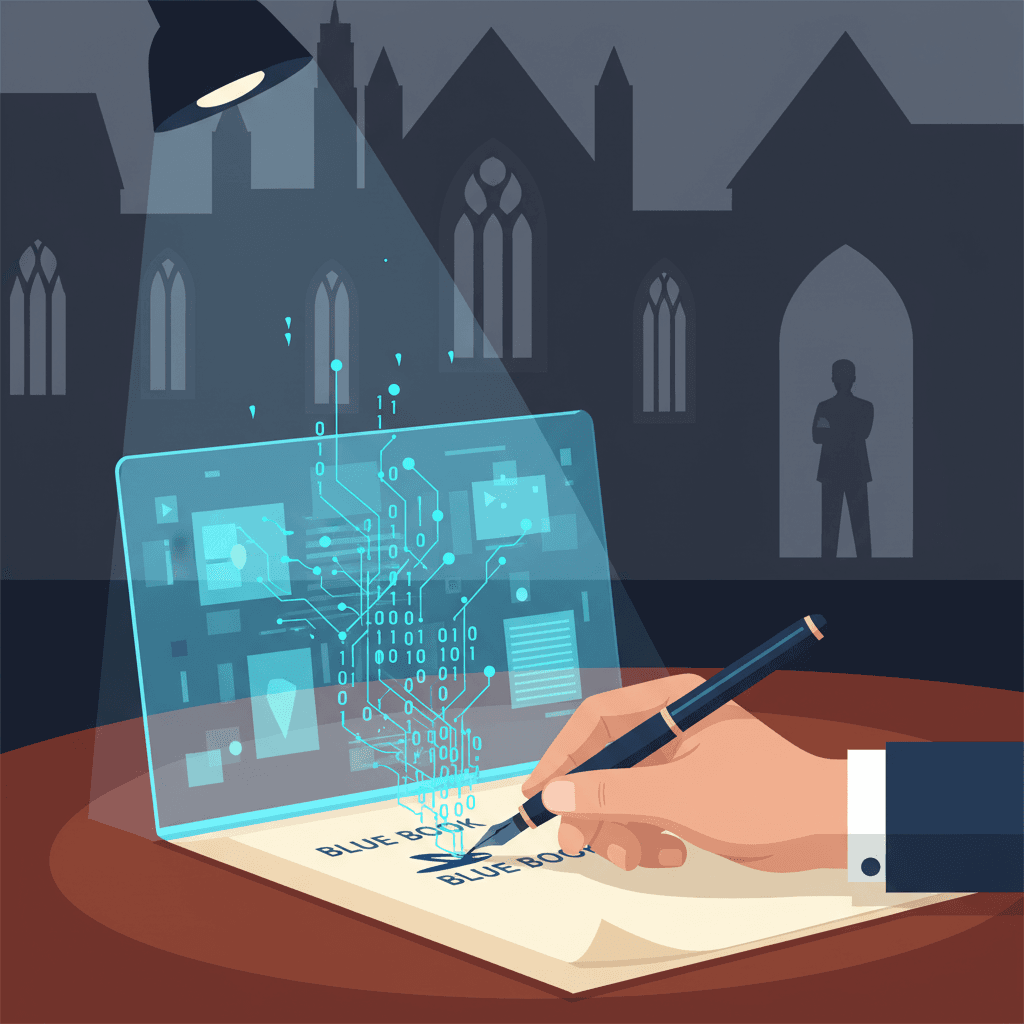
The current graduating class at Stanford University is departing from one of the world’s most prestigious institutions with a distinction they never requested: they are the first cohort to have spent their entire collegiate experience in the shadow of generative artificial intelligence.[1][2] This transition has sparked a profound internal reckoning, spearheaded by student and investigative journalist Theo Baker, whose reflections on the pervasive influence of ChatGPT suggest that the technology has not merely assisted students but has fundamentally institutionalized a culture of academic dishonesty. According to these observations, the arrival of large language models acted as a catalyst for a pre-existing ethos of corner-cutting, transforming what was once a series of isolated infractions into a standardized operating procedure for the modern elite student.[1][3]
At the heart of this shift is the concept of "just a little bit of fraud," a phrase reportedly coined by a student to describe the casual negligence and minor ethical compromises that have become the campus norm.[1] This sentiment extends far beyond the lecture hall, appearing in the way student organizations handle corporate sponsorship hardware and how individuals navigate university bureaucracy.[4][5] However, its most visible impact remains in the classroom, where the line between original thought and algorithmic output has been almost entirely erased. The traditional academic experience, defined by the friction of learning and the difficulty of mastery, is being replaced by a drive for total efficiency. In this environment, the primary goal of the student has shifted from the acquisition of knowledge to the successful navigation of tasks, leading to a landscape where the credential is valued far above the education it is supposed to represent.
The extent of this cultural erosion is perhaps most visible within Stanford’s famed computer science department, a pipeline for the global tech industry. In a recent survey of nearly eight hundred and fifty computer science majors, roughly half of the respondents admitted they would rather cheat on an examination than risk failure.[5][2] This data point highlights a significant shift in the risk-reward calculus of modern students. For many, the threat of an academic integrity violation is outweighed by the intense pressure to maintain a perfect transcript and secure high-paying roles in a volatile job market. The irony is not lost on the community: the very students responsible for building and refining the next generation of AI tools are also the ones most frequently using those tools to bypass the foundational learning required to understand them.[2] This has led to a paradoxical situation where students are signing honor pledges swearing they have not used unauthorized assistance while simultaneously keeping an AI interface open in another window.[1]
The university’s response to this crisis marks a dramatic reversal of long-standing institutional philosophy.[2] For over a century, Stanford maintained a ban on proctored exams, trusting in the Honor Code to ensure student integrity. However, the sheer scale of AI-assisted cheating has forced the administration to reinstate proctored, handwritten "blue book" examinations. This retreat to analog methods is a stark admission that the technological arms race between students and detectors has been lost. While companies like Turnitin and various AI-detection startups promised software solutions to verify human authorship, these tools have proven unreliable, often producing false positives or failing to catch sophisticated prompting techniques. By returning to physical monitoring and pen-and-paper assessments, the university is attempting to re-establish a baseline of verified human performance, yet this move also signals a breakdown in the fundamental trust that once anchored the relationship between the institution and its pupils.
For the broader AI industry, these developments carry significant and potentially troubling implications.[6] As the talent pipeline becomes increasingly saturated with graduates who have relied on generative tools to navigate their formative years, the industry faces a looming crisis of "hollowed-out" expertise. When entry-level engineers and analysts have spent their academic careers delegating complex problem-solving to machines, their ability to diagnose systemic failures or innovate beyond existing datasets may be severely compromised. There is a growing concern that the AI industry is inadvertently training its future workforce to be "hallucinators" of human effort—individuals who can produce polished final products without possessing a deep understanding of the underlying mechanics.[2] This shift risks creating a generation of professionals who are highly proficient in prompt engineering but lack the rigorous analytical skills necessary to advance the field or maintain the safety of complex systems.[2]
Furthermore, the normalization of "a little bit of fraud" in elite academic circles suggests a wider ethical drift within the technology sector. The "fake it till you make it" culture of Silicon Valley has always flirted with the boundaries of honesty, as seen in the high-profile downfalls of various local tech founders. However, when the default mode of education becomes a series of shortcuts, the guardrails against corporate misconduct and scientific fraud are significantly weakened. The transition from academic dishonesty to professional fraud is often a matter of scale rather than a change in character.[2] If the formative years of the world’s future leaders are defined by the successful evasion of rules through technology, the long-term impact on corporate governance and public trust could be devastating.
The transition toward an AI-driven educational model also raises fundamental questions about the value of a university degree.[2] Historically, a diploma served as a signal of persistence, critical thinking, and the ability to operate under pressure. As these traits become increasingly difficult to verify, the signaling power of the elite degree is likely to diminish. If employers cannot distinguish between a student’s genuine capability and an algorithm’s output, they may turn to even more intrusive forms of testing and surveillance during the hiring process, further escalating the tension between human workers and the tools meant to assist them. This environment creates a self-reinforcing cycle where students cheat because they feel the degree is just a hurdle, and employers treat the degree as worthless because they know students cheat.
In the final analysis, the reflections emerging from the Class of 2026 suggest that the integration of AI into education is not a neutral evolution.[1] While these tools offer undeniable gains in productivity, they also provide a path of least resistance that threatens to bypass the very cognitive struggles that constitute a real education. The "just a little bit of fraud" ethos is a symptom of a deeper malaise—a world where the outcome is prioritized so heavily over the process that the integrity of the individual becomes an obstacle to success.[2] As universities struggle to redefine their role in this new era, the focus may need to shift away from technological detection and back toward the cultivation of intrinsic motivation and ethical character. Without a fundamental recalibration of what it means to learn, the AI era may be remembered not for the intelligence it created, but for the human effort it allowed to atrophy.