
Physical AI triggers global robotics revolution as generalist machines transition from code to physical labor
As the digital brain finds its body, physical AI leverages massive investments to solve the global industrial labor crisis.
March 4, 2026
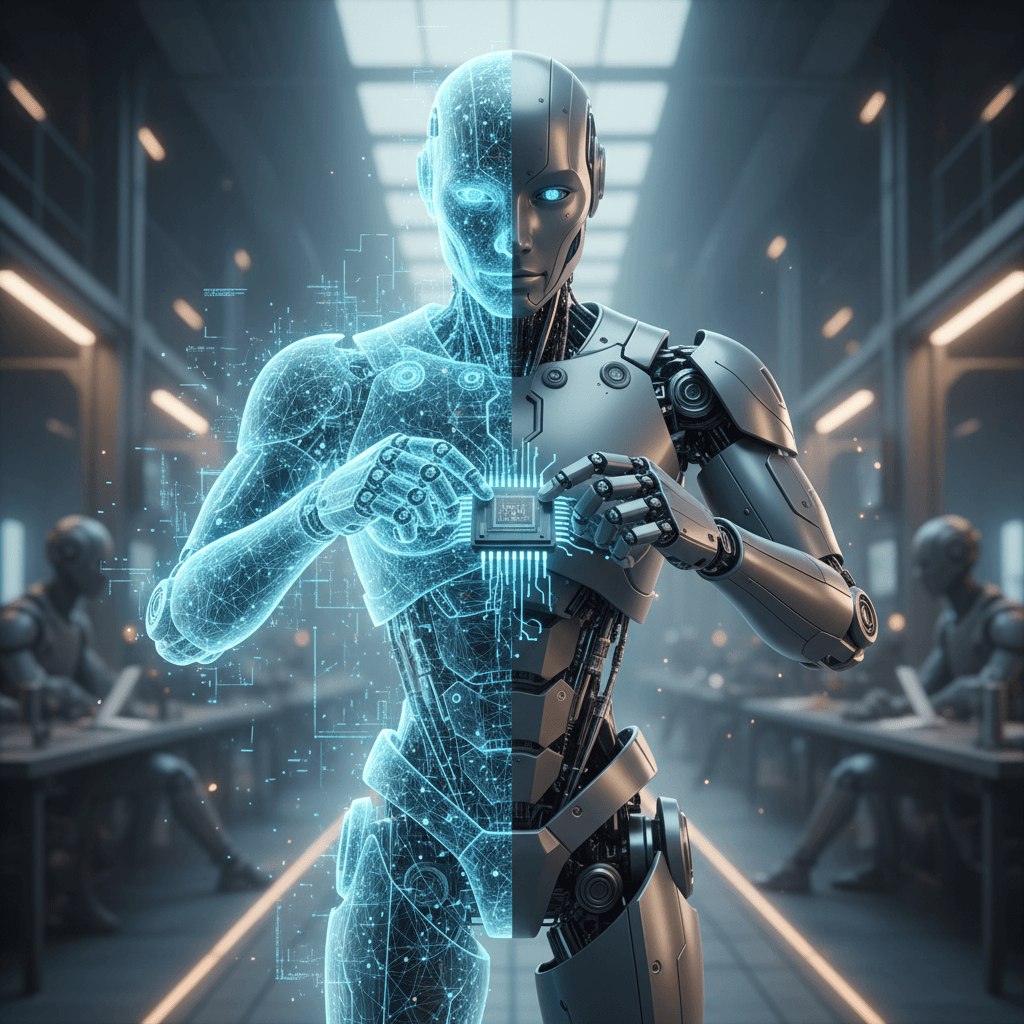
There is a particular kind of momentum in the technology industry that announces itself not through a single breakthrough, but through the simultaneous convergence of many. Physical AI is having that moment right now, and paying attention to where it is coming from, and why, tells you more than any single product launch can. For decades, artificial intelligence was largely confined to the digital realm, existing as a "brain in a box" that processed text, images, and code. Today, that brain is finding its body. The transition from virtual to physical AI represents a fundamental shift in the global economy, moving the center of innovation from chatbots and generative art to the kinetic world of manufacturing, logistics, and eventually, the home. This shift is being propelled by a massive influx of venture capital, the development of specialized foundation models for robotics, and a mounting labor crisis in the industrial sector that has made automation an operational necessity rather than a luxury.
The technological foundation of this revolution lies in the emergence of generalist robot foundation models, which are doing for physical movement what large language models did for human speech. For years, robotics relied on rigid, pre-programmed instructions where every joint movement had to be mathematically defined. The new wave of physical AI utilizes what researchers call vision-language-action models. These systems allow a machine to look at a cluttered table, understand a verbal command like "pick up the red cup," and execute the task without a specific script for that exact environment. At the center of this movement is NVIDIA, which has positioned itself as the primary infrastructure provider for the robotics age. Its Project GR00T—Generalist Robot 00 Technology—is designed as a multimodal foundation model that enables humanoid robots to perceive the world, reason through complex tasks, and learn from human demonstration. By using simulation platforms like Isaac Lab, robots can now practice tasks for the equivalent of thousands of years in a virtual environment before they ever step onto a physical factory floor.[1] This "sim-to-real" pipeline has dramatically shortened the development cycle for intelligent machines, allowing them to adapt to new environments in real-time.
The financial scale of this pursuit is staggering, reflecting a belief among investors that physical AI will eventually surpass the digital software market in total value. Startups that were in stealth mode only a few years ago are now commanding valuations in the billions. Skild AI, a Pittsburgh-based firm, recently secured $1.4 billion in funding led by SoftBank Group, bringing its valuation to more than $14 billion.[2][3][4] The company’s "omni-bodied" brain is designed to be hardware-agnostic, meaning the same AI model can theoretically control a bipedal humanoid, a four-legged quadruped, or a robotic arm. Similarly, Figure AI has seen its valuation soar following successful pilot programs and massive investment from the likes of Microsoft, NVIDIA, and Amazon. The race has also lured the industry’s biggest names back into the fray. OpenAI, which shuttered its robotics division in 2021 due to a lack of training data, has aggressively re-entered the field, recruiting top mechanical engineers to help ground its advanced reasoning models in physical systems. These companies are no longer just building tools; they are building a new class of labor.
Tesla remains perhaps the most visible driver of this trend through its Optimus humanoid program. During recent earnings updates, the company detailed a roadmap that shifts its primary focus from electric vehicles to mass-produced robotics.[5] Tesla is currently transitioning its Fremont manufacturing plant to prioritize the production of the Optimus Gen 3 model, with internal targets suggesting a ramp-up to several thousand units in the near term and a long-term goal of one million units per year.[6] The company’s advantage lies in its existing fleet of millions of vehicles, which act as a massive data collection network for real-world navigation and spatial awareness. By treating its robots as "cars on legs," Tesla is leveraging the same neural networks that power its Autopilot software. The competitive landscape is further crowded by established players like Boston Dynamics, which recently retired its hydraulic Atlas in favor of a fully electric version designed for commercial scalability, and Chinese manufacturers who are already delivering thousands of humanoid units to various industrial sites.
The urgency behind this "global race for robots" is fueled by a structural labor shortage that is beginning to threaten global supply chains. According to research from Deloitte and the Manufacturing Institute, the United States alone faces a projected 2.1 million worker shortfall in the manufacturing sector by 2030.[7] In Europe and Asia, the statistics are even more concerning, with aging populations and high turnover rates in warehousing leading to significant production constraints. For many manufacturers, the goal is not to replace human workers but to fill "dull, dirty, and dangerous" roles that have remained vacant for years. BMW’s Spartanburg facility in South Carolina recently became a bellwether for this transition, beginning pilot tests with Figure AI robots to handle parts on the assembly line. Unlike traditional industrial arms that are bolted to the floor and require safety cages, these new physical AI agents are designed to be collaborative, working alongside humans in unstructured environments. The return on investment for such systems is becoming clearer as the cost of the hardware drops; analysts suggest that a general-purpose humanoid could eventually cost less than a mid-range electric vehicle, making them accessible to small and medium-sized enterprises.
However, the path to a fully automated physical economy is fraught with technical and ethical hurdles. While AI can now solve complex reasoning puzzles, the "high-stakes dexterity" required to handle delicate objects or navigate unpredictable human environments remains a challenge.[1] Data acquisition also remains a bottleneck. Unlike the internet, which provided a near-infinite supply of text for training LLMs, the physical world does not have a central repository of "motion data." Companies are forced to rely on expensive teleoperation—where humans wear VR suits to record movements—or synthetic data generated in simulators. There are also significant geopolitical implications to this shift. As physical AI becomes a core component of national productivity, the race for dominance in robotics has become a matter of industrial sovereignty. Governments are beginning to view the hardware and software stack of physical AI with the same strategic importance as semiconductor manufacturing, leading to a surge in domestic incentives for robotics research and development.
The current moment for physical AI is often compared to the "iPhone moment" for mobile computing. We have moved past the era of specialized, clunky prototypes and into an era of general-purpose platforms.[8][9] The convergence of high-density battery technology, advanced actuators, and transformer-based AI models has created a perfect storm for the robotics industry. As these machines move from the lab to the warehouse and eventually into our daily lives, the boundary between software and hardware will continue to blur. AI is no longer something we just look at on a screen; it is becoming a participant in the physical world, capable of building products, moving goods, and interacting with its surroundings with increasing autonomy.[9][10] This transition will redefine the nature of work, the structure of global manufacturing, and the very definition of what it means to be an "intelligent" machine. The momentum is irreversible, and as the technology continues to mature, the question is no longer whether physical AI will arrive, but how quickly it will reshape every facet of our kinetic reality.