
Physical AI hits industrial scale as Schaeffler deploys thousands of humanoid robots across global factories
Humanoid’s landmark deal with Schaeffler signals the transition from experimental pilots to industrial-scale physical AI in manufacturing.
May 14, 2026
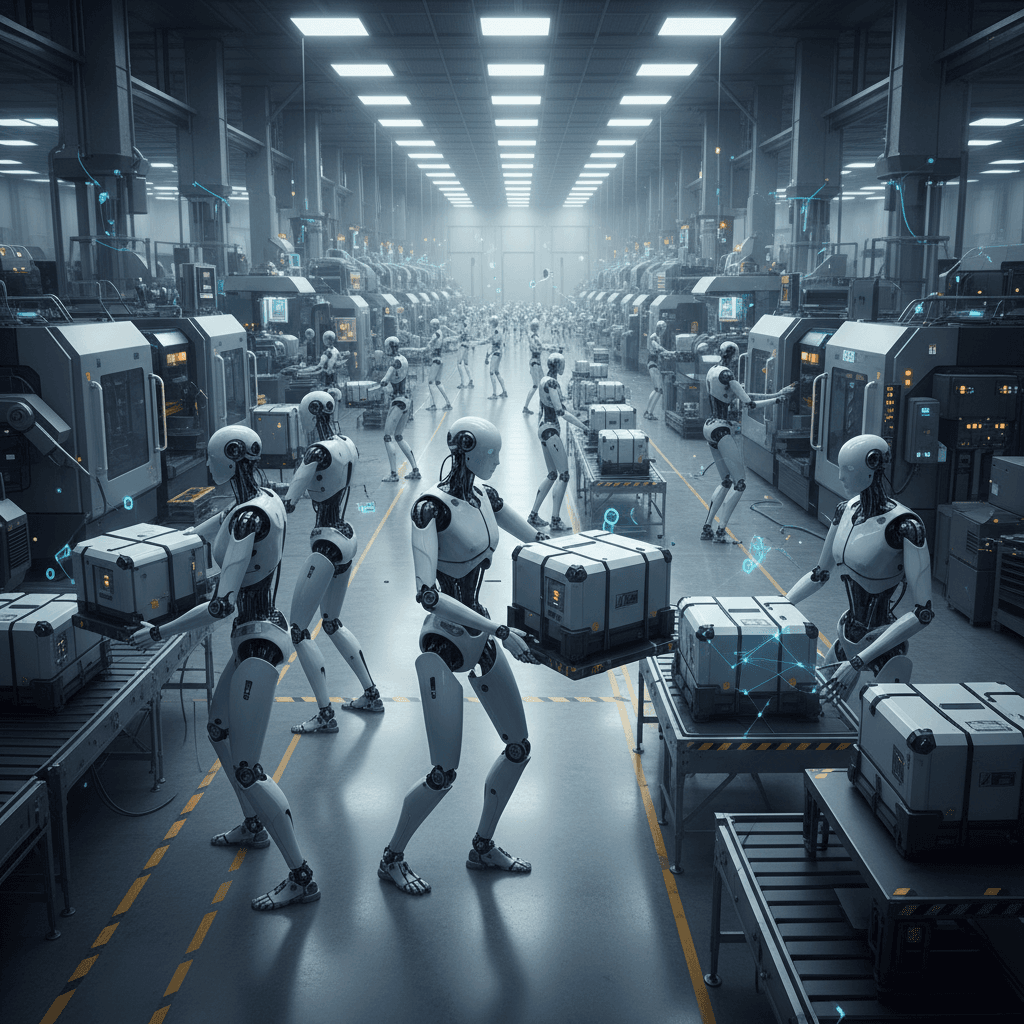
The emergence of physical artificial intelligence is transitioning from a conceptual milestone to a concrete industrial reality as manufacturers move beyond small-scale pilot programs toward massive, multi-year deployments. At the center of this shift is a landmark agreement between the British technology firm Humanoid and the German industrial giant Schaeffler.[1][2][3] The partnership represents one of the most significant commitments to general-purpose robotics in the manufacturing sector to date, with plans to integrate between 1,000 and 2,000 humanoid robots into Schaeffler’s global production network by 2032.[2] This deal underscores a pivotal moment for the robotics industry, as legacy industrial suppliers and agile AI startups align to solve the dual challenges of chronic labor shortages and the need for more flexible automation.
Unlike the stationary robotic arms that have defined automotive and industrial assembly lines for decades, these new systems represent a leap toward embodied or physical AI.[4] These machines are designed to operate in environments built for humans, using the same tools and navigating the same aisles without requiring a total redesign of factory floor layouts.[5] The agreement between Humanoid and Schaeffler is structured around a Robot-as-a-Service model, a financial framework that allows industrial firms to treat robotics as an operational expense rather than a massive upfront capital investment. This model includes comprehensive fleet management, 24/7 technical support, and continuous software updates, ensuring that the robots' capabilities evolve as the underlying AI models improve.
The first phase of this deployment is scheduled to begin at two of Schaeffler’s major German sites.[2][1][3][6] In Herzogenaurach, the focus will be on box handling within a live production environment, a task that has traditionally been physically demanding and repetitive for human workers. Simultaneously, at the Schweinfurt facility, the partnership will conduct capability demonstrations and integration testing aimed at validating stable, continuous operations at a full production scale.[6][1] These early steps are intended to prove that humanoid robots can handle the variability of a modern factory, where parts, packaging, and logistics paths are rarely as static as they are in laboratory settings.
A unique aspect of the Humanoid-Schaeffler deal is its reciprocal nature. While Humanoid provides the silicon brains and robotic platforms, Schaeffler will serve as a preferred supplier for the high-precision actuators—the specialized motors that move robotic joints—for Humanoid’s future wheeled platforms. This supply pact is expected to cover a seven-digit number of actuators through 2031, indicating that Humanoid is preparing for a production scale far beyond the initial Schaeffler rollout.[1] This vertical integration highlights a growing trend in the industry: robotics firms are securing their supply chains by partnering with the very industrial giants they are seeking to automate. For Schaeffler, the move allows them to diversify their revenue streams, hedging against volatility in the automotive sector by becoming a foundational player in the robotics supply chain.
The momentum at Schaeffler is reflective of a broader, hyper-competitive landscape where the world’s largest corporations are racing to field their own robotic workforces. BMW has been testing Figure AI’s humanoid systems at its Spartanburg plant in South Carolina, where the robots use neural networks to map pixels from their cameras directly to precise actions, such as loading sheet metal. Mercedes-Benz has entered a similar collaboration with Texas-based Apptronik to deploy the Apollo humanoid for kit delivery and quality inspections.[7] Even logistics leaders like Amazon have begun trialing Agility Robotics’ Digit, a bipedal machine designed to move empty totes and navigate the cramped corridors of fulfillment centers. These companies share a common motivation: the global manufacturing sector is facing a projected shortage of millions of workers by the end of the decade, a gap that traditional automation simply cannot fill.
The technical catalyst for this acceleration is the convergence of high-performance hardware and "foundation models" for movement. In the past, programming a robot to pick up a box required thousands of lines of rigid code; today, physical AI utilizes large behavior models that allow robots to learn through imitation and reinforcement. By observing human teleoperation or training in massive physics-accurate simulations, these robots are developing a level of "common sense" regarding physical interaction. They are learning to adjust their grip when an object is slippery, to navigate around unexpected obstacles, and to correct their own mistakes without human intervention. This shift from task-specific programming to general-purpose learning is what enables a single robot to potentially handle box moving in the morning and quality inspection in the afternoon.
However, the path to full-scale commercialization remains fraught with technical and economic hurdles. While unit costs are declining—with some analysts predicting that humanoid prices could fall from six figures to the range of a mid-sized sedan by 2030—reliability remains a critical concern. A robot dropping a tray in a service setting is a minor inconvenience, but a humanoid causing a collision on a high-speed production line can lead to millions of dollars in downtime or pose significant safety risks to human coworkers. This is why the phased approach adopted by Schaeffler and Humanoid is so crucial. The industry is currently in a validation era, where the primary objective is to prove that these machines can achieve a "mean time between failures" that makes them economically viable compared to human labor.
The geopolitical dimension of this race is also becoming more pronounced. While Western firms like Tesla, with its Optimus project, and Figure AI are leading in terms of sophisticated software and AI reasoning, China has rapidly emerged as a manufacturing powerhouse for robotic hardware. Some reports suggest that Chinese manufacturers already account for a vast majority of global humanoid shipments, leveraging an existing electronics supply chain to produce components at a fraction of the cost of Western competitors. This has created a sense of urgency among European and North American firms to establish domestic manufacturing footprints and secure strategic partnerships, like the one between Humanoid and Schaeffler, to ensure they are not left behind in what is being termed the "next smartphone-sized" market.
As these robots move closer to the factory floor, the economic implications are profound. Goldman Sachs Research has projected that the global humanoid market could reach $38 billion by 2035, with shipments scaling into the hundreds of thousands annually.[8][4] While there are understandable concerns regarding job displacement, many industry leaders argue that humanoids will primarily fill the roles that humans no longer want to perform—the "dull, dirty, and dangerous" tasks. By automating the most physically taxing parts of the assembly process, companies hope to retain their aging human workforces longer while maintaining productivity in regions with declining birth rates.
The successful deployment of thousands of robots at Schaeffler over the next several years will serve as a bellwether for the entire physical AI industry. If these machines can prove their worth in the high-stakes environment of a global industrial supplier, it will pave the way for a rapid expansion into other sectors, including healthcare, retail, and eventually domestic assistance. We are currently witnessing the transition of AI from the digital world of screens and text into the physical world of motion and labor.[9][8] The partnership between a young British AI startup and a centenarian German engineering firm may well be remembered as the moment the factory floor changed forever, signaling the dawn of an era where the line between human and machine work becomes increasingly, and permanently, blurred.