
Pharma giants reap billions from operational AI as drug discovery hits biological roadblocks
While automated discovery hits biological barriers, pharmaceutical giants are finding multi-billion-dollar returns in manufacturing and administrative efficiency.
May 5, 2026
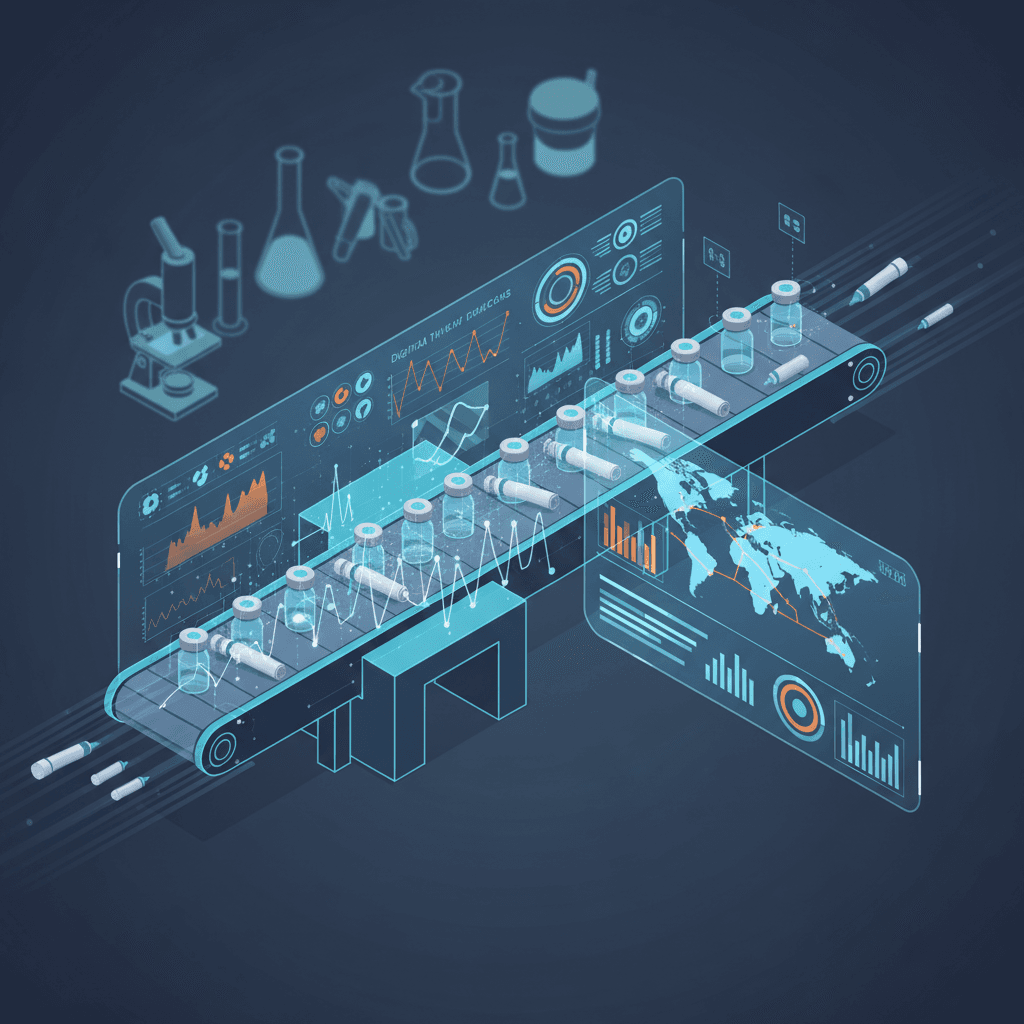
For decades, the pharmaceutical industry has pursued a singular, high-stakes dream: a world where artificial intelligence can conjure life-saving medicines with a few lines of code, bypassing the grueling, expensive, and often failing process of traditional laboratory research. This vision of an automated "miracle lab" has driven billions of dollars in venture capital and sparked high-profile partnerships between legacy drugmakers and tech giants. However, as the initial dust of the generative AI boom settles, a new and far more pragmatic reality is emerging. While the lab remains a stubborn fortress of biological complexity that AI has yet to conquer, the technology is delivering a massive, multi-billion-dollar payoff in the most unglamorous corners of the industry—the factory floor, the supply chain, and the administrative back-office.
The shift in sentiment was recently articulated by the leadership of Eli Lilly, the world’s largest pharmaceutical company.[1][2] Digital executives at the firm have observed that while AI is paying off nearly everywhere else in the business, it has barely moved the needle in the area where the industry hyped it most: drug discovery.[3] This candid assessment reflects a broader industry-wide recalibration.[4] For years, the narrative focused on AI-designed molecules and the promise of slashing the decade-long development cycle for new drugs. Yet, despite the massive investment, the industry still faces a persistent 90 percent failure rate for experimental drugs in clinical trials.[3][4] Even the most advanced AI pioneers, some founded over a decade ago, have yet to bring an AI-developed drug to the commercial market. The bottleneck, it appears, is not just the speed of design, but the fundamental, slow-moving reality of human biology that no algorithm can yet bypass.
In contrast to the slow progress in the lab, the manufacturing sector of the pharmaceutical industry is undergoing a quiet revolution. To meet the unprecedented demand for weight-loss and diabetes treatments, companies like Eli Lilly have turned to AI-powered "digital twins" to optimize production.[1] By creating a virtual replica of a physical factory, engineers can use machine learning to simulate thousands of variables, such as temperature and pressure combinations, to identify the most efficient production parameters. This approach has allowed manufacturers to boost output and shorten production cycles without the risk of real-world equipment failure. In the case of popular GLP-1 medications, AI-driven manufacturing optimizations have reportedly generated enough additional product to be materially significant to corporate earnings—a tangible, immediate return on investment that remains elusive in the research and development phase.
The operational impact extends beyond production volume into the realms of quality control and waste reduction. Traditional drug manufacturing involves rigorous, manual inspection processes that are prone to human error. Modern AI systems now monitor production lines in real-time, using high-speed cameras to take dozens of photographs of every single auto-injector or vial in a matter of milliseconds.[5] These systems can detect microscopic defects far more accurately and faster than any human team, significantly reducing the amount of wasted material and ensuring higher safety standards. Sanofi, for instance, has implemented in-house AI solutions that learn from past batch performance to consistently drive higher yield levels.[6][7][8] By moving from reactive to proactive maintenance, these companies are preventing the costly downtime that often follows equipment failure, saving millions of dollars per facility annually.
Perhaps the most surprising win for AI has been in the administrative and back-office functions of the pharmaceutical giants. These enterprises are notoriously bogged down by vast amounts of documentation, regulatory filings, and complex procurement networks.[9] Sanofi has emerged as a leader in this space with its "plai" app, a company-wide platform that aggregates over a billion data points across all business functions. Used daily by more than 20,000 employees, the app provides a "360-degree view" of operations, from research costs to supply chain logistics.[6] In the supply chain alone, the tool can predict 80 percent of potential low-inventory situations, allowing teams to secure materials and adjust logistics before a shortage occurs. This level of decision intelligence has reportedly doubled the speed of decision-making in several departments, turning what were once month-long processes into tasks that take just days or hours.
Administrative efficiency is also finding a home in the grueling world of regulatory compliance. Preparing the thousands of pages required for FDA submissions has historically required an army of specialized writers and lawyers. Now, generative AI models are being used to synthesize clinical trial data and draft initial reports, allowing human experts to focus on verification rather than data entry. Similarly, Novartis has implemented AI-driven procurement systems to manage its massive global spend. Their "Buying Engine" uses machine learning to predict demand for thousands of different stock units across various geographies, enabling better contract negotiations and an estimated five percent annual saving on procurement costs.[10] These incremental gains, while less spectacular than a new cure, are cumulatively worth billions to the industry's bottom line.
The disconnect between operational success and lab-based struggle highlights the inherent difficulty of applying AI to biology. In the back-office or the factory, AI deals with structured data—dollars, dates, and mechanical tolerances—where patterns are relatively predictable. Biology, however, is a chaotic system of trillions of interactions that scientists still only partially understand. As digital chiefs have pointed out, even if an AI can design a perfect molecule in 18 months, the industry must still wait for the "biology to work" during human trials, which take years and cannot be simulated with enough accuracy to satisfy regulators. This "biological barrier" means that the timeline for bringing a drug from discovery to the patient remains largely unchanged, even as the initial design phase accelerates.
This realization is forcing a strategic shift in how pharmaceutical companies communicate with investors.[11] The "Ferrari engine" of discovery AI is of limited use if it is attached to a "broken pipeline" of legacy operational systems. Industry analysts now estimate that while AI in drug discovery could eventually become a multi-billion dollar market, the immediate $90 billion in potential industry savings over the next five years will largely be driven by these operational and manufacturing efficiencies. Executives are moving away from "isolated pilots" in R&D and toward "scaling for results" across the entire enterprise.[11][12][13] The focus has shifted from the "Holy Grail" of discovery to the "plumbing" of the business, where the ROI is clear, measurable, and immediate.
Ultimately, the current state of AI in pharma serves as a reality check for the broader technology industry. It demonstrates that the most publicized and hyped use cases for a new technology are not always the ones that provide the most value in the short term.[3][14][9] While the dream of AI-discovered blockbuster drugs remains a long-term goal, the technology is currently finding its greatest success in the mundane but essential work of keeping factories running, supply chains moving, and offices organized. By saving billions in these "unsexy" areas, AI is not failing the pharmaceutical industry; it is providing the financial and operational foundation that may one day allow the lab-based revolution to finally take hold. For now, the real intelligence in pharma isn't just in finding new cures, but in the efficiency of the machine that delivers them.
Sources
[1]
[2]
[4]
[8]
[10]
[11]
[12]
[13]