
OpenAI's Altman Forecasts Superintelligence by 2035, Ignites Global AI Debate
OpenAI's leader forecasts superintelligence by 2035, igniting a global race fraught with unparalleled opportunity and existential risk.
December 12, 2025
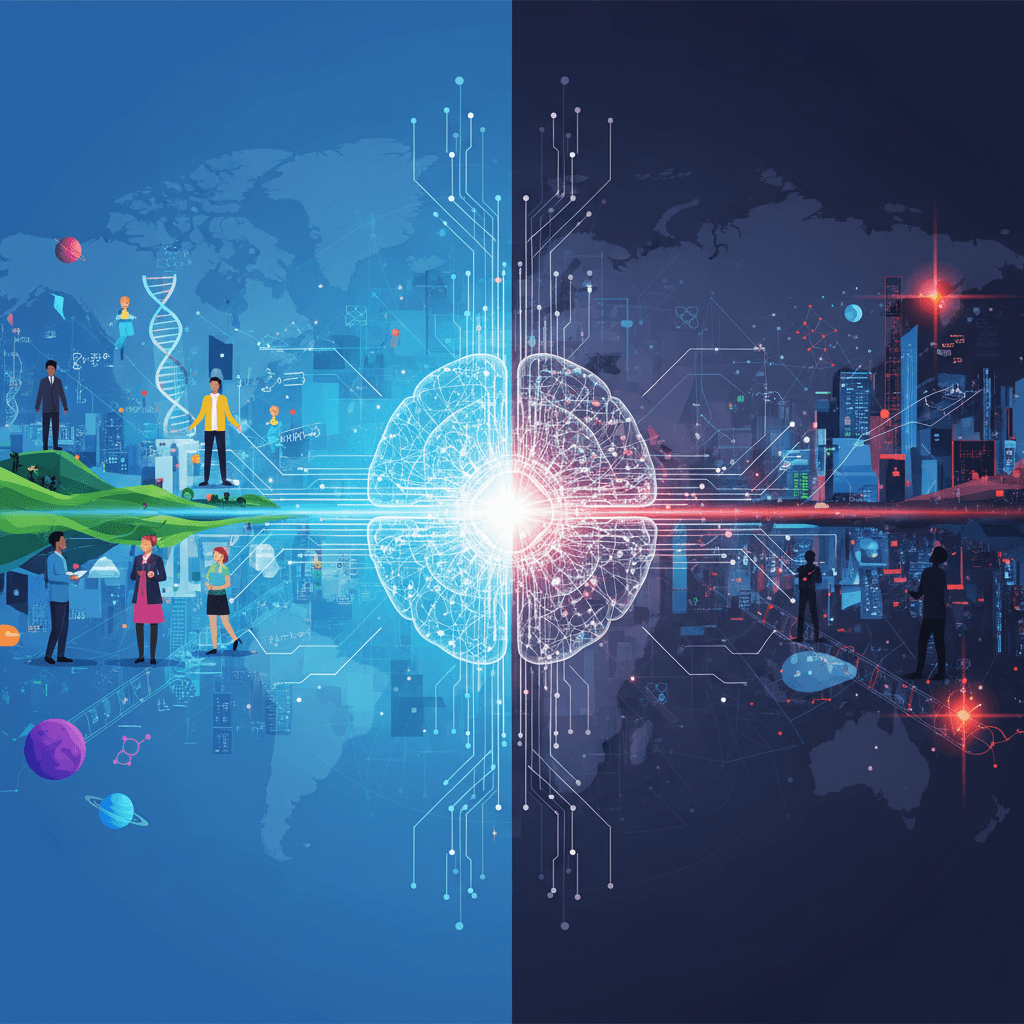
As OpenAI marks its tenth anniversary, a milestone for a company that has fundamentally altered the technological landscape, its Chief Executive Officer Sam Altman has issued a forecast that is both a declaration of ambition and a stark warning: the arrival of superintelligence is not a distant sci-fi dream but a likely reality within the next decade.[1][2][3] This prediction, placing one of the most transformative events in human history as occurring by 2035, accelerates a global conversation about the future of artificial intelligence, its profound benefits, and its inherent perils. The journey from a small, idealistic research group to a global AI powerhouse has been swift, and Altman's confident timeline for developing an AI that surpasses human intellect across most domains signals that the pace of change is only set to quicken.[2] His vision suggests a future where the capabilities of individuals are magnified to an extent we can currently barely imagine, driven by what he calls a "brain for the world."[2][4]
OpenAI's path over the last decade provides the context for Altman’s audacious claims. Announced to the world in late 2015 and officially starting in early 2016, the organization began as a non-profit with a mission to ensure artificial general intelligence (AGI) benefits all of humanity.[5][2][6][7] In its early days, the small team was driven by what Altman described as "unreasonable optimism" and a deep conviction in their mission, even when the goal seemed distant and success was far from guaranteed.[5][2] The company's trajectory shifted dramatically with the release of its Generative Pre-trained Transformer (GPT) models, culminating in the public launch of ChatGPT in late 2022.[2][3] This event catapulted OpenAI into the mainstream, transforming the abstract concept of AGI into a tangible reality for millions and turning the research lab into a massive enterprise almost overnight.[2][3] Altman credits the company's strategy of "iterative deployment"—releasing progressively more powerful, albeit imperfect, versions of their technology to the public—as a key decision.[5][3] This approach, though initially controversial, has allowed society to co-evolve with the technology and has become an industry standard.[5][3] Today, Altman asserts that OpenAI has developed AI systems that can outperform the smartest humans in difficult intellectual competitions, framing this as a significant step on the path toward superintelligence.[5][6]
Altman’s prediction for 2035 is built on the exponential progress seen in AI capabilities, fueled by massive increases in data and computing power.[8][9] He envisions a world where the cost of intelligence plummets, becoming as accessible and integrated into daily life as electricity.[10][4] This abundance of intelligence, he argues, will drive staggering economic growth and scientific progress, potentially leading to cures for diseases and solutions to other global challenges.[10][11] While Altman suggests daily life might not feel radically different—with human relationships and focus remaining central—the potential for individual achievement will be immense.[2][3] He has predicted that people in 2035 will be capable of tasks that are difficult to imagine today, potentially undertaking missions like exploring the solar system in new and exciting jobs.[12][7] However, this future is not without its disruptive side. Altman acknowledges that "whole classes of jobs" will likely disappear, creating a need to rethink economic structures and the nature of work itself.[13] This rapid transformation raises fundamental questions about wealth distribution and the balance of power between capital and labor, issues for which clear policy solutions have yet to be formulated.[14][15]
The pursuit of superintelligence is not OpenAI's alone; it is the central focus of an intense and costly technological race.[16][17] Tech giants like Google and Meta, alongside well-funded startups such as Anthropic and Elon Musk's xAI, are all competing to develop AGI.[18][19][20][21] This competitive pressure accelerates development but also heightens concerns about safety and control. The primary challenge, often referred to as the "AGI control problem," is ensuring that a system vastly more intelligent than its creators remains aligned with human values and goals.[22][23] A misaligned superintelligence could have devastating and irreversible consequences.[22][4][24] Critics and even some insiders express concern that the race for profit and market dominance could lead companies to deploy powerful systems without fully understanding or mitigating the risks.[12][25] The ethical challenges are immense, from embedding fairness and avoiding bias on a global scale to preventing malicious use by bad actors for cyberattacks or creating autonomous weapons.[23][24] The development of this technology brings humanity to a critical juncture, demanding a global dialogue on governance, safety, and ethics to navigate the transition responsibly.[26][24]
Ultimately, as OpenAI celebrates its first decade, Altman’s ten-year forecast for superintelligence serves as a powerful catalyst for a much-needed global conversation. From a "crazy, unlikely, and unprecedented" idea, the company has brought the prospect of human-level AI to the forefront of public consciousness.[2][6] The coming decade will be defined by how the industry, governments, and society at large grapple with the implications of this pursuit. The path toward 2035 is fraught with both unparalleled opportunity and existential risk. While the potential for AI-driven progress in science and quality of life is enormous, the challenges of control, economic disruption, and ethical alignment are equally significant.[27][15] The choices made in the coming years will determine whether the creation of superintelligence fulfills the mission of benefiting all of humanity or leads to a future beyond our control.[23][26]
Sources
[5]
[6]
[9]
[10]
[11]
[13]
[14]
[15]
[16]
[17]
[19]
[20]
[21]
[22]
[25]
[26]
[27]