
OpenAI Landmark Report: Enterprise AI Saves Workers Up to an Hour Daily
New report touts AI-driven productivity gains, yet skepticism and a growing skills gap challenge its universal impact.
December 8, 2025
OpenAI has released a landmark report asserting that its generative artificial intelligence tools are saving knowledge workers between 40 and 60 minutes per day on professional tasks.[1][2][3][4] The inaugural “State of Enterprise AI 2025” report, based on a survey of 9,000 employees across nearly 100 organizations, paints a compelling picture of accelerated AI adoption and substantial productivity gains within the corporate world.[1][2][4] According to the findings, 75% of enterprise workers reported that AI improved either the speed or the quality of their work.[1][2][3][4][5] This declaration comes at a critical juncture for the AI industry leader, as it navigates intensifying competition and seeks to solidify the business case for widespread enterprise AI integration.[1][6]
The report details a significant surge in the integration of AI into daily business operations, suggesting a shift from casual experimentation to deep, systematic use.[2][4][5] OpenAI highlights an eightfold increase in weekly messages within its ChatGPT Enterprise platform over the past year, with the average user sending 30% more messages.[4][5] More structured and repeatable workflows are also on the rise, with the use of "Custom GPTs" and "Projects" growing 19-fold in 2025.[2][4][5] These customized environments now handle approximately 20% of all enterprise messages, indicating a move towards standardizing AI for professional use.[7] The data suggests that companies are deploying AI for increasingly complex and sophisticated tasks, a trend underscored by a reported 320-fold growth in the consumption of "reasoning tokens" via its API.[4][6]
The productivity benefits detailed in the report vary across different professional roles. Data science, engineering, and communication professionals reported the highest average time savings, reaching up to 80 minutes daily.[7][8] The impact is felt across departments, with 87% of IT workers reporting faster issue resolution and 85% of marketing and product teams executing campaigns more quickly.[1][5][8] Furthermore, 73% of engineers noted faster code delivery.[5][8] Beyond just speed, the report claims AI is expanding worker capabilities. A significant 75% of users reported that AI enables them to complete tasks they previously could not, with a notable 36% increase in coding-related messages from employees outside of traditional technical roles.[6][5][9] The data also suggests a direct correlation between the breadth of use and the benefits received; users who applied AI to seven distinct types of tasks reported saving five times more time than those who used it for only three or four.[7][9]
However, the optimistic findings from OpenAI's self-published report are met with considerable skepticism from independent researchers and industry analysts.[10] Critics are quick to point out that the report is not peer-reviewed and functions as a powerful marketing tool released shortly after academic studies cast doubt on the return on investment from enterprise AI.[3][10][11] An August study from MIT, for instance, found that the vast majority of organizations saw zero return from their generative AI initiatives.[3][10][11] Researchers from Harvard and Stanford introduced the term "workslop" to describe AI-generated content that appears productive but lacks the substance to meaningfully advance tasks.[10][11] Scrutiny has also been applied to OpenAI's methodology, which surveyed workers just three to four weeks into their use of the platform, potentially capturing initial enthusiasm rather than sustained, long-term value.[10] The reliance on self-reported time savings is another point of contention, as individuals often overestimate the efficiency gains from new tools.[10]
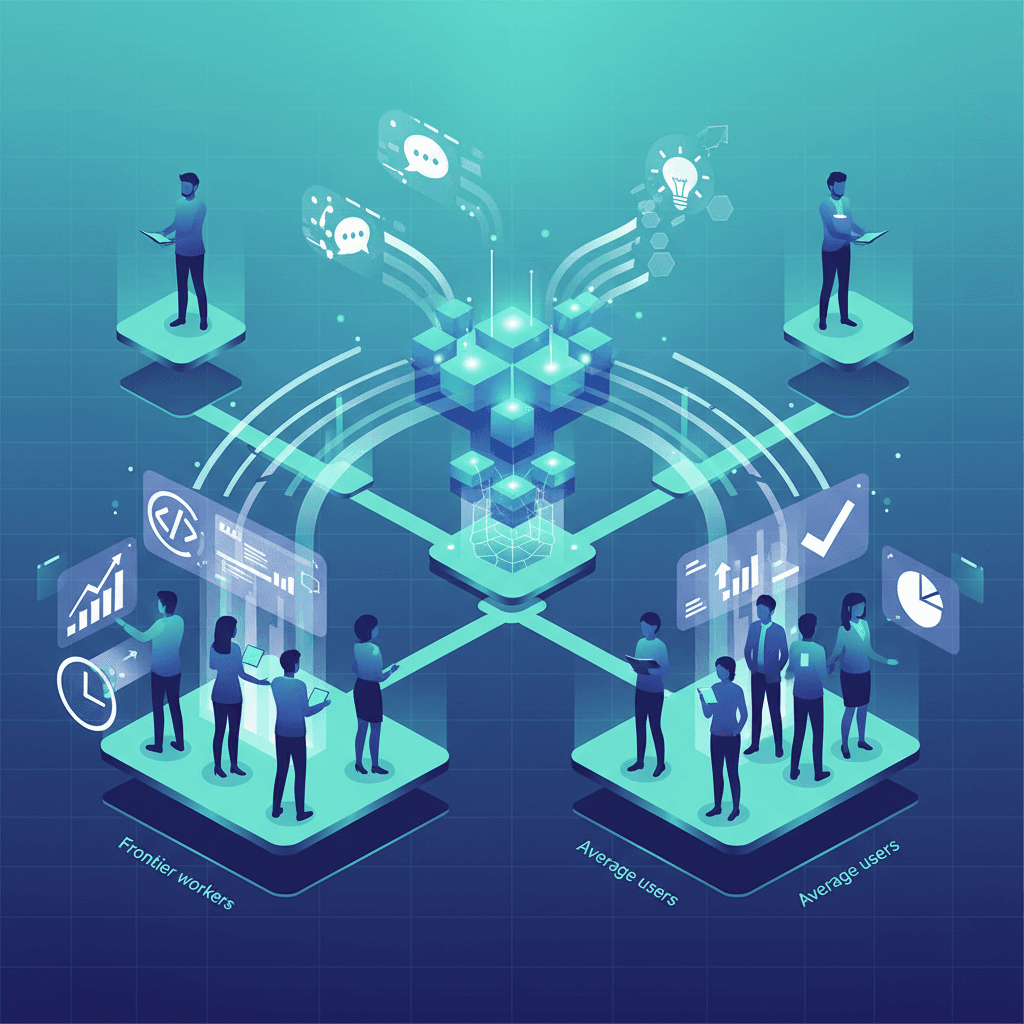
The report also sheds light on a growing divide in AI adoption, distinguishing between average employees and a cohort of "frontier" workers.[4][5] This top 5% of users sends six times more messages than the median employee and engages more deeply with advanced features.[4][5][10] This disparity suggests that the remarkable productivity gains are not evenly distributed, but are instead concentrated among a small minority of highly engaged users.[10] This creates a potential skills gap within organizations, where some employees extract immense value from AI while others lag behind, using it only for simple tasks.[6] This trend of uneven adoption is a critical challenge for businesses aiming to leverage AI at scale, as it indicates that simply providing access to the tools is insufficient to unlock their full potential.[6][12]
In conclusion, OpenAI's report presents a strong, data-backed narrative for the transformative potential of generative AI in the workplace, claiming tangible time savings and enhanced capabilities for knowledge workers. The findings suggest that enterprise AI is rapidly moving beyond a novelty phase into a period of deep integration and measurable impact. However, this industry-led research must be viewed within the broader context of independent academic skepticism and questions surrounding its methodology. While the potential for productivity gains appears significant, especially for advanced users, the path to realizing these benefits universally across an organization is complex. The emergence of a skills gap and debates over the true return on investment highlight the ongoing challenges and the critical need for objective, peer-reviewed analysis as the AI revolution continues to unfold within the enterprise.