
OpenAI Adopts Ads for ChatGPT; Anthropic Stakes Future on Ad-Free Trust
Generative AI splits: OpenAI adopts ads for scale while Anthropic bets on B2B trust and ad-free integrity.
February 4, 2026
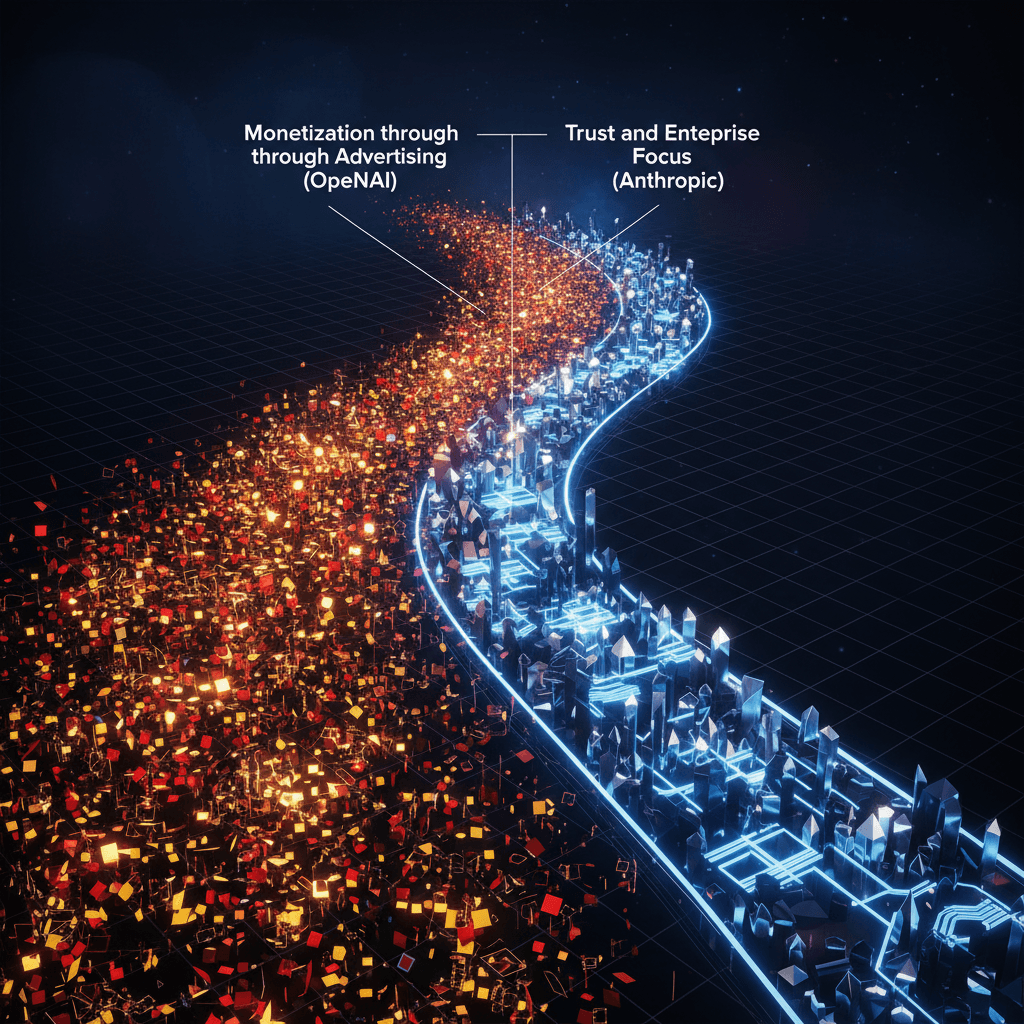
The landscape of generative artificial intelligence is undergoing a critical strategic divergence as industry rivals Anthropic and OpenAI commit to fundamentally different monetization models, setting the stage for a competitive battle focused as much on user trust and integrity as on technological capability. OpenAI, the creator of the widely popular ChatGPT, is moving forward with plans to introduce advertising into its conversational AI platform, while Anthropic has taken a staunchly opposing stance, publicly pledging to keep its Claude chatbot permanently ad-free. This contrasting approach reflects a broader philosophical split in the fledgling AI economy and will have significant implications for user experience, data privacy, and the future of enterprise AI adoption.
OpenAI’s decision to integrate advertising into ChatGPT is a calculated move to subsidize the immense operational costs of large language models and monetize its massive, predominantly free user base. The company has confirmed that advertisements will appear on the free version of ChatGPT and the lower-cost ‘Go’ tier, but premium subscriptions like Plus, Pro, Business, Enterprise, and Edu accounts will remain ad-free, maintaining a clear value proposition for paid users.[1][2][3] The rollout is planned to begin with internal testing in the United States, with a promise that ads will be "clearly labeled" and visually separated from the chatbot's actual responses to avoid confusion, and that they will not influence the content generated by the AI.[1][4][3] Furthermore, OpenAI has pledged to uphold user privacy by not selling conversation data to advertisers and by allowing users to turn off ad personalization.[1][4][3] However, the reported pricing model for ChatGPT advertisements suggests a high-end inventory, with early reports indicating a cost-per-thousand-impressions (CPM) around $60, a rate comparable to premium television and live sports, significantly higher than typical social media ad platforms.[5] This aggressive pricing suggests a strong conviction in the unique value of conversational ad placement, where advertisements could be contextually relevant to a user's query and potentially woven into sidebar displays or even sponsored information within responses, despite the company's promise of answer independence.[2]
In direct opposition to this path, Anthropic has positioned its Claude AI as the premium, integrity-first alternative, drawing a clear line in the sand by committing to an entirely ad-free experience.[6][7][8] The company has framed its decision as one rooted in user trust, arguing that the introduction of sponsored links into a personal conversational space would be "inappropriate" and could compromise Claude's ability to act "unambiguously in users' interests," particularly when offering advice on sensitive topics like health or work.[6][7] This strategic differentiation was amplified through a high-profile advertising campaign, including Super Bowl commercial spots, that explicitly mocked rival AI chatbots for interrupting conversations with sponsored content, putting Anthropic squarely in the role of the user-advocate.[6][7] By rejecting the digital advertising model that dominates the tech industry—as evidenced by giants like Google and Meta—Anthropic is staking its long-term growth on a pure subscription and enterprise contract revenue model.[7]
The divergent monetization strategies highlight the fundamental difference in the two companies' target markets and revenue models. OpenAI's consumer-first approach, which led to the viral success of ChatGPT, has resulted in a vast user base—hundreds of millions of weekly active users—with approximately 95 percent of them on the free tier.[2][9] Advertising is a logical mechanism to monetize this scale without relying solely on a conversion to premium subscriptions.[2][4] By contrast, Anthropic has adopted an enterprise-first strategy, focusing on developing safety-focused, reliable, and compliant solutions for corporate clients and regulated industries.[10][9][11] This focus on the business-to-business (B2B) market, prioritizing features like security and corporate integration with products like Claude Enterprise, has resulted in a significantly higher revenue per user.[9][11] While OpenAI has a larger market share overall, Anthropic's emphasis on enterprise needs and coding applications has yielded a high rate of revenue growth, projecting billions in annual recurring revenue (ARR) and establishing a strong foothold in the enterprise LLM market.[12][9][11] The math illustrates this difference starkly: one analysis suggested Anthropic generated an exponentially higher amount of revenue per monthly user compared to OpenAI's revenue per weekly user, reflecting the premium value of its enterprise-focused positioning.[9]
The implications of this schism are profound for the broader AI industry. Anthropic's decision to forgo advertising positions it as a 'trusted' and 'neutral' provider, a significant advantage in sectors requiring high levels of data integrity and reliability, such as finance, legal, and government, where the appearance of commercial bias could be catastrophic.[10][11] The promise of an ad-free experience serves as a unique selling proposition in a world saturated with digital marketing, potentially luring power users and enterprises away from a ChatGPT experience that, while more accessible, is now explicitly commercialized for its free users. Furthermore, the introduction of advertising raises a central ethical and technical challenge for OpenAI: ensuring the clear separation of church and state between the AI’s core function and its revenue engine. Although OpenAI has promised answer independence, the structural pressure to subtly or overtly integrate sponsored content remains a concern for critics, who fear that financial incentives could eventually bias an AI's advice. Anthropic is betting that this fundamental tension is a decisive weakness for its competitor. This strategic fork in the road indicates that the generative AI market is maturing not just in technology, but in business model segmentation, suggesting that success will not be a winner-take-all scenario but one where consumer-scale and enterprise-stickiness will define different, yet equally viable, paths to long-term profitability.[9][11]
Sources
[1]
[2]
[3]
[4]
[6]
[9]
[10]
[11]
[12]