
Nvidia CEO Jensen Huang slams tech leader god complex while framing AI as job creator
Nvidia’s CEO critiques tech industry doomerism, reframing AI as a powerful engine for job creation and human empowerment.
May 2, 2026
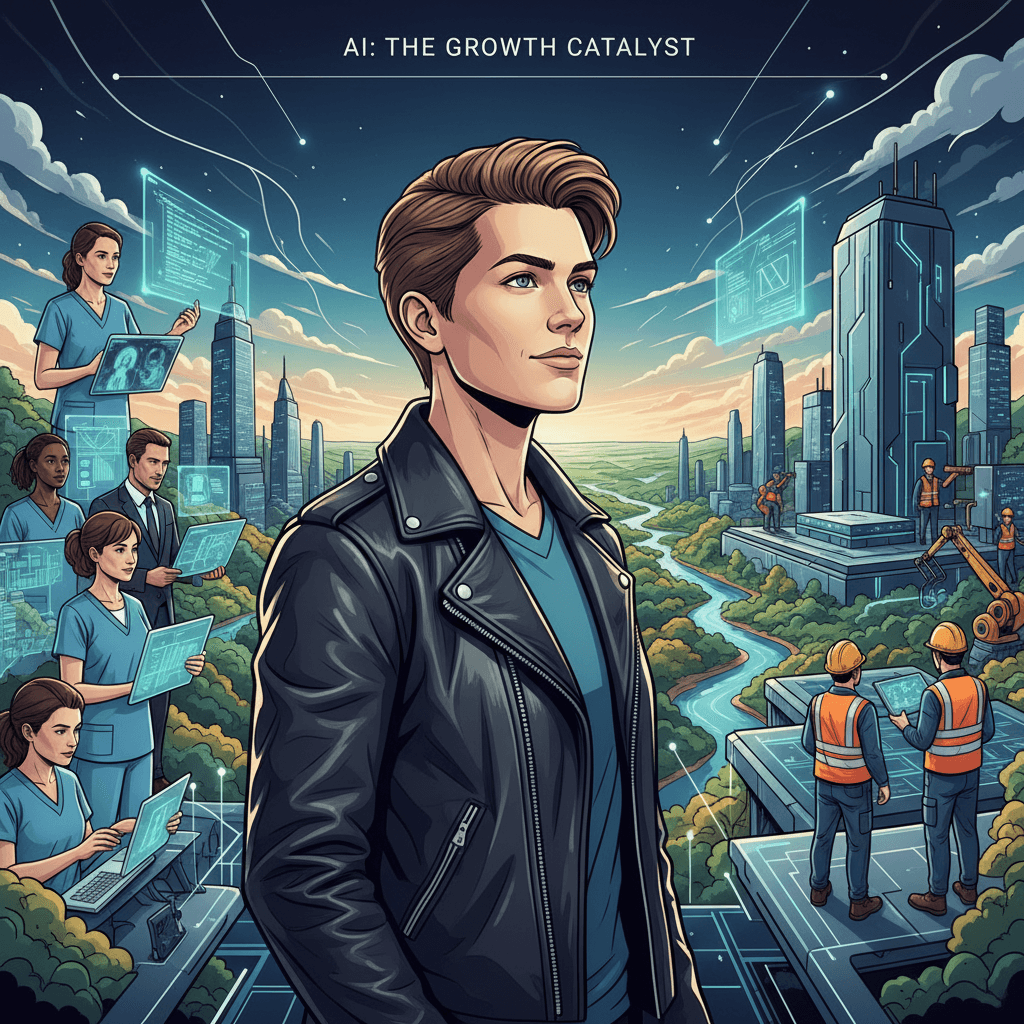
Nvidia CEO Jensen Huang has issued a sharp critique of fellow technology leaders, accusing them of harboring a "god complex" when making alarmist predictions about artificial intelligence causing widespread, permanent job losses.[1] Speaking at a series of industry summits and panels, including a high-profile appearance at the Stanford Graduate School of Business and the World Economic Forum, Huang argued that the current wave of "AI doomerism" is not only factually incorrect but actively harmful to society. By painting a future where human labor is obsolete, Huang contends that influential figures are discouraging the next generation from pursuing vital careers, potentially creating a self-fulfilling prophecy of talent shortages in fields ranging from software engineering to healthcare. The billionaire executive, whose company provides the essential hardware for the modern AI revolution, is now positioning himself as a primary counter-voice to the narrative of a "white-collar apocalypse," framing AI instead as an unprecedented engine for economic growth and human empowerment.
The core of Huang’s frustration lies in what he describes as the hubris of executives who believe their leadership of tech companies grants them the foresight to predict the total collapse of the labor market. Huang noted that simply because an individual becomes a CEO, they often adopt a mindset where they believe they know everything about the future trajectory of society.[1] He specifically targeted the practice of "talking young people out of future careers" by telling them that AI will soon replace their chosen professions. This rhetoric, according to Huang, does real damage by causing students to abandon studies in computer science, medicine, and the arts under the mistaken belief that those skills will be useless in five to ten years. He warned that this scaremongering costs jobs today by stifling the very innovation and investment needed to make AI safer and more productive. Instead of a future where humans are replaced by "alien" or "conscious" entities, Huang maintains that AI should be viewed as what it truly is: sophisticated computer software designed to augment human capability.[2][3][4]
To illustrate the danger of these reckless predictions, Huang frequently points to the field of radiology as a cautionary tale of failed tech prophecies. Over a decade ago, prominent AI researchers, including Geoffrey Hinton, famously predicted that the training of radiologists should stop immediately because AI would soon outperform them in scan analysis. However, as Huang observes, while AI has indeed been integrated into nearly every corner of modern radiology workflows, the world is currently facing a significant shortage of radiologists rather than a surplus.[1] This discrepancy arises because doomers often fail to distinguish between a job’s tasks and its ultimate purpose.[1] In the case of a radiologist, the task is reading an image, but the purpose is diagnosing disease and managing patient care. By automating the time-consuming task of image analysis, AI has allowed radiologists to process more patients more accurately, which has increased the overall demand for the profession.[5] Huang applies this same logic to software engineering; while AI can now write code faster than any human, the "purpose" of an engineer is to solve complex problems and build new things. He noted that at Nvidia, engineers are "busier than ever" because the time saved by AI tools allows them to tackle larger, more ambitious projects that were previously unimaginable.[6]
Beyond the philosophical debate, Huang provides specific economic data to support his optimistic outlook, asserting that AI has already contributed to the creation of over half a million jobs in recent years.[7] His argument is rooted in the classic relationship between productivity and growth: when companies leverage AI to become more efficient, they do not simply shrink their workforces to save money. Instead, "companies with imagination" use those productivity gains to expand their operations, enter new markets, and innovate, which in turn leads to faster hiring. Huang predicts that the ongoing shift toward AI factories and sovereign AI infrastructure represents the largest infrastructure buildout in human history, estimated to be a multi-trillion-dollar transition.[8] This massive physical expansion is already creating a "gold rush" for traditional tradecraft jobs. He pointed out that the demand for plumbers, electricians, construction workers, and network technicians to build out AI data centers is driving salaries into the six-figure range.[8] This "reindustrialization" effect suggests that AI's impact is not limited to the digital world but is actively revitalizing physical industries and manufacturing sectors.
The vision of the future that Huang promotes is one of a vast "human-AI partnership" rather than a replacement of the workforce.[4][6] He revealed that within the next decade, he expects Nvidia itself to operate with a relatively small core of 75,000 employees supported by a massive fleet of approximately 7.5 million AI agents working around the clock.[3] These agents will handle repetitive, administrative, or highly technical micro-tasks, acting as "digital assistants" that harass and micromanage their human counterparts into higher levels of productivity.[6] In this model, every employee becomes an "AI expert" regardless of their job title.[9] Huang’s advice to the youth is not to fear the technology but to become the most proficient users of it.[10][9] He argues that it is highly unlikely most people will lose their jobs to AI itself; rather, they are at risk of losing their jobs to other humans who know how to use AI effectively.[11] By democratizing access to high-level technical capabilities, AI serves as a "great equalizer," allowing individuals with domain expertise in areas like biology, farming, or carpentry to revolutionize their own industries without needing to be master coders.
Ultimately, Huang’s pushback against the "god complex" of his peers serves as a call for a more grounded and responsible conversation about the future of work. He believes that the relentless focus on "doomsday narratives" and "science fiction scenarios" distracts from the immediate benefits of AI in solving global challenges like energy production, disease diagnosis, and economic stagnation. By reframing AI as a tool that enhances the "human purpose" of a role, Huang intends to shift the narrative from one of fear and subtraction to one of growth and addition.[4] He maintains that as long as society does not "run out of ideas," the productivity gains brought by AI will continue to lift living standards and create more work than they eliminate. The industry's path forward, in Huang’s view, requires tech leaders to abandon the hubris of declaring which careers are "dead" and instead focus on building the infrastructure that will allow every individual to thrive in an AI-augmented world. This transition will require more engineers, more tradespeople, and more innovators than ever before, provided they are not scared away from the future by the very people building it.
Sources
[2]
[3]
[4]
[7]
[10]
[11]