
NBA plans AI transition to automate out-of-bounds calls and eliminate replay delays
The league will use Hawk-Eye technology to automate boundary calls, eliminating costly errors while speeding up game flow.
May 28, 2026
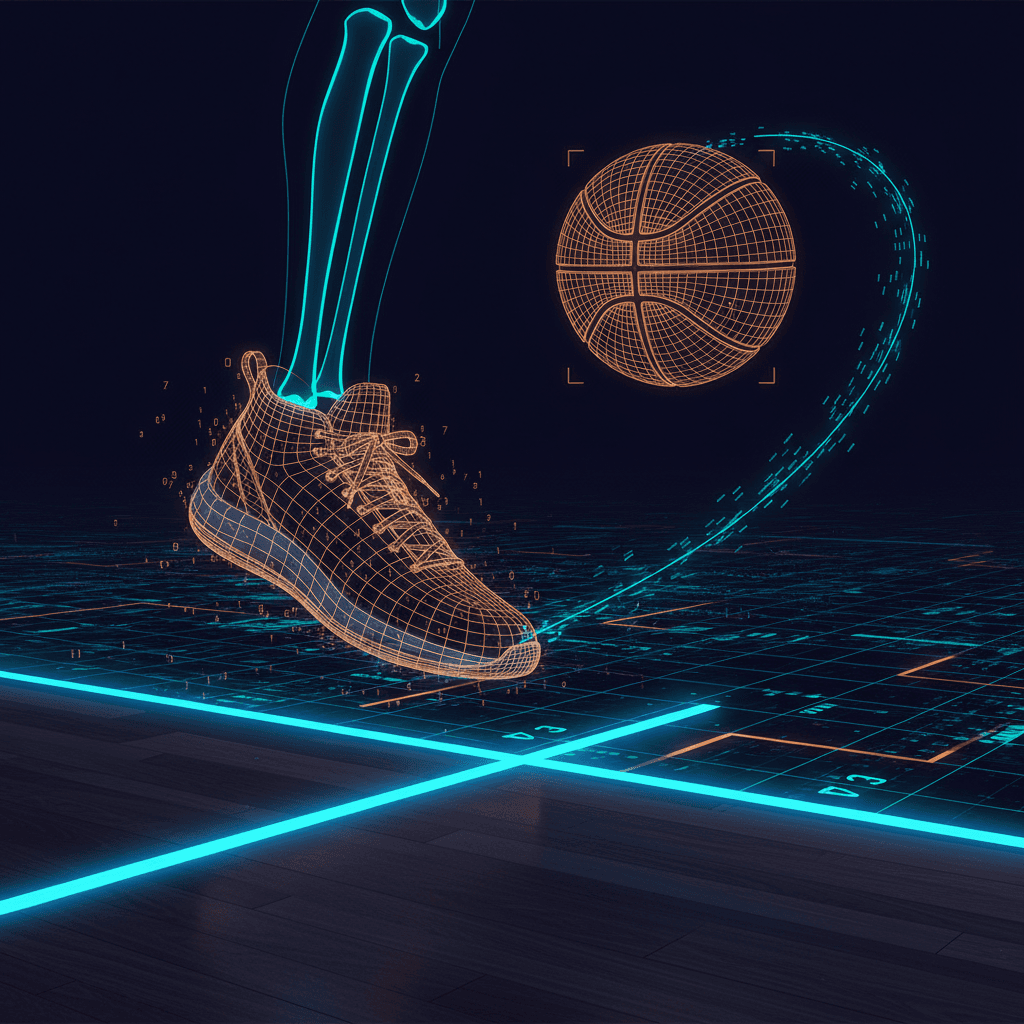
In an era where technology is rapidly redefining the boundaries of professional sports, the National Basketball Association is preparing to make one of its most technologically ambitious leaps yet. NBA Commissioner Adam Silver announced that the league plans to transition to an artificial intelligence system to automatically handle objective officiating decisions, with a primary focus on out-of-bounds calls and possession rulings[1][2]. Speaking on ESPN's "The Pat McAfee Show," Silver revealed a vision where high-stakes game stoppages and long replay delays could become things of the past[1][3]. The proposed system will leverage computer vision and an advanced array of synchronized cameras placed around the court to instantly track player and ball movements[3][2]. By automating these binary, black-and-white decisions, the league aims to streamline game flow, eliminate human error on the baseline, and usher in a new era of automated sports officiating[3][4]. Silver compared the upcoming basketball tracking system to the highly successful Hawk-Eye technology that has long been used to determine line calls in professional tennis and baseball, promising an instantaneous "just play on" experience for players and fans alike[1][5].
The urgency behind this technological shift was underscored by a high-profile officiating controversy during a critical postseason matchup. In Game 5 of the Western Conference Finals between the San Antonio Spurs and the Oklahoma City Thunder, a disputed call late in the third quarter dramatically altered the momentum of the game[2][6]. Spurs center Victor Wembanyama drove toward the lane and lost possession, with the ball flying out of bounds[6]. While on-court officials ruled that Wembanyama touched the ball last, television replays clearly showed the ball bouncing off the foot of Thunder forward Chet Holmgren before crossing the baseline[2][6]. The Spurs bench, led by assistant coach Mitch Johnson, frantically requested a coach’s challenge, but the referees did not grant it in time and instead assessed Johnson a technical foul for his protests[6]. The Thunder retained possession, extended their lead, and went on to secure a crucial victory to take a three-to-two lead in the series[2][6][7]. This glaring error, occurring in one of the most critical stretches of the NBA playoffs, served as a stark reminder of the limitations of human sight and the existing replay review protocols. Silver admitted that such highly visible mistakes are precisely what the league hopes to eliminate by automating objective boundary rulings[2][8].
The technological foundation for this automated future is already being laid through a robust, multi-year partnership between the NBA and Sony's Hawk-Eye Innovations[2]. Originally established in 2023, this collaboration has focused on deploying state-of-the-art three-dimensional optical tracking technology across NBA arenas and during Summer League testing[2]. The Hawk-Eye system operates by utilizing multiple high-frame-rate cameras installed at precise angles around the arena, capturing player and ball coordinates in real time with sub-second latency[2]. This allows the software to generate a continuous, highly accurate digital reconstruction of the court, tracking dozens of joint points on each player's body simultaneously. To determine out-of-bounds plays, the AI algorithm processes the exact microsecond of contact between the ball and a player’s body or footwear relative to the boundary lines. This level of precision goes far beyond what the human eye can process at full speed. By transforming physical court space into a highly synchronized data stream, the league can bypass the traditional, slow-moving process of sending referees to the baseline replay monitors, turning complex possession disputes into immediate, data-driven decisions[3][2].
For the broader artificial intelligence and technology industries, the NBA’s commitment to automated officiating is a massive validation of real-time computer vision and edge computing. The sports world is increasingly turning to sophisticated machine learning pipelines to solve complex operational challenges. Major League Baseball recently introduced its Automated Ball-Strike system to handle pitch-tracking challenges, while global soccer governing body FIFA has successfully implemented semi-automated offside technology at its highest levels of competition[1][2]. Other major leagues are closely observing these developments; both WNBA Commissioner Cathy Engelbert and NHL Commissioner Gary Bettman have recently emphasized the growing role of AI in tracking pucks, balls, and players to refine the viewer experience and improve officiating[9]. The scaling of these technologies represents a lucrative frontier for hardware manufacturers, cloud computing providers, and AI developers who specialize in processing massive volumes of visual data at the edge. The need for sub-second decision-making forces these AI models to run on highly optimized local servers within the arenas, pushing the boundaries of what is possible in ultra-low latency deep learning and real-time spatial analytics.
One of the most compelling aspects of the NBA’s automated future is the deliberate division of labor between artificial intelligence and human officials. Commissioner Silver emphasized that the goal is not to replace human referees entirely, but rather to free them from the burden of making objective calls[5][2]. Decisions like whether a player's foot stepped on the three-point line, whether goaltending occurred, or which player touched an out-of-bounds ball last are strictly binary and can be solved mathematically by computer vision[3]. By shifting these mechanical tasks to an automated system, on-court referees can dedicate their entire cognitive focus to subjective aspects of the game[1][5]. Basketball is a highly physical sport where contact occurs on almost every play, and distinguishing between a legal defensive stance and an illegal impediment requires deep human judgment, context, and experience[5][4]. Referees must also navigate complex player behaviors, such as the controversial practice of flopping or exaggerating contact to deceive the officials[5]. Silver noted that while players are coached to sell contact, there is a fundamental difference between mere exaggeration and outright deception[5]. Evaluating these nuances of human intent and physical force is a task that cameras and neural networks are currently ill-equipped to handle, ensuring that human referees will remain the moral and qualitative core of the game[5][4].
While the transition to a fully automated out-of-bounds system will not happen overnight, the path forward for the NBA is clear. Sports technology experts anticipate that the league will likely pilot the automated system in the developmental G League before deploying it on the main stage, allowing the underlying algorithms to train on a wider variety of real-world scenarios and minimize edge-case errors[1]. However, Silver's public endorsement of the technology signals a definitive culture shift within the upper echelons of professional sports[1][2]. No longer are leagues willing to accept human error as an acceptable variable in multi-million-dollar games, especially when the technological solutions to eliminate those errors are readily available. By blending the unmatched computational accuracy of artificial intelligence with the nuanced judgment of seasoned human referees, the NBA is setting a new global standard for athletic integrity. This balanced approach promises to deliver a faster, fairer, and more entertaining product for basketball fans worldwide, while cementing AI's role as an indispensable partner in the future of professional sports[4][9].