
Musk’s $1.25 Trillion Merger Pivots AI from Earth to Orbital Compute
Musk’s $1.25T monolith merges rockets and AI, leveraging Starlink revenue for a massive financial rescue.
February 3, 2026
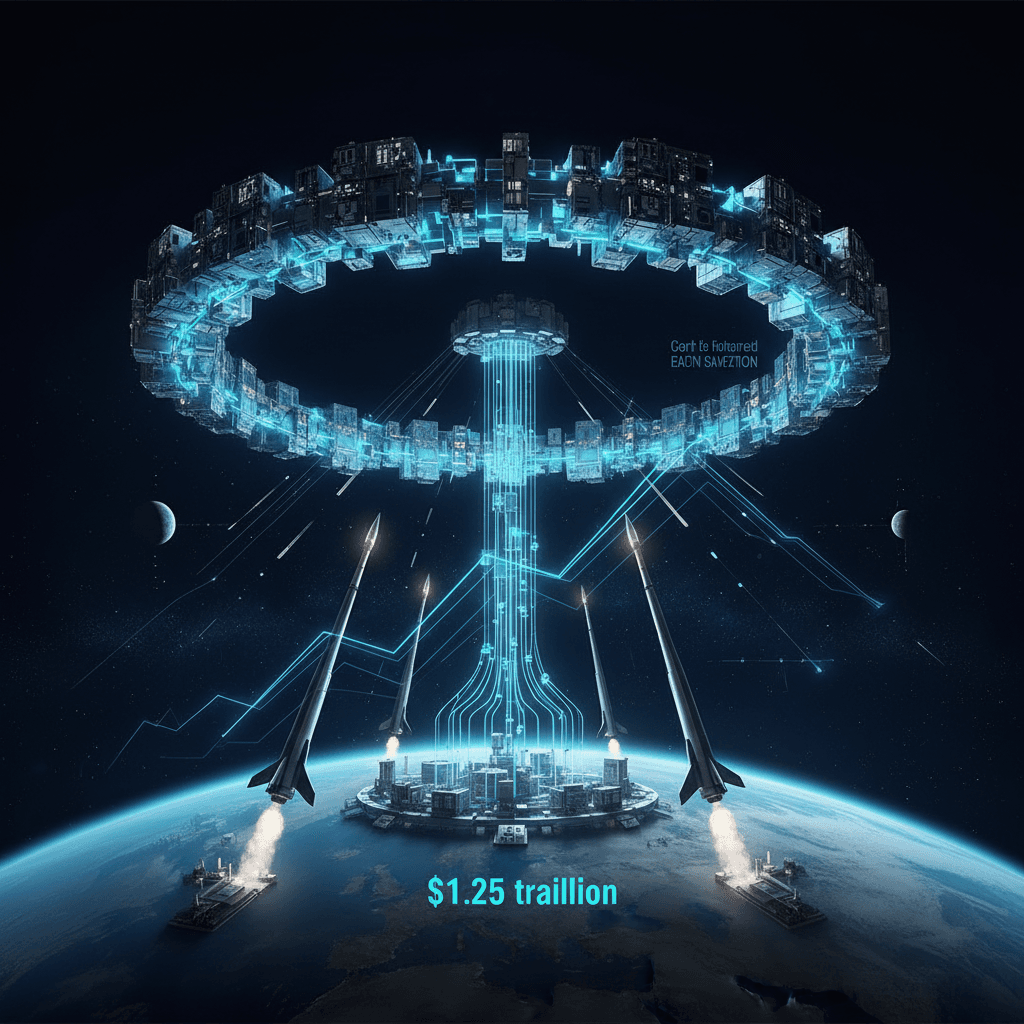
The merger of Elon Musk’s rocket and satellite company, SpaceX, with his artificial intelligence startup, xAI, has created a colossal new entity valued at an estimated $1.25 trillion, setting the stage for what is projected to be the largest Initial Public Offering in history. The transaction, structured as an acquisition by SpaceX, with a reported valuation split of $1 trillion for SpaceX and $250 billion for xAI, integrates two vastly different high-technology sectors: deep-space exploration and generative AI.[1][2][3][4] While the official rationale centers on a profound, almost philosophical vision for the future of AI computation, a closer look at the finances suggests a powerful economic urgency driving the consolidation.[1][2][5] The merged company is framed as the "most ambitious, vertically-integrated innovation engine on (and off) Earth," unifying rockets, satellite internet, direct-to-mobile communications, and the Grok chatbot under one corporate umbrella.[6][3][7]
The stated technical justification for the merger is based on the idea that artificial intelligence has outgrown its terrestrial infrastructure.[1][2][8][7] Musk argues that the immense power and cooling requirements of current, large terrestrial data centers make them environmentally and socially unsustainable for the future scaling of AI.[1][3][7] The long-term vision positions space-based AI as the only viable path for true scale, leveraging the virtually limitless solar energy and space available in orbit.[9][8][7] SpaceX has already filed plans with the Federal Communications Commission (FCC) for a constellation of up to one million satellites designed to function as orbital data centers, a monumental infrastructure project that the merged company is now positioned to undertake.[6][10] The combined entity’s thesis hinges on the claim that within two to three years, the lowest-cost method for generating AI compute will be in space, a core tenet that will underpin the narrative presented to prospective IPO investors.[2][11][7] The ultimate goal, as described in a statement on SpaceX's website, is to use the capabilities unlocked by space-based data centers to finance and enable self-growing bases on the Moon and a civilization on Mars.[9][8]
Beneath the ambitious space-age narrative, the merger provides a critical financial lifeline for the nascent xAI, which had been burning through significant capital.[1][5][10] Reports indicate that xAI was operating at a reported burn rate of approximately $1 billion per month while generating almost no direct revenue, a staggering figure even for a high-growth AI startup.[1][12][5] Meanwhile, SpaceX, though still private, has solidified its position as a cash-generating enterprise, benefiting from the sustained growth and operational dominance of its Starlink satellite internet service, which boasts millions of customers and has driven the company's valuation upward from an estimated $800 billion in a recent secondary stock sale to its current $1 trillion contribution to the merged entity.[11][12][3][4] By folding xAI into the highly valued and profitable SpaceX, the AI firm gains immediate access to a stable, enormous funding platform and an invaluable infrastructure development engine.[11][10] This move is widely viewed as a shrewd financial maneuver to essentially "bail out" the cash-hungry AI venture and, more importantly, offer xAI's existing investors a clear and highly lucrative exit strategy through the impending SpaceX IPO.[5][10]
The consolidation radically redefines the landscape of the AI industry by making a direct, integrated play for vertical dominance.[6][11] The new mega-company is not merely a user of AI; it is an integrated provider of the AI model (Grok), the data source (X, which merged with xAI in an earlier transaction), the compute power platform (the planned orbital data centers), and the launch and communication infrastructure (rockets and Starlink).[6][3][7] This combination creates an almost entirely self-contained ecosystem, a "Muskonomy," that allows for unprecedented, end-to-end control over the development and deployment of generative AI at a planetary, and potentially multi-planetary, scale.[6][10] The AI sector, which is currently engaged in an arms race for computing power and data, must now contend with a competitor whose core infrastructure provider—SpaceX—is the same company developing the AI itself, positioning the combined entity to potentially leapfrog competitors whose growth remains constrained by terrestrial power, land, and cooling limitations.[11][8] Furthermore, the IPO, expected to seek a colossal $50 billion capital raise, will pivot the market's perception from a launch and satellite internet company to a forward-looking, fully integrated orbital compute giant, forcing a re-evaluation of valuation models across the technology sector.[1][9][11][4]
The merger, however, is not without its complexities and challenges, particularly concerning corporate governance and regulatory scrutiny.[5][10] Critics have raised concerns about the blurring of boundaries between Musk’s various privately held entities and the potential for conflicts of interest, especially following a recent commitment from Tesla, a publicly traded company, to invest billions into xAI.[10][4] The sudden consolidation also raises questions about the fiduciary responsibility owed to the different investor bases, particularly as the valuable, stable SpaceX platform is now absorbing a costly, unproven AI startup.[5][10] The ultimate success of the combined company's $1.25 trillion valuation and the subsequent mega-IPO will rest on the market's belief in the hyper-futuristic vision of profitable, orbital AI compute and the company's ability to execute a radical infrastructure shift from Earth to space.[11][10] This audacious move solidifies the combined company as a monolithic force, leveraging the undeniable revenue streams of its space operations to underwrite a moonshot bet on the exponential, energy-intensive growth of artificial intelligence, thereby setting a new and formidable benchmark for vertical integration in the global technology industry.[2][11][8]