
LeCun Quits Meta, Challenges Generative AI with New "World Model" Startup
Meta's ex-AI chief Yann LeCun charts a radical 'non-generative' path, building world models for machines with genuine understanding.
December 6, 2025
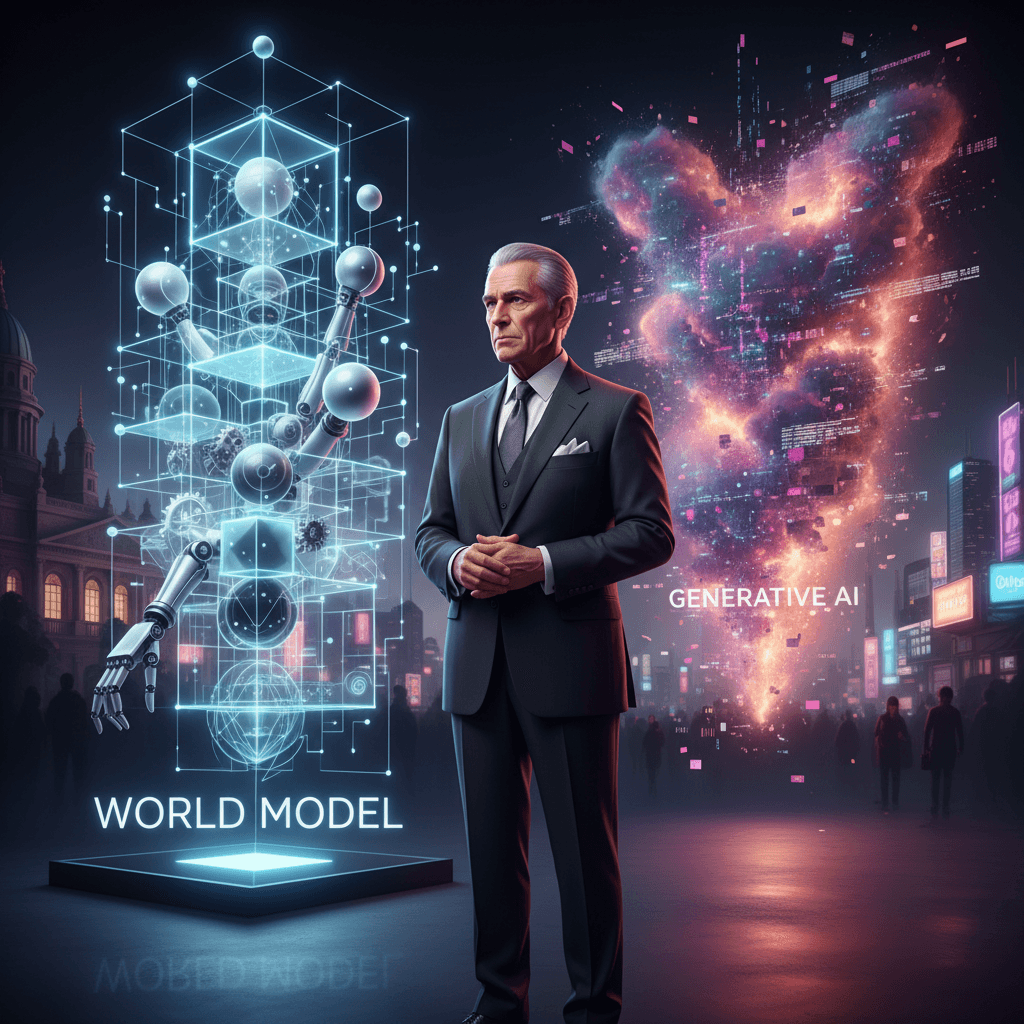
A prominent figure in the development of modern artificial intelligence is charting a new course, directly challenging the prevailing trend that has captivated the tech industry. Yann LeCun, the outgoing chief AI scientist at Meta, is departing the company to launch a new startup centered on a concept he calls "world models." The move is a direct repudiation of the current industry-wide focus on generative AI, a technology LeCun argues has "hypnotized" Silicon Valley and is insufficient for creating truly intelligent systems. His new venture will instead pursue a "non-generative" approach, aiming to build machines that can understand the world, reason, and plan, rather than simply generating text or images based on patterns in data.
LeCun, a Turing Award laureate for his foundational work on neural networks, has become an increasingly vocal critic of the generative AI boom. He contends that Large Language Models (LLMs), the technology underpinning systems like ChatGPT, are a "dead end" on the path toward human-level intelligence.[1] In his view, these models lack a genuine understanding of the physical world and are incapable of the kind of common-sense reasoning that even a child possesses.[2][3] He points to a paradox where AI can pass the bar exam but no robot exists that can clear a dinner table and load a dishwasher, a task a ten-year-old can learn in minutes.[4][3] This, he argues, is because LLMs operate by predicting the next word in a sequence, a process that doesn't require a real-world grounding or the ability to grasp cause and effect.[5] LeCun believes that simply scaling up current generative models will not bridge this fundamental gap, a stance that puts him at odds with the dominant strategy being pursued by major tech companies, including his former employer Meta.[6] He has asserted that the future of AI is "non-generative" because while the generative approach works for text, it fails for other modalities.[7]
The alternative vision LeCun is championing revolves around "world models" and an approach called objective-driven AI.[8][1] A world model is an AI system that builds an internal, abstract representation of its environment, allowing it to simulate how the world works and predict the consequences of actions.[9][10] This is fundamentally different from generative models, which mimic the surface-level statistics of data without an underlying understanding. The goal is to imbue machines with the ability to reason about movement, objects, and real-world interactions, paving the way for breakthroughs in robotics and autonomous systems.[10] This approach is part of a broader paradigm LeCun calls objective-driven AI, which shifts the focus from generating content to achieving specific goals.[1] Instead of simply creating plausible outputs, these systems would be designed to learn, remember, reason, and plan to accomplish tasks.[8][11]
The technical foundation for this vision is a new type of AI architecture LeCun's team has been developing, known as the Joint Embedding Predictive Architecture (JEPA).[7] Unlike generative models that try to predict every missing pixel in an image or every subsequent word in a text, JEPA works by predicting abstract representations of the world in a shared "latent space."[7] This allows the model to ignore irrelevant details and focus on learning the core concepts and dynamics of the environment, much like how humans and animals learn.[12] By training AI to predict the consequences of its actions in this abstract space, LeCun believes machines can develop a more robust understanding of the world and learn with far greater efficiency than current systems, which require massive amounts of data.[13] Prototypes based on this architecture, such as I-JEPA for images and V-JEPA for video, have already been developed.[7]
LeCun's new, as-yet-unnamed startup will be a global entity dedicated to pursuing this vision of Advanced Machine Intelligence (AMI).[14][2] Signaling a deliberate move away from the current epicenter of AI development, he has stated the company will have a significant base in Paris, aiming to leverage European talent that he believes is not being fully realized.[14][2] He remarked that to do this kind of work, one has to move outside of Silicon Valley.[14] Meta will be a partner in the new venture, but not an investor, a detail that underscores a strategic divergence in vision.[2][15][6] LeCun explained that he and Meta CEO Mark Zuckerberg agreed that the potential applications for world models extended far beyond Meta's core interests, making an independent entity the logical next step.[14][6] With more details expected in early 2026, the launch of this new company represents a significant moment for the AI industry, challenging the current monoculture and proposing a radically different path toward creating more capable and intelligent machines.[2]