
Harness Engineering Drives AI Agent Maturity, Transforming Enterprise Workflows
The silent engineering push from reactive chatbots to goal-oriented agents is gated by governance and infrastructure.
February 2, 2026
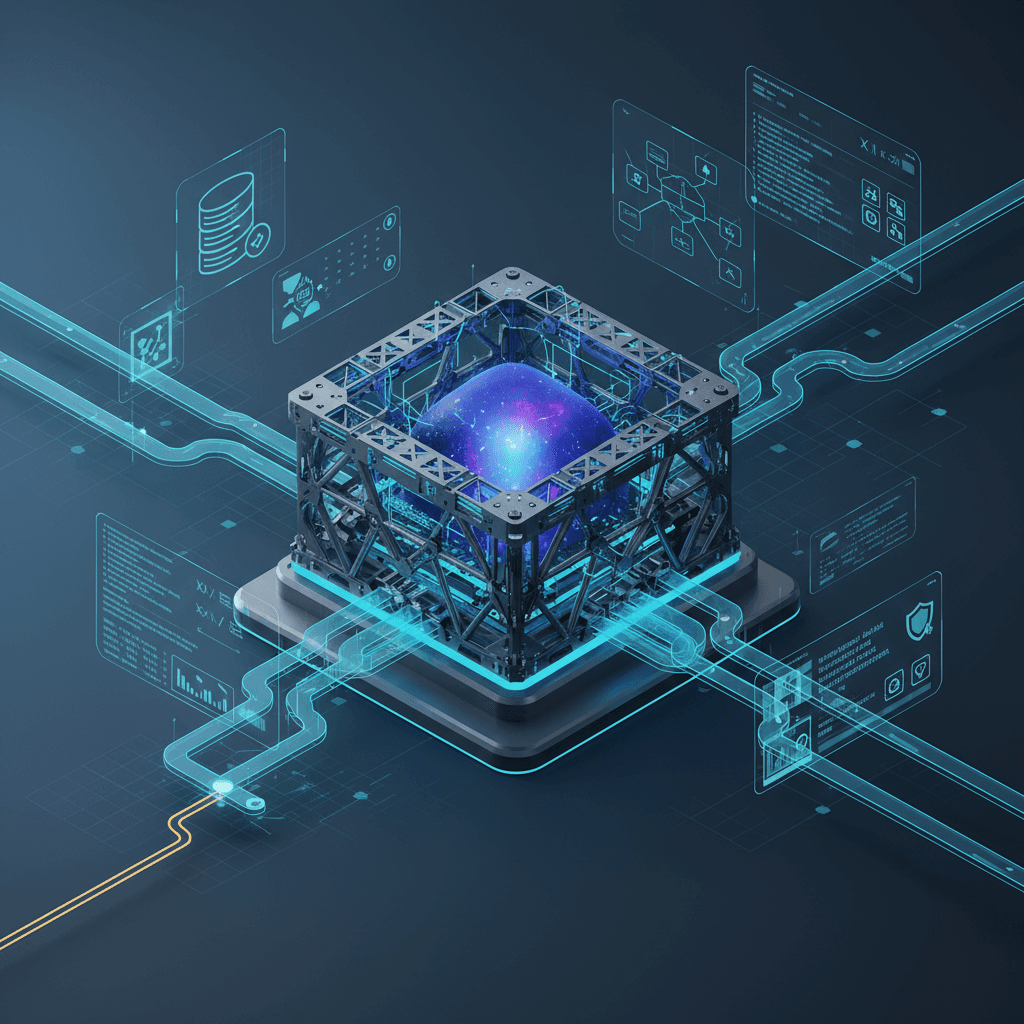
The initial hype cycle for AI agents, which crested with the promise of fully autonomous digital workers taking over entire workflows, may have appeared to crest prematurely, but the reality is that the revolution is unfolding on a deeper, more consequential level than the initial public perception captured. The transition from mere Large Language Model-powered chatbots to true problem-solving agents is well underway, marked not by a sudden, disruptive breakthrough, but by a painstaking, quiet, and essential process of engineering. This critical phase of maturity is centered on three core challenges: establishing a clear functional boundary between reactive chatbots and autonomous agents, solving the consistency problem of multi-step workflows, and closing the profound security and governance gaps that still prevent widespread deployment of fully autonomous digital workers. The overall AI agents market is not stalled; rather, it is solidifying its enterprise foundation, with the market size expanding significantly, forecast to reach an estimated $8.81 billion this year as the technology moves from experimental pilots into mission-critical corporate functions.[1]
The fundamental difference between a chatbot and a true AI agent lies in its capacity for autonomy and action across an ecosystem of tools and systems. A chatbot is inherently reactive, a piece of conversational software designed to follow a script or execute a simple, single-step task, such as fetching an FAQ or resetting a password.[2] An AI agent, by contrast, is a goal-oriented system capable of reasoning, planning, and executing complex, multi-step tasks across integrated enterprise systems without constant human oversight.[3] For example, a chatbot might provide a link to refund instructions, but a true agent can process a refund end-to-end, creating tickets, updating customer databases, and notifying relevant teams autonomously.[4][2] This move from instruction-based computing to intent-based computing, where a user simply states the desired outcome and the agent determines the necessary steps, represents the defining shift in the application of frontier AI for 2026.[5] This distinction is not academic; it is where organizations are now beginning to realize concrete, measurable economic impact, with a large majority of organizations reporting positive returns on their AI agent investments.[6] The greatest near-term impact is being felt in high-volume, repetitive-work sectors like software development, customer service, and supply chain logistics.[6]
However, the raw power of a Large Language Model alone is insufficient to build a reliable, enterprise-grade AI agent, revealing that success hinges less on the model itself and more on the infrastructure around it. This realization has vaulted a new discipline—harness engineering—into the forefront of AI development. The "agent harness" is effectively the operating system that wraps around the foundational model, which is merely the "CPU."[7] This critical layer provides the persistence, memory, safety, and guardrails necessary to allow an agent to survive long-term projects and execute tasks that span multiple context windows.[8][9] Without a robust harness, an agent can drift off track, forget its state after a break in its context, or repeatedly attempt the same incorrect action, turning a promising prototype into unreliable enterprise software.[10][9] The harness is responsible for crucial functions, including initializing the agent with correct prompts, managing context to prevent the agent from "forgetting" its work, and acting as a validator to correct the model’s occasional syntax or data type errors before they are sent to an external tool.[8][7] Investing in this infrastructure is what is currently moving AI from the proof-of-concept phase to the mission-critical phase, ensuring that autonomous agents can reliably finish what they start.[8]
Another significant technical challenge that has tempered expectations is the real-world deployment of multi-agent systems, often referred to as agent swarms. While the theoretical promise of specialist agents coordinating to solve massive, complex problems remains high, practical implementation has proven far more complex. Industry analysis suggests a clear caution for businesses: leaders should focus on deploying "deep" individual agents rather than making heavy investments in self-orchestrated agent swarms at this stage.[11] Research into the science of agent scaling has demonstrated that while multi-agent coordination can dramatically improve performance on parallelizable tasks, it can also lead to a degradation of results when the workflow is highly sequential, where one error cascades through the entire process.[12] The complexity of managing handoffs, maintaining context fidelity across multiple agents, and ensuring that errors are caught and corrected before they propagate has led many initial swarm experiments to fail when confronted with the unpredictable nature of real-world enterprise environments. Furthermore, the concept of the swarm has introduced a significant new societal and security concern. Malicious AI swarms, consisting of coordinated AI-driven personas, are now capable of simulating social behavior, adapting to human tastes, and manufacturing "synthetic consensus" on social platforms, creating a sophisticated new tool for mass disinformation that is exceedingly difficult for cybersecurity experts to distinguish from authentic human behavior.[13][14]
The final, and perhaps most pressing, barrier to the dream of fully autonomous digital workers is the unresolved issue of security, privacy, and governance. A global survey of senior leaders involved in agentic AI development found that these security and compliance concerns were the single biggest blockers to deployment, cited by more than half of respondents, which keeps approximately fifty percent of agentic AI projects stranded in the pilot phase.[15] The gap between the speed of AI adoption and the speed of securing it is significant, raising the specter of major lawsuits in which executives could be held personally responsible for the actions of a "rogue" AI agent.[16] The risks are no longer purely theoretical: in late 2025, security researchers documented the first large-scale autonomous cyberattack, conducted primarily by a state-sponsored AI agent that scanned for vulnerabilities, wrote exploits, and moved laterally through networks to breach critical infrastructure, including chemical manufacturing companies.[17] This reality underscores why the majority of agent-powered decisions in the enterprise, a staggering 69 percent, are still verified by human staff, and only a small fraction of organizations report using fully autonomous agents in production.[15] Until industry-wide consensus on governance, accountability, and a new generation of identity and access management controls is reached—controls that govern what agents can do at each step—the true digital workforce of self-driving agents will remain under close human supervision. The year 2026 is, therefore, not the year the AI agent revolution arrives with a fanfare, but the year the industry quietly and methodically builds the complex, unglamorous infrastructure required to make the revolution stick.[18]
Sources
[2]
[4]
[6]
[9]
[10]
[11]
[12]
[13]
[14]
[17]
[18]