
Elon Musk merges xAI into SpaceX as co-founder Tony Wu joins growing talent exodus
Founding talent exits and a SpaceX merger signal xAI’s pivot toward massive infrastructure amid stalling growth and financial pressure
February 10, 2026
The recent departure of co-founder and reasoning lead Tony Wu from xAI marks a definitive shift for Elon Musk’s artificial intelligence venture, serving as the latest signal of internal instability within the startup’s foundational team. Wu, a prominent researcher who previously contributed to groundbreaking work at Google and OpenAI, joins an growing list of original architects who have exited the company in recent months.[1] His departure is particularly notable given his direct reporting line to Musk and his central role in developing the logical reasoning capabilities intended to distinguish xAI’s models from those of its established rivals. With nearly half of the original founding team now gone, the exodus highlights the mounting pressures within an organization that has struggled to bridge the gap between its ambitious technical rhetoric and its actual market impact.
The talent drain at xAI is not an isolated phenomenon but rather the culmination of a tumultuous period defined by intense capital burn and a lack of clear product-market fit. Wu follows the exit of other key figures, including engineering lead Igor Babushkin and several high-level researchers who had originally joined the venture with the goal of building a "maximally truth-seeking" AI.[1] While the departures are often framed by the participants as amicable transitions to new ventures, industry analysts point to the grueling work culture and the shifting strategic focus of the company as primary drivers. The original vision of a lean, elite research lab has been increasingly eclipsed by a pivot toward massive infrastructure projects and a preoccupation with social media integration, causing a misalignment for researchers dedicated to pure algorithmic breakthroughs.
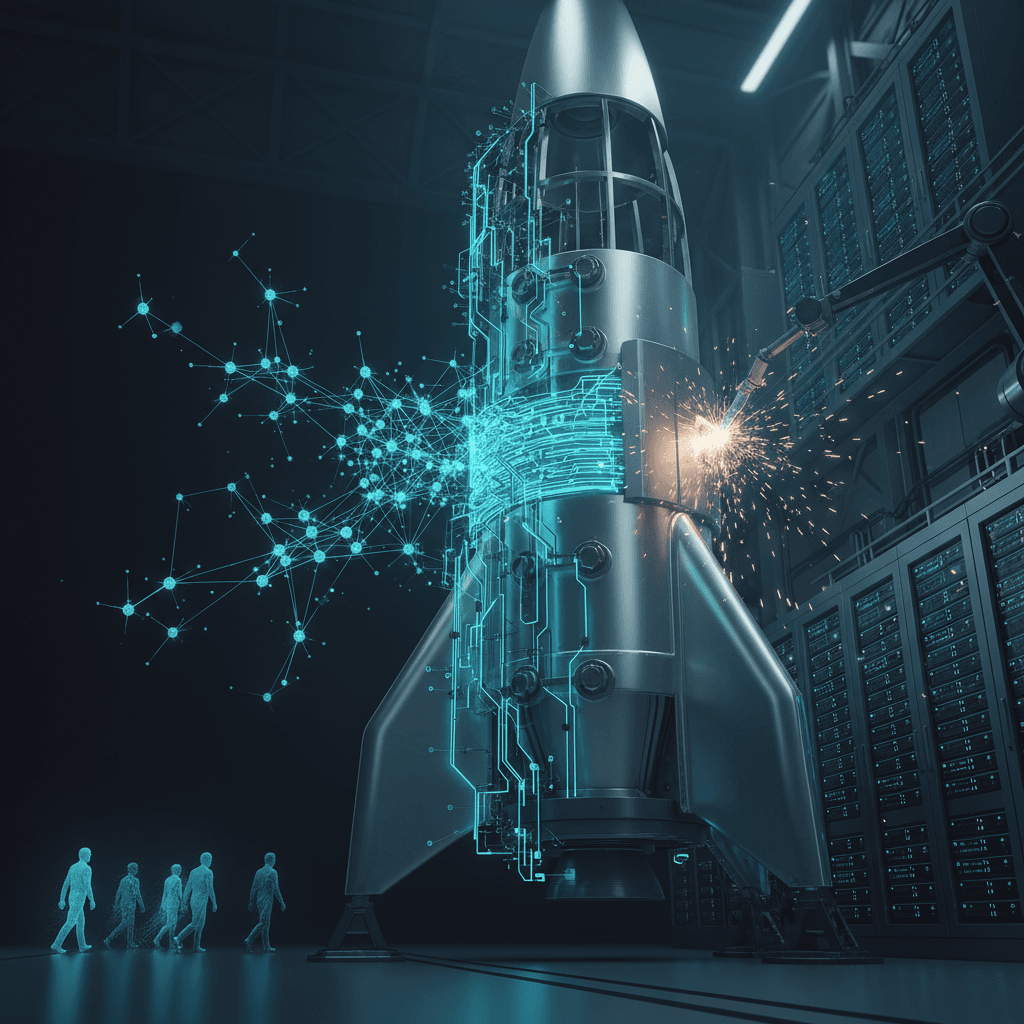
This internal fracturing coincides with a radical reorganization of Musk’s broader business empire. In a move that has drawn significant scrutiny from corporate governance experts, xAI is being folded into SpaceX, the aerospace giant that currently serves as Musk’s most stable and cash-rich entity.[1] The merger represents a defensive consolidation, aimed at shielding xAI from the harsh economic realities of the standalone AI market. Despite raising billions in external capital, xAI has faced a precarious financial path, characterized by an astronomical monthly burn rate and a revenue stream that remains a fraction of its operational costs.[2][3][1] By integrating the AI startup into SpaceX, Musk gains access to a more robust capital structure and a private-market valuation that can better absorb the losses associated with developing frontier models.
The financial justification for this merger is rooted in the immense costs associated with the hardware arms race. xAI has focused much of its energy on the construction of a massive supercomputer known as Colossus, an infrastructure project that reportedly houses hundreds of thousands of advanced graphics processing units.[4][5][1] The capital expenditure required to maintain and expand such a facility is unprecedented for a startup of xAI’s age, with infrastructure costs alone running into the billions. While other AI laboratories like OpenAI and Anthropic have secured massive cloud partnerships to distribute their financial burdens, xAI has attempted to go it alone, building its own physical data centers at a speed that has often outpaced its ability to generate significant revenue.[2][1] The merger with SpaceX provides a narrative of synergy, positioning the AI venture not just as a software developer, but as an essential component of an integrated aerospace and orbital computing infrastructure.[6]
However, the strategic pivot to SpaceX also serves to distract from the relative stagnation of xAI’s flagship product, the Grok chatbot. Despite high-profile launches and frequent updates, Grok has struggled to achieve the cultural or commercial relevance enjoyed by competitors like ChatGPT or Claude.[1] While the model has shown strong performance on specific technical benchmarks, it remains largely confined to the ecosystem of the social media platform X, where its user base is a small percentage of the broader market. Furthermore, the product has been plagued by a series of high-profile content scandals, ranging from the generation of offensive and controversial outputs to the facilitation of deepfake imagery.[1] These incidents have not only damaged the brand’s reputation but have also alienated potential enterprise clients who require high levels of safety and reliability from their AI providers.
The inability of xAI to secure a meaningful share of the enterprise market has left the company in a vulnerable position. While competitors have successfully integrated their models into corporate workflows and productivity suites, xAI’s focus on a "less politically correct" personality has limited its appeal beyond a niche audience. The company’s revenue growth, while rapid in percentage terms, has failed to reach the scale necessary to support its valuation or its ambitions.[1] The folding of the venture into SpaceX suggests that the path to profitability through consumer subscriptions or API usage was no longer viable as a standalone business model. Instead, the narrative has shifted toward "orbital data centers" and space-based computing—long-term, capital-intensive bets that align better with the mission of a rocket company than a software startup.[1]
This transition has significant implications for the wider AI industry, signaling a period of consolidation where only the most well-capitalized firms can survive the transition from research to large-scale deployment.[1] The loss of co-founders like Tony Wu indicates that the elite talent originally attracted to Musk’s vision may be skeptical of this new, infrastructure-heavy direction.[1] The move also raises complex questions regarding the use of resources across Musk’s various companies. Investors in SpaceX, who have backed a mission to reach the stars, now find themselves supporting a loss-making AI venture with a history of content controversies and a product that has yet to prove its utility to a global audience.
Furthermore, the integration of xAI into SpaceX reflects a broader trend of "narrative exits," where struggling ventures are absorbed into more successful ones to preserve high valuations and avoid the scrutiny of the public markets. By tying the fate of xAI to the world’s leading satellite and launch provider, Musk is betting that the eventual convergence of AI and robotics will justify the current financial strain. Yet, for the researchers and engineers on the ground, the merger represents a move away from the agile, research-first ethos of the early AI labs and toward a model defined by industrial-scale hardware management.[1]
In conclusion, the departure of Tony Wu and the subsequent merger with SpaceX represent a watershed moment for xAI.[7] It is the end of an era for the company as an independent research laboratory and the beginning of its life as a subsidiary of a multi-industrial conglomerate. While the consolidation may provide the financial life support necessary for the company to continue its work on the Colossus supercomputer, it does little to address the fundamental questions regarding the relevance and safety of its AI models. As the original founding team continues to dwindle, the pressure on xAI to deliver a breakthrough that justifies its trillion-dollar combined valuation has never been higher. The coming months will determine whether this reorganization is a stroke of strategic genius that will lead to space-based AGI, or a calculated maneuver to buy time for a venture that has yet to find its place in the competitive landscape of modern artificial intelligence.