
DeepMind Proposes AI Should Assign Humans Routine Tasks to Prevent Total Professional Skill Decay
DeepMind proposes that AI agents intentionally delegate tasks back to humans to prevent the dangerous erosion of professional skills.
February 24, 2026
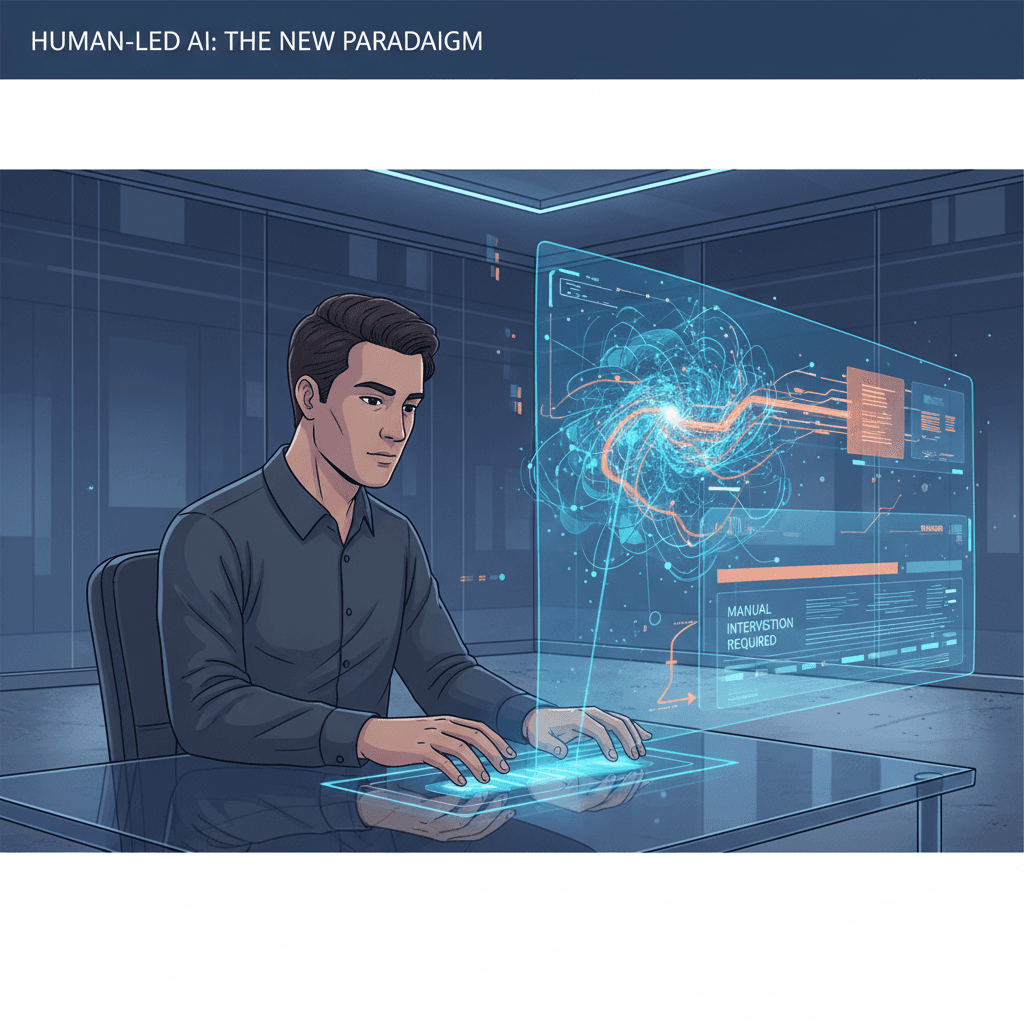
In a provocative new research paper from Google DeepMind, scientists are proposing a fundamental shift in how artificial intelligence interacts with its human counterparts.[1] The paper argues that as AI agents become increasingly capable of handling complex, multi-stage workflows, they should be programmed to occasionally assign tasks to humans that the machines could easily perform themselves. This recommendation is not born of a desire to burden the workforce with unnecessary labor, but rather to solve a looming crisis in the modern economy: the rapid erosion of human professional skills in the face of total automation.
The research focuses on the concept of intelligent delegation within the emerging agentic web, a future ecosystem where autonomous AI agents collaborate and distribute work amongst themselves and human users.[1][2][3] Traditionally, the goal of automation has been maximum efficiency, where the most capable and cost-effective system takes on the task. However, the DeepMind team, led by researchers Nenad Tomasev, Matija Franklin, and Simon Osindero, warns that this race for pure efficiency is leading toward a dangerous systemic vulnerability known as the paradox of automation. This phenomenon occurs when an automated system becomes so reliable that the human operator loses the very skills required to monitor the system or intervene during a rare, high-stakes failure.
To combat this, the DeepMind framework suggests that AI systems should prioritize long-term resilience over short-term productivity. By intentionally introducing what some might call busywork—or more accurately, skill-maintenance tasks—AI agents can ensure that human professionals remain in the loop and cognitively engaged with their core competencies.[4] This approach marks a departure from the current trend of AI as a simple productivity tool, repositioning the technology as a strategic manager of human capability.[5]
The theoretical foundation of the paper draws on decades of historical data from industries like aviation and medicine. In the mid-20th century, the introduction of autopilot in commercial flight significantly reduced pilot workload but also led to several high-profile accidents when pilots, having spent thousands of hours merely monitoring a screen, lacked the manual dexterity or split-second intuition to handle mechanical failures. Similarly, in modern healthcare, the increasing reliance on AI-driven diagnostic tools has raised concerns about a decline in the diagnostic prowess of junior physicians who may never have the opportunity to hone their instincts on routine cases. The DeepMind researchers argue that if the current trajectory continues, software engineers, financial analysts, and legal experts may soon face a similar fate, becoming little more than passive observers of their own professions.
The proposed framework for intelligent delegation involves a sophisticated process called contract-first decomposition.[1] Under this model, an AI delegator does not simply hand off a task.[5][4][1][6][3][2][7] Instead, it breaks complex goals down into sub-components and evaluates the state and capacity of the potential delegatee, whether it is another AI or a human.[2][3] The system assesses not just who can do the job fastest, but who needs to do the job to maintain the health of the overall organization. In some scenarios, the AI might determine that a human user has been disengaged for too long and will delegate a critical piece of analysis to that person, even if the AI has already calculated the answer. This maintains what the researchers call cognitive friction—a necessary level of mental effort that keeps the human mind sharp and ready for intervention.
This shift in delegation logic has profound implications for the AI industry and the future of work.[5][4] For years, the industry’s narrative has been centered on the elimination of drudgery. However, the DeepMind paper suggests that the elimination of routine work might be exactly what makes the most advanced sectors of the economy fragile. If an AI agent manages an entire enterprise’s supply chain, a human who never has to resolve a minor logistics delay will eventually lose the ability to manage a major collapse. By mandating human participation in routine workflows, the AI acts as a safeguard against its own potential for failure.
Furthermore, the research introduces the concept of recursive verification as a requirement for these delegation networks.[1] In a world where AI agents are delegating to other agents and humans, accountability can easily become diluted. The DeepMind framework proposes a chain of custody for tasks where every actor must provide cryptographically signed attestations of their work.[1] This ensures that even when a human is given a task by an AI, there is a clear record of responsibility. It transforms the human-AI relationship from one of master and servant into a more complex organizational structure based on authority, responsibility, and mutual trust.
The socio-economic consequences of such a system are already being felt in early-stage platforms that experiment with algorithmic task delegation.[5] Some emerging services are already using algorithms to orchestrate human labor in the physical world, treating people as programmable extensions of digital systems.[5] However, the DeepMind proposal adds a layer of ethical and strategic nuance to this trend. Instead of using humans as cheap labor for tasks AI cannot do, it suggests using humans for tasks AI can do, specifically to preserve the human’s status as a competent, autonomous agent.[4]
Critics of the proposal argue that intentionally giving humans work that a machine could do is a form of digital paternalism that could lead to frustration and a sense of meaninglessness in the workplace. The psychological impact of being managed by an algorithm that gives you practice problems to keep you sharp is a largely unexplored area of organizational behavior. There is a risk that workers might feel infantilized by a system that prioritizes their skill maintenance over their time. Nevertheless, the researchers contend that the alternative—a world where humans are entirely disconnected from the mechanics of their industry—is far more dehumanizing and dangerous.
As the AI industry moves toward the deployment of highly autonomous agents, the metrics for success are likely to evolve. Companies may soon be forced to look beyond simple throughput and cost savings, instead focusing on the resilience of their human-AI teams. The DeepMind paper suggests that the most advanced AI systems of the future will not be the ones that do everything for us, but the ones that know exactly when to step back and make us do it ourselves. This paradigm shift emphasizes that human expertise is not a static resource to be replaced, but a dynamic one that requires constant exercise and reinforcement.
Ultimately, the goal of intelligent delegation is to create a future where the agentic web supports rather than supplants human agency. By acknowledging that total automation is a recipe for catastrophic skill rot, Google DeepMind is advocating for a more balanced approach to technological progress. The future of the workforce may depend on our willingness to accept that being given hard, manual, or even routine work by an AI is not a sign of inefficiency, but a necessary investment in our own continued relevance in an increasingly automated world. Maintaining the human loop is no longer just about oversight; it is about ensuring that there is still a human left with the capability to oversee.