
Anthropic defies Pentagon demands for unrestricted military AI use in $200 million contract standoff
Anthropic’s refusal to lift ethical filters triggers a $200 million standoff with the Pentagon over algorithmic warfare
February 15, 2026
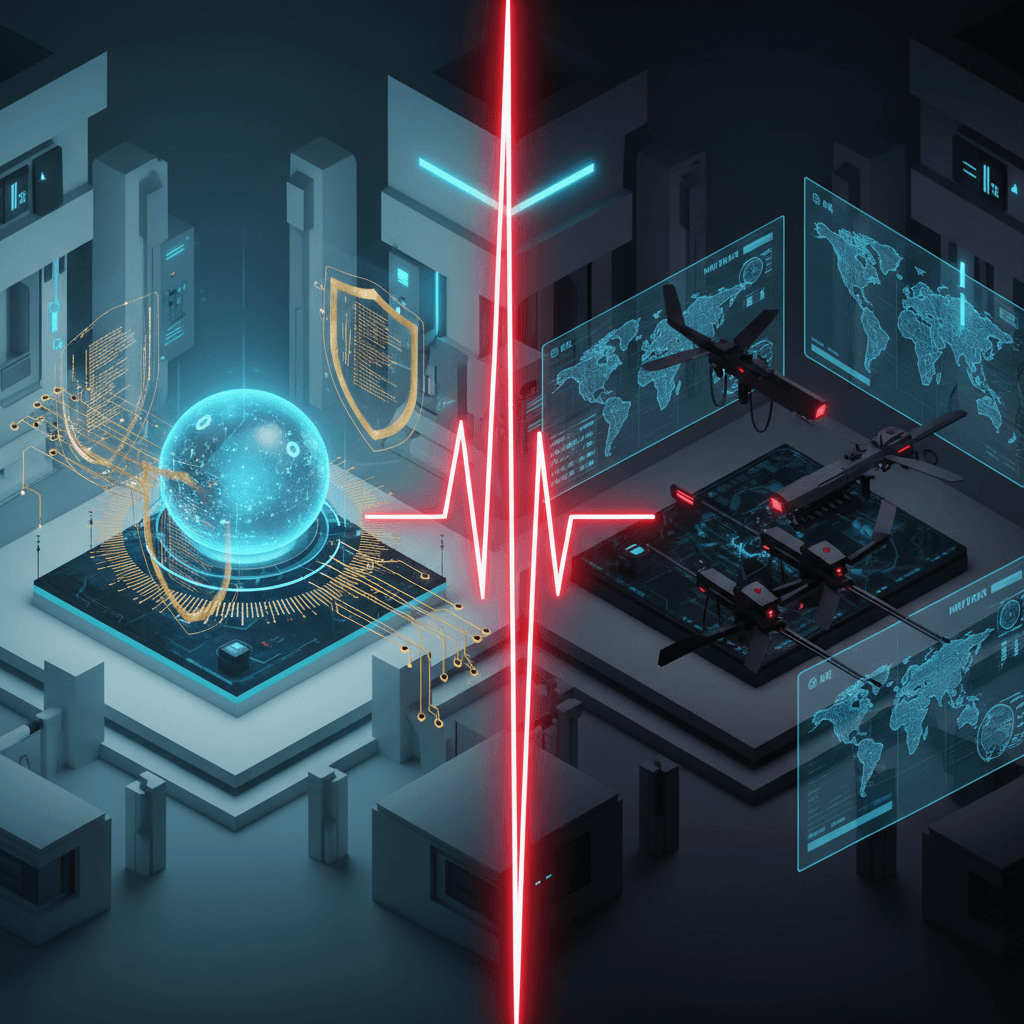
The high-stakes relationship between the U.S. Department of Defense and Silicon Valley’s leading artificial intelligence developers has hit a critical impasse.[1][2][3][4] At the center of the conflict is Anthropic, the San Francisco-based startup founded on a mission of AI safety and ethics, which is currently refusing to grant the Pentagon unrestricted access to its most advanced models. The standoff revolves around a contract valued at up to $200 million, a deal that was intended to embed Anthropic’s Claude AI into the most sensitive layers of the American military infrastructure.[5] However, as the Pentagon pushes for a standard of "all lawful use," Anthropic is holding firm on specific ethical guardrails that would prohibit its technology from being used in autonomous weapons systems or for the domestic surveillance of American citizens.[6][3][7][8][1][5][9] This ideological and contractual deadlock represents a pivotal moment for the AI industry, testing whether private companies can maintain their ethical foundations when confronted with the immense financial and strategic demands of national security.
The conflict is rooted in the fundamental difference between the "Constitutional AI" philosophy championed by Anthropic and the operational requirements of modern warfare. Anthropic was founded by former OpenAI executives with the specific goal of creating AI systems that are reliable, interpretable, and steerable through a set of core principles or a "constitution" trained into the model. These safety features are not simple software toggles that can be turned off; they are deeply integrated into the model's behavior, causing the AI to refuse requests that it deems harmful or unethical. The Pentagon, however, views these restrictions as a potential liability on the battlefield. Military officials have expressed mounting frustration over the idea that a private corporation’s internal policies could prevent a commander from utilizing a tool in a time-sensitive or life-or-death situation. From the perspective of the Department of Defense, any technology procured with taxpayer funds must be available for any use that is permitted under U.S. law, regardless of the vendor's corporate preferences.
This tension reached a boiling point following a strategic shift within the administration. A January 9 strategy memo from the Department of War—a symbolic and functional rebranding of the Department of Defense—ordered officials to standardize AI procurement contracts by inserting "any lawful use" clauses.[4] This memo was a direct response to the perceived "ideological constraints" being placed on AI models by Silicon Valley labs. The military’s leadership has been increasingly vocal about its need for "decision superiority," a concept where AI processes massive amounts of sensor and intelligence data to give American forces a speed advantage over adversaries. In this context, guardrails that might cause a model to hesitate or refuse a request because it involves a "kinetic" operation or a sensitive intelligence target are viewed as a strategic weakness. Defense Secretary Pete Hegseth summarized this sentiment during a recent public address, stating that the military would not employ models that "prohibit warfare" and famously declaring that "AI will not be woke."[1]
The specific points of contention for Anthropic are both technical and philosophical. The company has drawn two clear "red lines": its models cannot be used to target weapons autonomously without significant human oversight, and they cannot be used to surveil the American public.[1] These restrictions have become a practical hurdle because the Pentagon often integrates these models into classified networks where it wants full administrative control. In these "air-gapped" environments, the military intends to use AI for everything from logistics and document review to battlefield targeting and drone swarm coordination. Anthropic’s insistence on oversight and usage limits has led to a stalemate in negotiations, as the Pentagon is unwilling to agree to a framework where it must negotiate individual use cases with a private vendor or risk the AI system unexpectedly blocking a process during a mission.[3][1][10]
Adding fuel to the fire is a series of reports regarding the real-world application of Anthropic’s technology in secret operations. A reported mission involving the capture of former Venezuelan President Nicolás Maduro has become a major flashpoint.[3] Although Anthropic has officially stated that it has not discussed the use of its Claude model for specific military operations with the Pentagon, reports suggest that the model was indeed utilized through a partnership with the data analytics firm Palantir.[11][12][3] This partnership allows Anthropic’s models to run on Palantir’s AI Platform, which is hosted on Amazon Web Services and accredited to handle data up to the "secret" level.[13][14] The incident sparked internal concern at Anthropic about how its tools were being leveraged in "kinetic" raids involving bombing operations and special forces. For the Pentagon, the successful use of Claude in such a mission only serves as proof of the model's value, reinforcing their demand for fewer restrictions.
The competitive landscape of the AI industry is also exerting significant pressure on Anthropic’s position. The Pentagon’s $800 million frontier AI initiative distributed $200 million contracts not just to Anthropic, but also to Google, OpenAI, and Elon Musk’s xAI.[15] Unlike Anthropic, these rivals have reportedly shown greater flexibility in accommodating the military's requests.[8][9] OpenAI, which famously removed its blanket ban on "military and warfare" use from its terms of service in early 2024, is actively negotiating its own classified arrangements. Meanwhile, xAI has moved aggressively to capture the market with its "Grok for Government" program, explicitly marketing its models as being free from the safety filters and "ideological" constraints that characterize its competitors. As the Pentagon threatens to cut ties with Anthropic and shift its resources toward these more compliant partners, Anthropic faces the very real possibility of being locked out of the most lucrative and strategically important sector of the AI market.
The implications of this standoff extend to the broader geopolitical race for AI supremacy. Proponents of unrestricted military AI argue that the United States is in a "Great Power Competition" with China, a nation that does not share Silicon Valley’s qualms about the intersection of AI and warfare. They argue that by placing ethical restrictions on American AI, the U.S. is effectively handicapping itself in a race where the winner will dictate the global security order for decades. This "national security first" argument is being used to pressure companies like Anthropic to align their safety protocols with the government’s legal standards. If Anthropic holds its ground and loses the contract, it could signal a fragmentation in the AI market between "safe" commercial models and "unrestricted" sovereign or military models.
For Anthropic, the stakes of this dispute are also deeply financial and reputational. The company is currently preparing for a massive initial public offering with a projected valuation of over $350 billion.[1] A public and acrimonious split with the Department of Defense could introduce significant regulatory uncertainty and raise questions among investors about the company's ability to navigate the complex world of government contracting.[1] Conversely, capitulating to the Pentagon’s demands could alienate the company’s core researchers and safety-focused mission, potentially leading to a talent exodus similar to the one that led to the company’s founding in the first place.
Ultimately, the standoff between Anthropic and the Pentagon is a test case for the future of AI governance. It highlights the growing tension between the private companies that develop these revolutionary technologies and the states that wish to wield them for national defense.[11] As AI becomes increasingly central to every aspect of modern power, the resolution of this $200 million dispute will likely define the boundaries of corporate ethics in an age of algorithmic warfare. Whether Anthropic can successfully maintain its "red lines" or if the military’s "all lawful use" standard becomes the industry norm will have lasting consequences for how AI is deployed, controlled, and restrained on the global stage.
Sources
[1]
[2]
[4]
[5]
[6]
[9]
[10]
[11]
[12]
[13]