
AI Architects Battle Over AGI's Definition, Diverging Billions in Research.
The philosophical battle between Meta and Google DeepMind: Is AGI built through scaling or architectural overhaul?
December 23, 2025
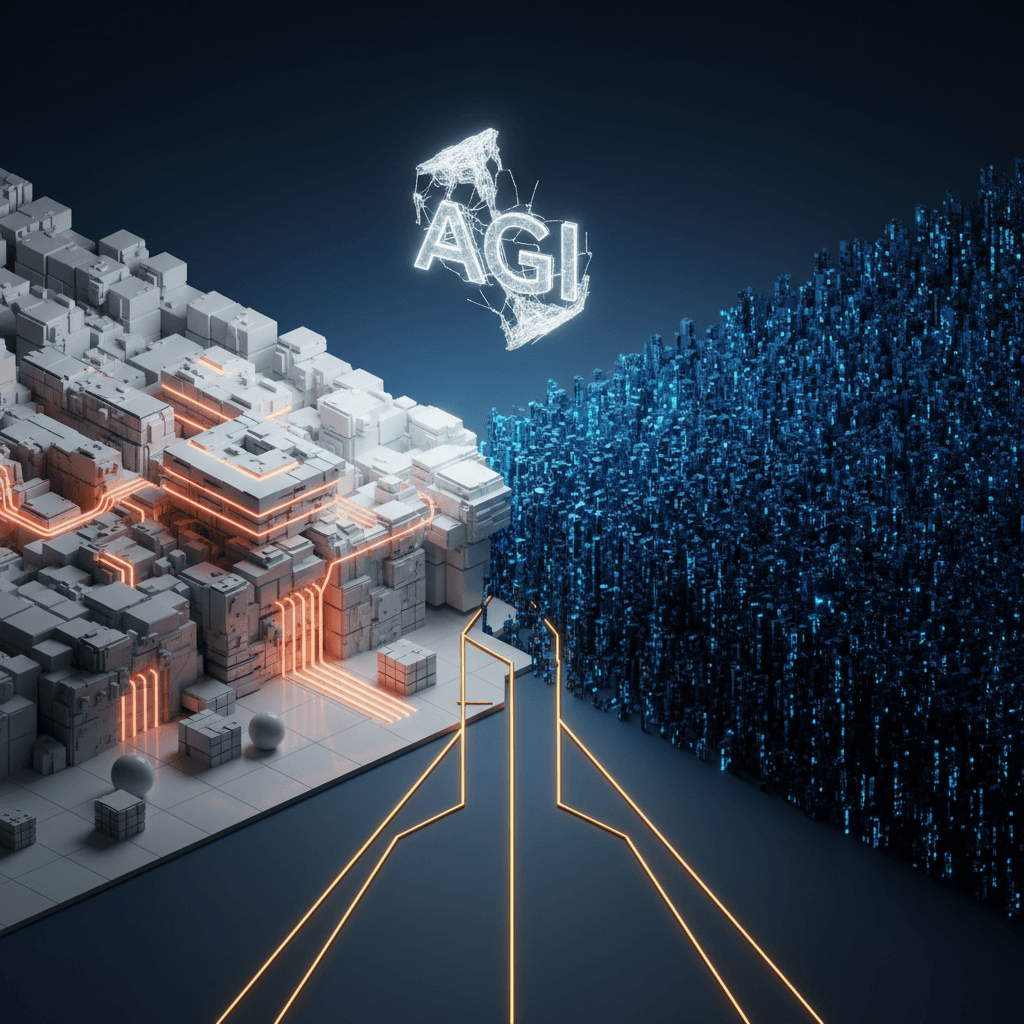
A fundamental and philosophical rift is emerging at the highest echelons of artificial intelligence research, spotlighting a critical disagreement over the very definition and feasibility of Artificial General Intelligence, or AGI. The dispute has been brought into sharp public view by a recent, pointed exchange between two of the field’s most influential architects: Yann LeCun, the Turing Prize-winning Chief AI Scientist at Meta, and Demis Hassabis, co-founder and CEO of Google DeepMind, the organization most synonymous with the pursuit of AGI. This is more than a mere academic squabble; it signifies a divergence in research roadmaps between two of the world's most dominant AI labs, impacting the direction of billions of dollars in investment and the future of the technology itself.
The rhetorical conflict was ignited by LeCun, who provocatively dismissed the concept of "general intelligence" as "complete BS" during a podcast appearance, arguing that the term, which is largely used to designate human-level intelligence, is fundamentally flawed.[1][2][3] LeCun's core contention is that the human perception of its own cognitive breadth is an illusion stemming from specialization.[1][2] He argues that human intelligence is "super specialized," optimized by evolution for specific domains, primarily navigating the physical world and complex social interaction.[3] To support this view, he points to domains like chess and other structured tasks where humans are easily and dramatically outperformed by machines, suggesting that our intellectual reach is limited to the problems we are capable of apprehending.[3][1] By this measure, LeCun concludes that the concept of a truly "general" intelligence is meaningless and that current systems should instead focus on building "world models" with a deeper, physically-grounded understanding of reality, which he believes is a necessary path beyond the limitations of large language models (LLMs).[4][5]
Hassabis, whose company's entire mission is built around the achievement of AGI, fired back with unusual directness, stating LeCun was "just plain incorrect" and accusing him of a "fundamental category error."[2][1] The Google DeepMind CEO’s rebuttal centers on a crucial technical-philosophical distinction: LeCun, he argues, is confusing "general intelligence with universal intelligence."[3][2][6] While acknowledging that no finite, practical system can escape the "no free lunch theorem" and be universally perfect at every conceivable task, Hassabis asserts that the *architecture* of systems like the human brain and modern AI foundation models are, in a theoretical sense, "approximate Turing machines."[3][6] This means they are capable of learning any computable function in principle, given sufficient time, memory, and data.[3][6][7] For Hassabis, the human capacity for inventing entire fields of endeavor, from advanced mathematics to complex games like chess, is the ultimate proof of an underlying, deep generality, regardless of the fact that an AI can later master those specific creations.[1] He views the brain as an "extremely general" learning machine, an argument that provides the foundational justification for DeepMind's ambitious, scaling-centric approach to AGI.[6][8]
This philosophical division extends directly into the technical roadmaps of Meta and Google DeepMind. LeCun has consistently maintained that simply scaling up current LLMs, which he has compared to systems not even as smart as a cat, is a dead-end path to AGI.[9][10][11] He argues that LLMs primarily excel at "PhD-like recall" and retrieval, but fundamentally lack the ability to generate genuinely novel scientific or creative breakthroughs, reason, plan hierarchically, or acquire common-sense physics—the knowledge that comes from sensory and embodied interaction with the real world, not just text data.[5][4] The path he advocates requires new, unified cognitive architectures centered on self-supervised learning and world models.[4][5] By contrast, DeepMind, under Hassabis, remains committed to a strategy where scaling current systems to their maximum computational limits is seen as, at a minimum, a key component, or perhaps the entirety, of the final AGI system.[8] This reflects a belief that pushing the limits of existing architectures with massive data and compute will lead to emergent complexity, which is consistent with the progress seen in DeepMind’s specialized triumphs like AlphaFold and their general-purpose models like Gemini.[7][8]
The debate carries significant implications for the wider AI industry. The term "AGI" has become a central, multi-trillion-dollar objective, driving investment, talent acquisition, and corporate strategy.[7][2] LeCun's skepticism, despite his own five-to-ten-year timeframe for achieving human-level intelligence, serves as a grounded critique against the increasing hype and "delusional" timelines promoted by some, pushing back on the notion that a major breakthrough is imminent solely through current scaling paradigms.[2][9] His position validates the need for foundational research beyond mere scaling laws and redirects focus toward complex challenges like integrating common-sense physics and robust, persistent memory.[5] Hassabis's forceful defense, on the other hand, reinforces the current market's massive bet on foundation models as "approximate Turing machines."[3][7] His stance legitimizes the continued, large-scale investment in computational infrastructure and data-centric approaches that have led to commercial breakthroughs like GPT-4.[7] The disagreement, therefore, does not just highlight a semantic difference but outlines two competing grand theories for the creation of advanced intelligence, with one championing architectural overhaul and the other doubling down on the sheer power of scale. It is a fundamental choice that will shape which research groups—and by extension, which corporate interests—lead the next decade of AI development.[1][8]