

Build and deploy vertical AI agents without engineering overhead using a no-code platform that offers RAG-as-a-Service and high-quality knowledge retrieval.

DeepSeek Harness
Build, customize, and inspect autonomous AI coding agents with an open-source, modular harness where every tool, sandbox, and loop operates as a plugin.
About DeepSeek Harness
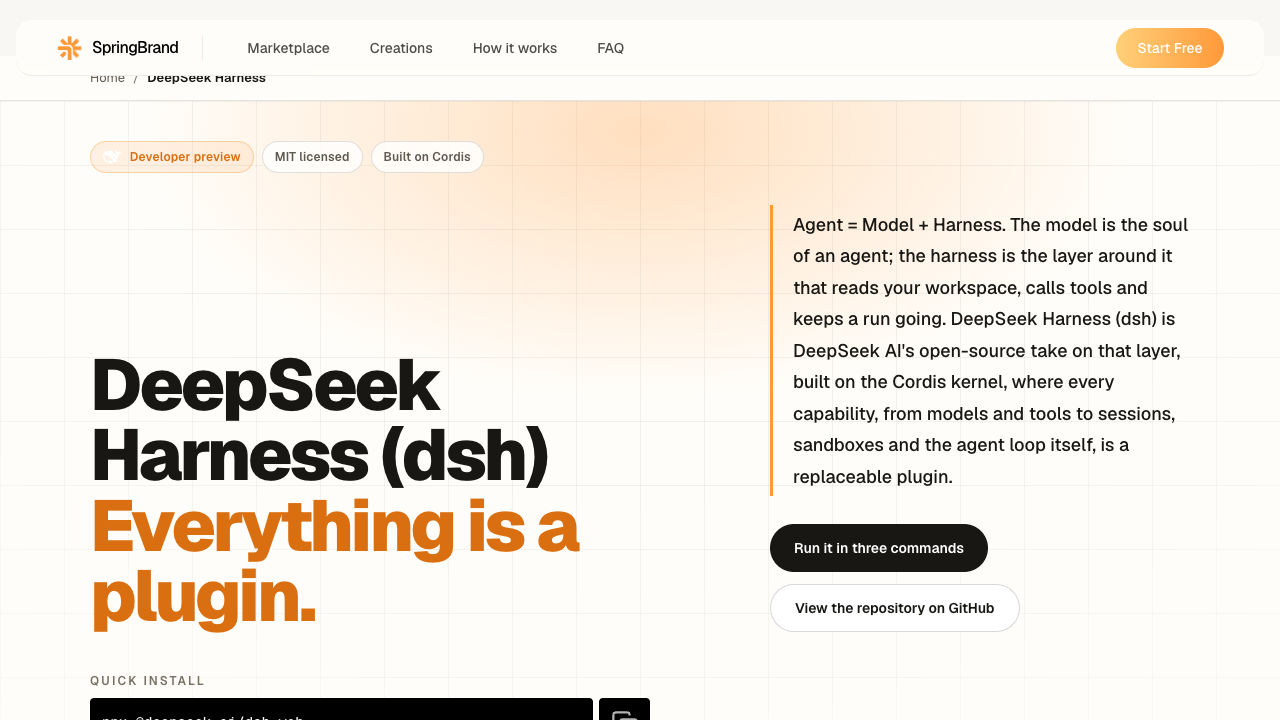
DeepSeek Harness (dsh) is an open-source framework and runtime created by DeepSeek AI for composing and operating autonomous AI agents. Unlike standard fixed-loop coding agents, dsh acts as the intermediary execution layer surrounding large language models. Built on top of the Cordis plugin kernel, every core capability—including model adapters, tool registries, sandboxes, session management, storage backends, and the agentic turn policy itself—functions as an independently mountable and reversible plugin. In practical operation, DeepSeek Harness runs locally on Node.js and serves an interactive Web UI alongside a headless runner. The platform executes agent tasks through explicit steps and turns, capturing all model requests, context injections, and tool interactions within a unified, append-only SessionEvent log. It ships with four distinct presets out of the box: Standard mode for full coding agent workflows, Code mode for orchestrating multiple tools using TypeScript via the Code Mode SDK, Minimal mode offering restricted bash and file editing for model evaluation, and Creator mode for authoring custom presets and testing runtime plugins in memory. DeepSeek Harness is primarily designed for product engineering teams wanting full architectural control over custom internal agents, AI researchers requiring deterministic and stable toolsets to benchmark model capabilities, and developers creating modular tooling or workflows under the open dsh-plugin ecosystem. It also benefits platform engineers who need to enforce strict file-effect sandboxing (via Landlock/bwrap, macOS Seatbelt, or Windows ACL tokens) and audit complete execution histories. What sets DeepSeek Harness apart from alternatives like OpenAI Codex or Claude Code is its unopinionated, plugin-first architecture. Rather than delivering a rigid application interface, dsh makes the entire runtime customizable via configuration patch layers and Cordis capability seams. Teams can effortlessly swap model backends (including DeepSeek, Anthropic, OpenAI, or custom OpenAI-compatible endpoints) or replace local subprocess engines with remote sandboxes without modifying core source code.
Pros & cons
Pros
- Completely open source and MIT licensed with zero waitlists or gating.
- Every component including the agent loop, tools, UI, and sandbox is a replaceable plugin.
- Enforces deterministic execution tracking through an append-only event stream.
- Runs entirely on local infrastructure with Node.js and your own API keys.
Cons
- Currently in developer preview with potential compatibility-breaking changes between releases.
- The CLI currently rejects binding to host 0.0.0.0, limiting network exposure for the Web UI.
- Requires manual workspace directory selection before the session composer becomes available.
Use cases
- Product engineering teams can assemble a repository-specific autonomous coding agent with customized tools and workspace policies.
- AI model researchers can use Minimal mode to compare different LLM capabilities against a fixed, minimal shell and editing surface.
- Platform engineers can integrate inspected agent execution loops, strict sandboxes, and approval policies into internal enterprise automation.
- Plugin developers can prototype, test, and publish modular agent tools and skills within Creator mode using the Cordis framework.
Features
- cordis-powered modular plugin architecture for all core capabilities
- interactive code mode sdk enabling programmatic tool chaining via typescript
- layered configuration system using bundles, profiles, and patch overlays
- multi-provider llm support across deepseek, anthropic, openai, and compatible endpoints
- multi-platform sandboxing using linux landlock/bwrap, macos seatbelt, and windows acl
- local web ui served on port 3080 plus a headless command runner
- append-only sessionevent log powering trajectory view, replay, and resume
- four built-in runtime modes: standard, code, minimal, and creator
Pricing
Open Source
Free
- MIT-licensed open-source code
- Local execution on Node.js via npx
- Cordis-based modular plugin architecture
- Append-only session log and Trajectory view
- 4 built-in runtime presets (Standard, Code, Minimal, Creator)
- Platform sandboxing on Linux, macOS, and Windows
- Support for custom and standard model API providers
- Interactive Web UI and headless runner
FAQs
Is DeepSeek Harness free and open source?
Yes, DeepSeek Harness is free software released under the permissive MIT license. Its complete TypeScript codebase is publicly available in the official deepseek-ai repository on GitHub.
What are the system requirements to run DeepSeek Harness?
You need Node.js version 22.19+ or 24+ and a configured model API key (such as DeepSeek, OpenAI, or an OpenAI-compatible endpoint). Building from source also requires pnpm 11.7.0 and Git 2.26+.
How does DeepSeek Harness differ from the deepseek-harness Python package?
They are completely unrelated projects. The official DeepSeek Harness (dsh) by DeepSeek AI is a TypeScript agent harness built on Cordis, whereas the Python package is an independent community API client library.
Can I expose the Web UI across an entire network?
Currently, the CLI defaults to running locally at http://127.0.0.1:3080 and intentionally rejects the '--host 0.0.0.0' configuration, meaning it cannot be directly served to external networks in developer preview.
How does session tracking work in DeepSeek Harness?
Every prompt, tool execution, reasoning output, and context injection is stored in an append-only SessionEvent log. This unified event stream directly powers execution tracing, search, replays, forks, and resumes.
Ratings & reviews
No reviews yet. Be the first to share how DeepSeek Harness worked for you.
Alternatives to DeepSeek Harness
View all alternatives
Create and deploy custom AI agents in minutes without coding to automate tasks, provide 24/7 customer support, and share via direct links or website embeds.

A no-code agent editor powered by Cheat Layer, enabling users to build robust and flexible AI agents with features like Semantic Targets, Semantic Triggers, and an Agent Recorder.

Turn local AI experiments into scalable serverless agents for developers with a framework that integrates pipes, memory, and tools into a single workflow.
Deploy self-healing AI agents in hours using a multi-model reasoning engine that eliminates orchestration code for developers and reduces runaway API costs.

Automate complex workflows by hiring specialized AI agents or commissioning custom digital co-workers tailored to your specific business tasks and research needs.

Build custom AI agents that operate 24/7 to automate complex workflows and cut costs for startups and enterprises through expert consulting and development.

Automate customer support and complex tasks with no-code AI agents that integrate with WhatsApp, Slack, and Google Workspace using real-time data and private APIs.

Build production-grade voice AI agents with sub-800ms latency and custom tool integrations to automate customer support, sales, and debt collection workflows.
Sponsored tools

Test your knowledge in live multiplayer Jeopardy-style trivia battles with AI-assisted grading that recognizes correct answers even with spelling mistakes.

Connect with engaged niche audiences or monetize your subscriber base through an automated marketplace featuring verified metrics and secure Stripe payments.

Monitor brand citations and prompt visibility across Google AI Overviews, ChatGPT, Perplexity, Claude, and Gemini with free 30-day answer engine reports.
Generate cinematic videos with synchronized audio and multi-modal references. Empower creators and marketers to direct consistent characters, action, and sound.

Create 2K AI videos with native stereo audio from text or images. Ideal for creators and marketers seeking rapid, studio-grade visual content production.

Generate marketing videos, AI avatars, and multi-language translations from prompts, images, or product links without any filming or manual editing.

Detect and strip hidden AI Unicode markers and rewrite sentences to eliminate statistical ChatGPT watermarks for writers, students, and content creators.