

Strip invisible characters and humanize Claude AI text outputs to bypass detection, eliminate watermarks, and clear document metadata in seconds.

ChatGPT Watermark
Detect and strip hidden AI Unicode markers and rewrite sentences to eliminate statistical ChatGPT watermarks for writers, students, and content creators.
About ChatGPT Watermark
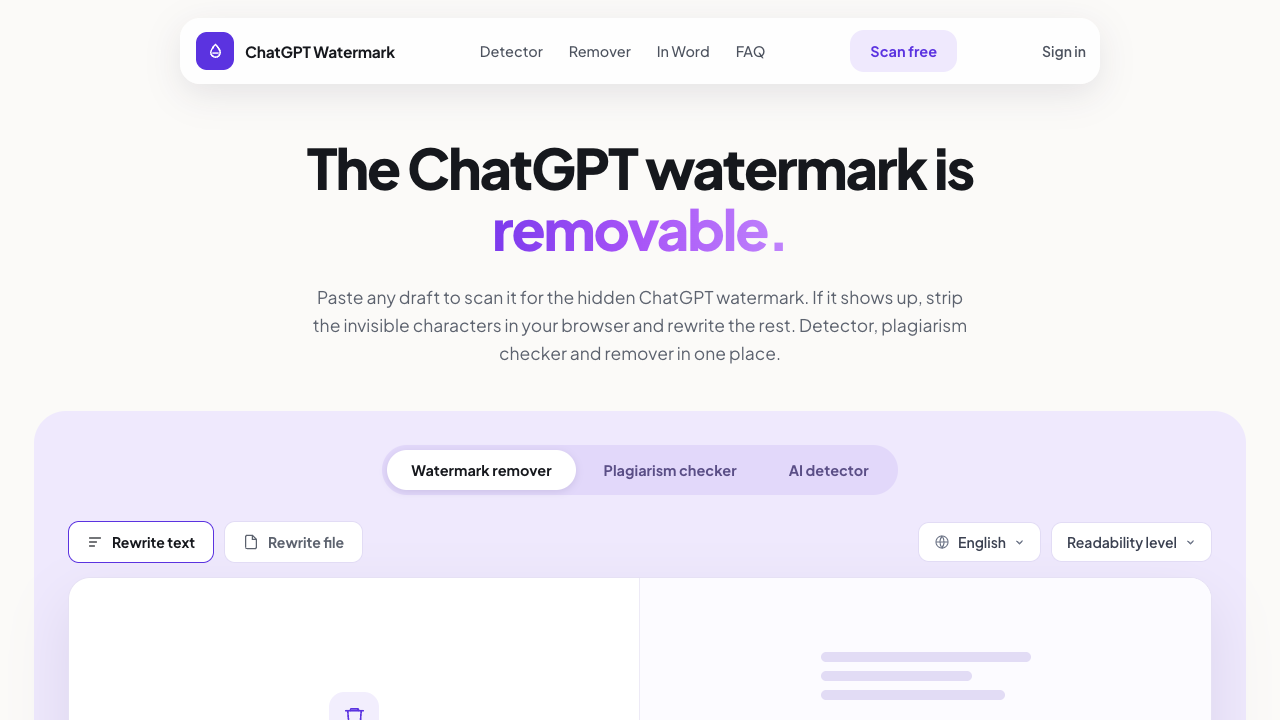
ChatGPT Watermark is a specialized web utility designed to identify and eliminate both mechanical and statistical watermarks left behind by OpenAI language models. When text is generated by ChatGPT, it often carries invisible Unicode characters such as narrow no-break spaces or zero-width joiners, alongside statistical token-choice biases that trigger detection systems. The platform combines a watermark detector, invisible character stripper, sentence rewriter, and plagiarism checker into a unified browser interface to help users inspect and sanitize their drafts. The platform operates across three coordinated stages. First, the scanner evaluates pasted text or uploaded documents of up to 15,000 characters, tallying hidden Unicode artifacts and evaluating AI writing patterns with sentence-level flagging. Next, users can strip mechanical characters directly in the browser without modifying visible words. To break the statistical watermark pattern, the system provides sentence-by-sentence rewriting adjusted to chosen readability levels, restructuring phrasing while keeping facts and figures intact. The tool also includes a plagiarism checker to verify text against indexed web sources. This service is designed for content creators, students, copywriters, and researchers who utilize AI drafting assistance but want to prevent accidental formatting glitches and automated detection flags. It provides clear instructions for removing artifacts in Microsoft Word and cleans documents that tools like Google Docs and Apple Pages cannot inspect natively. Because it requires no user account, payment cards, or credits, and enforces a strict policy against storing or logging user submissions, it is suitable for privacy-conscious writers needing immediate verification. Unlike many tools that claim to bypass detection via proprietary black boxes, ChatGPT Watermark is distinct in its transparency. It explicitly discloses the limitations of detection, noting that statistical token patterns cannot be decrypted without OpenAI's private key. By focusing on verifiable Unicode removal and transparent sentence rewrites, it provides a practical, honest approach to text sanitation without retaining user data.
Pros & cons
Pros
- Strips hidden Unicode characters like zero-width joiners and narrow no-break spaces directly in the browser.
- Completely free to use with no account creation, credit cards, or subscription credits required.
- Protects document privacy by guaranteeing that submitted text is never stored or logged.
- Transparently admits that statistical watermarks cannot be read without OpenAI's proprietary key.
- Supports both raw text pasting and file uploads up to 15,000 characters per operation.
Cons
- Cannot directly decrypt statistical watermarking without access to OpenAI's private key.
- AI writing pattern detection scores may yield false positives on formal human writing.
- Breaking the statistical watermark requires rewriting entire sentences rather than just stripping hidden characters.
- Google Docs and Apple Pages lack native search for invisible characters, requiring external scanning.
Use cases
- Digital publishers and bloggers can strip invisible Unicode characters from AI drafts before pasting into CMS editors to prevent formatting errors.
- Students and researchers can inspect written assignments for AI writing patterns and verify content uniqueness with the plagiarism checker.
- Copywriters can rewrite AI-generated drafts sentence by sentence to break statistical token patterns while keeping facts and keywords intact.
- Technical writers can follow specific Find-and-Replace instructions to purge narrow no-break spaces directly inside Microsoft Word documents.
Features
- mechanical invisible unicode character scanner and stripper
- microsoft word invisible character removal guidelines
- client-side processing with zero server-side text storage
- direct file upload and paste up to 15,000 characters
- configurable text readability level settings
- plagiarism checker against indexed web pages and papers
- ai detection pattern scoring with sentence flagging
- sentence-by-sentence rewriting engine
Pricing
Free
Free
- Up to 15,000 characters per scan
- Browser-based invisible Unicode stripping
- Sentence-by-sentence text rewriting
- AI writing pattern detection score
- Web and academic plagiarism checker
- File upload and text paste support
- No account or payment required
- Zero data logging or storage
FAQs
Does ChatGPT leave a watermark?
Yes, in two distinct ways. OpenAI employs statistical text watermarking that biases token selection patterns, while copied outputs frequently contain invisible Unicode characters like narrow no-break spaces.
How do you remove the ChatGPT watermark?
Removal requires scanning the draft to identify hidden Unicode characters, stripping those mechanical markers in the browser, and then performing a sentence-level rewrite to disrupt the statistical token patterns.
Can any tool detect the statistical watermark itself?
No third-party tool can decipher the statistical watermark because doing so requires OpenAI's proprietary cryptographic key. The scanner reports this layer as unreadable rather than guessing.
How do you remove invisible ChatGPT characters in Microsoft Word?
Open Find and Replace and search for ^u8239 with an empty replace field to remove narrow no-break spaces. Repeat the search with ^u8203 for zero-width spaces, then toggle paragraph marks to verify removal.
Does the website save or log my submitted text?
No, text is never stored or logged on remote servers. The mechanical invisible characters are stripped directly within your browser, ensuring your drafts remain private.
Ratings & reviews
No reviews yet. Be the first to share how ChatGPT Watermark worked for you.
Alternatives to ChatGPT Watermark

Remove invisible SynthID watermarks and C2PA metadata from AI-generated images and videos to prevent social platforms from throttling your reach.

Eliminate invisible SynthID AI watermarks from Gemini-generated images and videos directly in your browser without quality loss or compromising data privacy.

Cleanse Gemini-generated images and videos of hidden SynthID watermarks to ensure privacy and professional quality without any loss in resolution or pixel detail.

Eliminate distracting watermarks from photos, videos, and PDFs instantly with AI-powered detection that preserves image quality for creators and marketers.

Remove watermarks, logos, and text from photos using AI-powered detection and inpainting to ensure high-quality, blur-free results for creators and businesses.
Sponsored tools

Test your knowledge in live multiplayer Jeopardy-style trivia battles with AI-assisted grading that recognizes correct answers even with spelling mistakes.

Connect with engaged niche audiences or monetize your subscriber base through an automated marketplace featuring verified metrics and secure Stripe payments.

Monitor brand citations and prompt visibility across Google AI Overviews, ChatGPT, Perplexity, Claude, and Gemini with free 30-day answer engine reports.
Generate cinematic videos with synchronized audio and multi-modal references. Empower creators and marketers to direct consistent characters, action, and sound.

Create 2K AI videos with native stereo audio from text or images. Ideal for creators and marketers seeking rapid, studio-grade visual content production.

Generate marketing videos, AI avatars, and multi-language translations from prompts, images, or product links without any filming or manual editing.