
Wall Street’s AI productivity surge forces banks to plan massive job cuts.
Wall Street's AI testing ends; quantified productivity gains are now forcing structural realignment and major workforce reductions.
December 18, 2025
The era of artificial intelligence experimentation on Wall Street has formally concluded, yielding to a new chapter where generative AI is embedded in the daily machinery of the nation's largest financial institutions. By December 2025, the conversation among top bank executives had shifted decisively from proof-of-concept to operational reality, with efficiency gains translating almost immediately into revised workforce strategies. At a financial-services conference hosted by Goldman Sachs in New York, bank leaders confirmed that AI is now a core component of their productivity engine, and that the long-anticipated structural changes to the workforce are no longer a theoretical risk but a strategic certainty. The consensus among executives, while framed around improving service and regulatory compliance, also surfaced the hard economic reality: the future of finance is built on fewer people. This marks a pivotal moment for the AI industry, as one of the world's most capital-intensive and coordination-heavy sectors begins to fully monetize its trillion-dollar investment in intelligent automation.
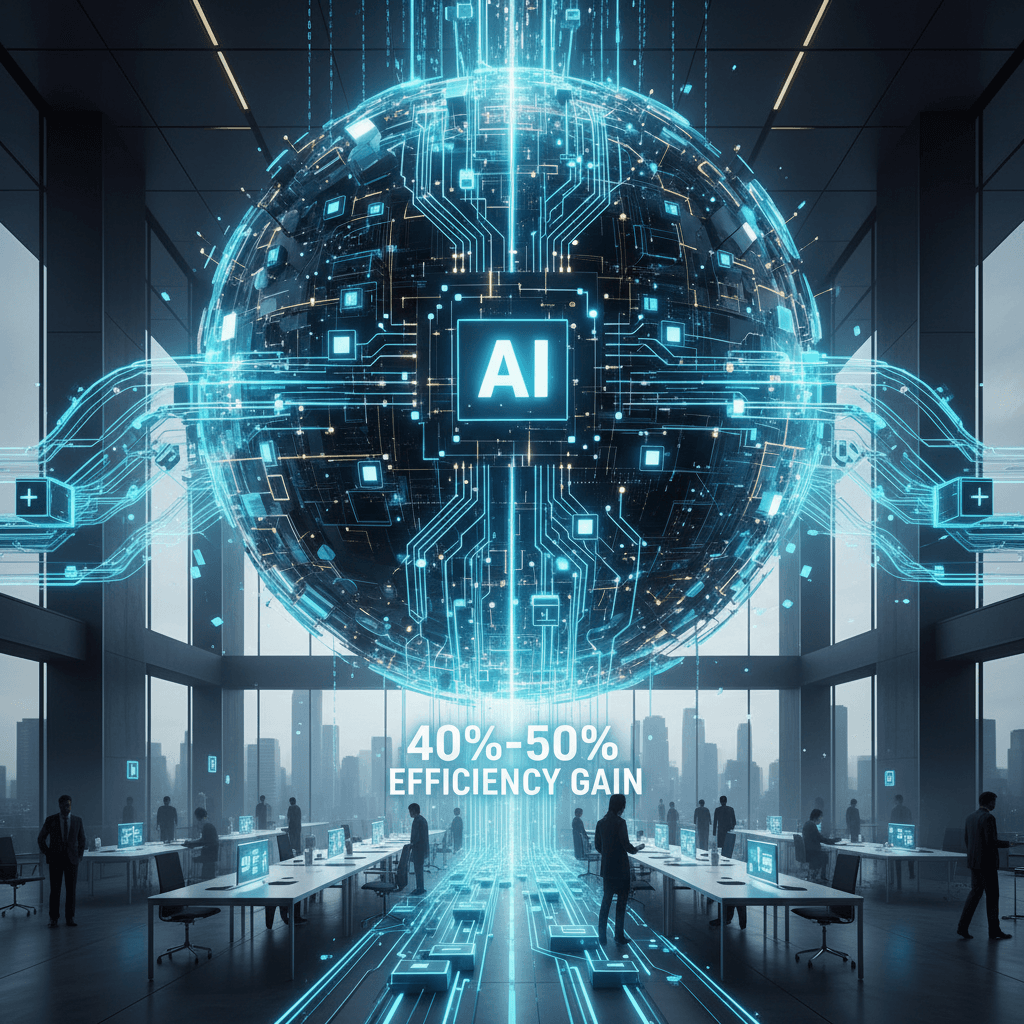
The measurable impact of generative AI on core banking functions has quickly moved beyond marginal improvements to represent a profound shift in output capacity. JPMorgan Chase, one of the most aggressive adopters of the technology, reported a doubling of productivity to roughly 6% in areas where AI tools have been deployed, according to comments made by a top executive at the conference.[1][2] For the bank's operational specialists, the expected leap is even more dramatic, with internal projections forecasting productivity gains that could eventually reach 40% to 50% as AI becomes fully integrated into routine work.[1][2] Citigroup also cited significant efficiency improvements, reporting a 9% rise in coding productivity, which has the effect of freeing up an estimated 100,000 hours of developer time per week.[3] These are not anecdotal gains; they are quantified results driven by deliberate choices, such as JPMorgan’s focus on its proprietary "LLM Suite," a controlled environment that allows 200,000 employees to use large language models securely for content drafting, summarizing complex internal documents, and instantly extracting information from legal contracts.[1][4] The sheer speed of AI-assisted work, such as the ability for investment bankers to create five-page presentations in 30 seconds—a task that previously consumed hours for junior analysts—illustrates the irreversible operational velocity change underway.[4]
These productivity benchmarks are directly informing corporate staffing plans, signaling a phased but inevitable reduction in headcount across Wall Street. The primary targets for displacement are roles that involve routine, repetitive, or coordination-heavy tasks, typically found in the middle and back offices, operations, and customer service.[5][6] Wells Fargo’s CEO noted that while the bank had not yet reduced headcount purely due to AI, management expects to find areas where fewer people are needed as productivity improves, and furthermore, the bank's internal budgets already point to a smaller workforce by 2026.[1] To manage the transition, Wells Fargo has also flagged higher severance costs in its preparations for future adjustments.[1] Echoing this sentiment, a JPMorgan executive indicated that the bank could reduce support and operations staff by at least 10% over the next five years, with CEO Jamie Dimon acknowledging that AI "will eliminate jobs."[7] Industry-wide analysis corroborates this outlook, with a Bloomberg Intelligence survey suggesting that global banks may eliminate up to 200,000 positions over the next three to five years.[5][6] The shift is so profound that one analysis suggests the banking industry, with a high percentage of jobs at risk of automation, is set to be the hardest hit sector by AI deployment.[6]
The integration of AI also signals a strategic retooling of the banks' core business processes, a move that executives have dubbed 're-engineering the firm.' At Goldman Sachs, the internal initiative known as "OneGS 3.0" is channeling the productivity gains from generative AI—which targets areas like client on-boarding, lending processes, regulatory reporting, and vendor management—to effect job reductions and hiring slowdowns.[8][9] The strategy transcends simple task automation; it involves redesigning entire workflows to leverage AI's strengths in parsing massive data sets, a capability that dramatically reduces the need for human coordination and manual data aggregation. This is also evident in the development of internal tools like the GS AI Assistant, which is used by thousands of employees for summarizing documents and drafting reports.[7] The focus is not only on efficiency but on using AI to manage the enormous and growing regulatory and compliance burden. For the financial services industry, this technological overhaul is an existential imperative, promising a path to higher profit margins. According to estimates from McKinsey, generative AI could unlock between $200 billion and $340 billion in annual value for the banking sector, predominantly through these productivity enhancements.[1]
For the AI industry, Wall Street's rapid adoption represents the highest-profile validation of generative AI's enterprise-level value outside of the core technology sector. The financial stakes are driving a new wave of investment, but also raising crucial questions about the talent pipeline. While the World Economic Forum projects that AI will displace 85 million jobs globally, it also anticipates the emergence of 97 million new roles, creating a net gain.[10] However, this aggregate optimism masks a significant displacement for workers in legacy roles, highlighting a critical skill mismatch. Banks are actively poaching top tech talent and launching massive internal reskilling programs, underscoring that the new jobs being created—AI engineers, data scientists, and prompt-literate analysts—are a poor fit for the displaced staff in operations and coordination.[11][12] The imperative now is on institutional leaders to manage the human impact of this transformation through planning for retraining and redeployment initiatives, as JPMorgan's CEO has stressed.[13] The financial giants have concluded their AI testing phase, and the resulting productivity surge is now dictating a structural realignment. Wall Street's future workforce will be smaller, highly augmented, and fundamentally different, securing AI's place as the primary driver of capital allocation and job transformation for the foreseeable future.