
SpaceX and xAI Merge, Forging Unprecedented Space-Based AI Powerhouse.
The consolidation accelerates Musk's plan for orbital data centers, leveraging Starlink and Grok for unprecedented scale.
January 30, 2026
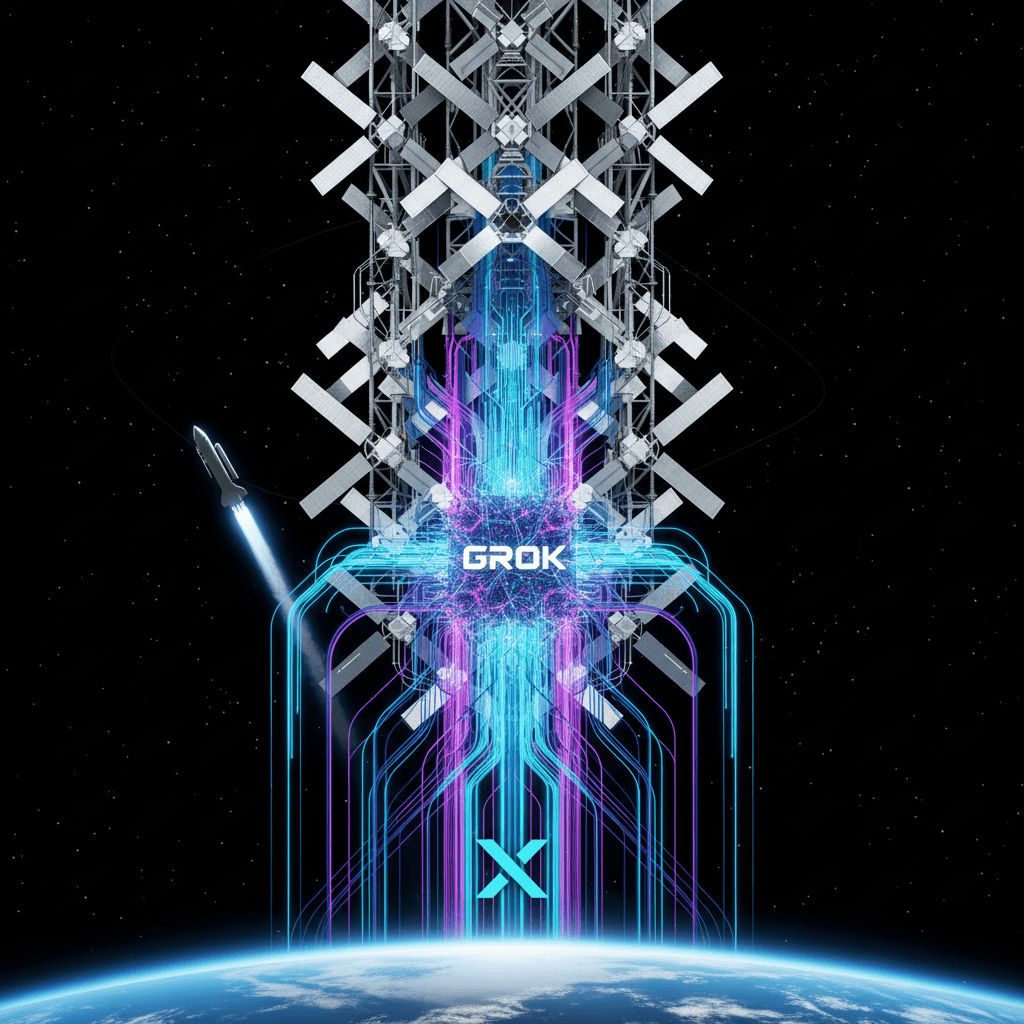
In a potential corporate maneuver that would fundamentally reshape the aerospace and artificial intelligence landscapes, SpaceX is reportedly in advanced negotiations to merge with xAI, the AI startup founded by Elon Musk. The move, which would consolidate xAI’s Grok chatbot, SpaceX’s Starlink satellite network and launch vehicles, and the X social media platform under a single corporate roof, is being considered ahead of a widely anticipated Initial Public Offering for the space exploration company. Such a consolidation represents a dramatic acceleration of Musk’s vision for a vertically integrated technology monolith, poised to leverage orbital infrastructure for next-generation AI development.[1][2][3] The proposed transaction would involve exchanging shares of xAI for stock in SpaceX, although the ultimate structure, valuation, and timeline remain fluid, with no final agreement signed.[1][2][4][5] This complex corporate move, evidenced by the recent establishment of Nevada-based entities to facilitate the transaction, suggests a serious intent to create an unrivaled titan in the converging fields of space, data, and computation.[1][3][4] SpaceX, recently valued near $800 billion in private secondary share sales, could see its valuation push past $1 trillion following the integration with xAI, which was last valued around $230 billion.[1][6][7]
The strategic rationale underpinning the merger lies in the profound synergy between advanced artificial intelligence and space-based infrastructure, a concept Musk has championed publicly. A key objective is the development and deployment of orbital data centers, an ambitious project intended to power AI workloads from space.[1][8][9] Musk has argued that the constant solar energy and natural cooling capabilities of the space environment could make it the “lowest cost place to put AI” within a few years.[1][10][7] By folding xAI into SpaceX, the combined entity would instantly possess a proprietary AI stack, featuring the Grok language model, tightly integrated with Starlink’s extensive global satellite network and the company’s unparalleled launch cadence.[7] This vertical integration provides a self-contained ecosystem for developing, training, and deploying AI, bypassing terrestrial constraints. The Starlink constellation, with its low-latency, high-bandwidth connectivity, would serve as a critical backbone for real-time AI processing and data transmission, while Grok’s capabilities could, in turn, be used to optimize autonomous satellite operations, network management, and even future deep-space missions.[8][9] This dynamic interplay between aerospace, communication, and AI could offer a significant operational advantage over industry rivals.
The integration of X, which xAI acquired previously, adds a crucial third pillar to the potential super-company: a massive, real-time data source. X’s vast and constantly flowing firehose of social media data serves as a unique and invaluable dataset for training and fine-tuning Grok’s large language model.[9] This continuous stream of conversational, topical, and user-generated content provides a significant competitive edge in the rapidly evolving AI race, where data quantity and recency are paramount. The combined entity would control the end-to-end process: generating the data via X, processing and refining the AI model (Grok), and then transmitting and operating the service through its own satellite communications network (Starlink), launched by its own rockets (SpaceX). Such a degree of vertical integration is practically unprecedented in modern technology, rivaled only by a few tech giants. Furthermore, the combined entity would be positioned strongly for lucrative government and defense contracts. xAI is already contracted to provide Grok AI services to the U.S. Department of Defense as part of a contract valued at up to $200 million, while Starlink's national security variant, Starshield, is also a key platform for global connectivity and advanced satellite systems for the Pentagon.[8][4] Merging these two companies would simplify the corporate structure for securing and executing massive, cross-domain government projects.
The potential merger is also viewed as a calculated move to enhance the impending SpaceX IPO, which is expected to be one of the largest in history. By combining the high-growth, speculative value of a cutting-edge AI company like xAI with the established and already highly valued aerospace and satellite communications business of SpaceX, the resultant entity presents an exceptionally compelling and diversified investment thesis.[3][11] This consolidation may allow the combined company to command a higher market capitalization upon listing, potentially exceeding $1 trillion, and offering investors exposure to a comprehensive, multi-sector technology leader. However, the complexity and sheer scale of combining such disparate businesses also introduce significant financial and operational risks. Analysts caution that while the synergistic potential is immense, the integration could distract the management of both companies, and the technical challenges of realizing space-based AI infrastructure remain considerable.[12][9] The deal also follows a pattern of corporate consolidation within Musk's empire, including the prior acquisition of X by xAI and cross-investments totaling billions of dollars between xAI, SpaceX, and Tesla, indicating a deliberate strategy to interlink his ventures.[3][11]
The broader implications for the global AI industry are profound. A unified SpaceX-xAI would represent a powerful new challenger to established hyperscalers and AI leaders like Google, Microsoft, Amazon, and OpenAI, particularly by defining a new frontier of space-based computation. By pioneering the deployment of data centers in orbit, the company could disrupt the traditional model of massive, ground-based data centers, setting a new benchmark for scale and operational efficiency in AI training.[1][7] This aggressive push for vertical integration and extraterrestrial infrastructure is a clear declaration of intent to compete not just on the quality of its AI models, but on the very foundation of its computing platform, using orbital mechanics and self-owned launch capability as a differentiator. The potential merger marks a pivotal moment in the history of corporate technology, one where the final frontier of space becomes an operational domain for the most advanced forms of artificial intelligence.
Sources
[1]
[3]
[5]
[9]
[10]
[11]
[12]