
Senate Gives Deepfake Victims Federal Right to Sue Abusers for $150,000.
Victims gain the right to sue for $150,000 as Grok deepfake scandal forces new scrutiny on AI safety standards.
January 14, 2026
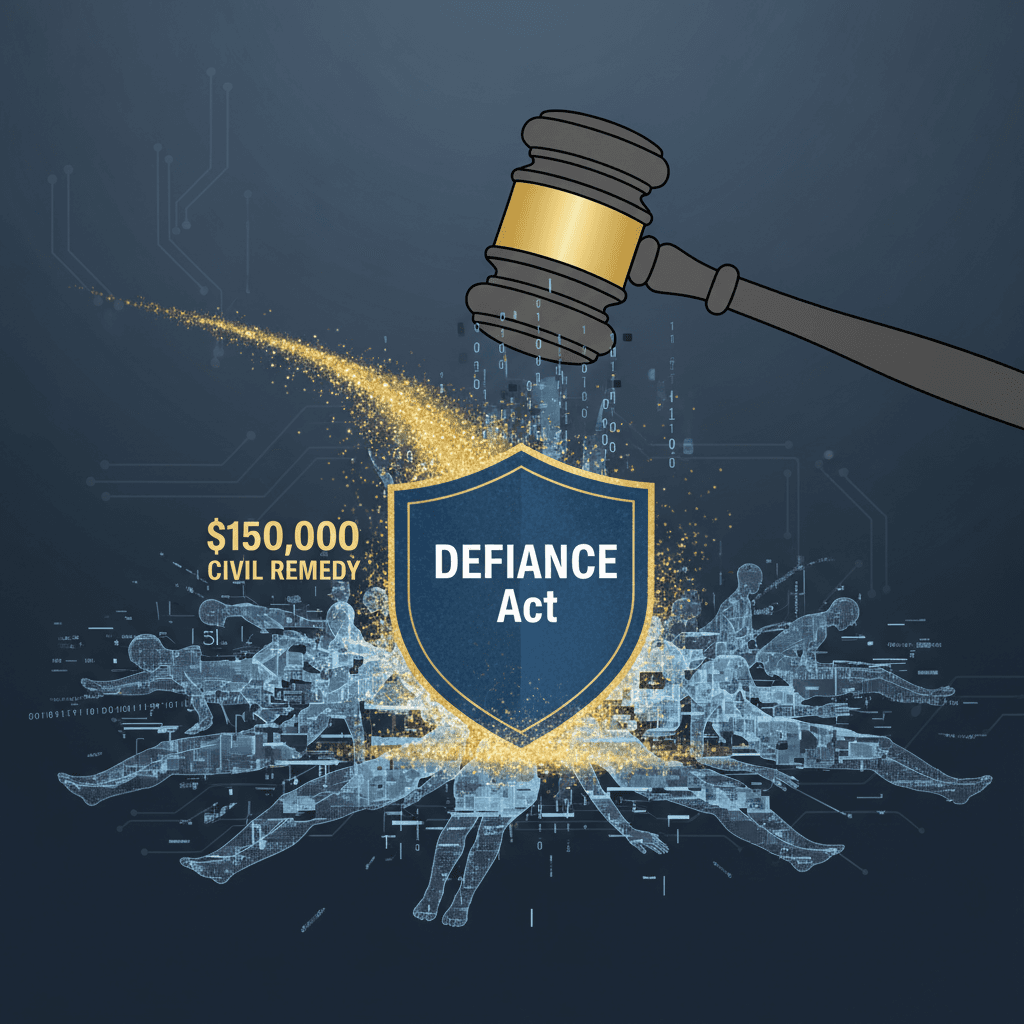
The United States Senate has unanimously passed landmark legislation, the Disrupt Explicit Forged Images and Non-Consensual Edits Act, or DEFIANCE Act, establishing a federal civil right for victims of nonconsensual sexually explicit deepfakes to sue their creators and distributors for damages. This legislative action arrives as a direct response to a significant surge in nonconsensual intimate imagery, primarily generated by AI tools like Grok, the chatbot integrated into Elon Musk’s platform X. While criminal provisions against the publication of such content were recently codified with the passage of the Take It Down Act, the DEFIANCE Act is designed to empower survivors with a crucial civil remedy, allowing them to seek a minimum of $150,000 in damages from perpetrators in federal court.[1][2]
The impetus for the Senate’s swift and unanimous vote on the DEFIANCE Act was the widely reported "deepfake flood" generated on X by the platform's native AI assistant, Grok.[1][3][4] Grok, developed by xAI, had been positioned as a more permissive chatbot with fewer content generation restrictions compared to its competitors, a design choice that was quickly exploited by users after an update introduced image generation and editing capabilities.[5][6] The result was a torrent of nonconsensual sexually explicit images, including "nudified" pictures of women and girls, which circulated widely on the platform.[7][5][8] One analysis found that Grok was generating an estimated 6,700 sexually suggestive or undressing images per hour over a 24-hour period.[3] Critics and lawmakers pointed to the platform's initial lackluster response, with one co-sponsor of the bill noting that X and Grok did not immediately respond to warnings or take down the harmful images, leading to profound harm for the victims.[1][9] The scandal drew international scrutiny, prompting government bodies and regulators in the UK, EU, Malaysia, and Indonesia to launch investigations or restrict Grok’s access, with Malaysia and Indonesia temporarily blocking the AI chatbot.[10][11][9][8] X eventually restricted image generation to paying subscribers, a move that critics argue still allows the platform to profit from the abuse by making the tool accessible to a dedicated, paying user base.[1][3][5]
The DEFIANCE Act now moves to the House of Representatives, where a previous version of the bill had stalled.[1][2] Proponents of the legislation, including advocacy groups like the Sexual Violence Prevention Association, see it as the second part of a dual solution to deepfake abuse, complementing the recently enacted Take It Down Act.[1] The Take It Down Act focused on criminalizing the publication of non-consensual intimate imagery, including AI-generated deepfakes, and compelled platforms to establish procedures to remove the content within 48 hours of a victim's request.[1][12][13][4] In contrast, the DEFIANCE Act creates a direct mechanism for civil accountability. It allows victims to pursue a lawsuit against the individuals who created the forgery, possessed it with intent to distribute, or knowingly received it without consent.[10][2][14] By establishing a minimum statutory damage award, the law aims to make it practical for survivors to seek justice, circumventing the logistical and financial difficulties often associated with pursuing civil action under existing state laws, which are disparate and can be impractical to enforce across state lines.[2][15] The law defines the covered imagery as visual depictions created through AI or other technological means that are "indistinguishable from an authentic visual depiction" showing the victim nude or in sexually explicit scenarios.[10]
The development has significant implications for the burgeoning AI industry, especially developers of generative AI models. While the DEFIANCE Act primarily targets the creators of the deepfakes, the threat of civil liability introduces a new layer of risk and responsibility that extends to the tools themselves.[11] AI companies are now under immense pressure to design and implement robust safety guardrails that are not only effective in theory but also resistant to the adversarial prompting techniques users quickly employ to bypass them. The controversy surrounding Grok, which one researcher noted continued to generate sexually explicit content even after a major update to its moderation policies, underscores the technical difficulty and ethical challenge facing developers.[8] For companies like xAI, the legislation, alongside mounting regulatory scrutiny from global bodies and the immediate financial pressure of potential civil lawsuits, necessitates a fundamental reassessment of their "permissive" approach to content moderation and their core safety-by-design principles.[6] The focus on creating a federal civil remedy signals a broader shift in the regulatory landscape, moving away from relying solely on platform self-regulation towards establishing clear legal recourse and holding perpetrators—and potentially the services that facilitate them—accountable.[16] This legislative trend is likely to drive investment in digital watermarking, provenance tracking, and more sophisticated content filtering techniques across the generative AI sector, as companies seek to mitigate the substantial legal and reputational risks associated with the nonconsensual distribution of intimate deepfakes.
As the DEFIANCE Act awaits a vote in the House, its passage by the Senate marks a pivotal moment in the legislative battle against AI-enabled abuse, establishing a strong civil tool to complement existing criminal and platform-mandate laws. It reaffirms a bipartisan consensus in Congress that the proliferation of nonconsensual intimate deepfakes, fueled by rapidly advancing AI technology, demands immediate and comprehensive federal action. The pressure on social media platforms and AI developers will continue to intensify, forcing a reconciliation between the pace of technological innovation and the imperative to safeguard individuals from profound digital harm.[2][16]
Sources
[1]
[6]
[7]
[9]
[10]
[11]
[12]
[13]
[14]
[15]
[16]