
Science Context Protocol Unites Global Labs, Unleashing Autonomous AI Agents
The Science Context Protocol bridges AI computation and physical lab robots, creating autonomous, global research networks.
January 2, 2026
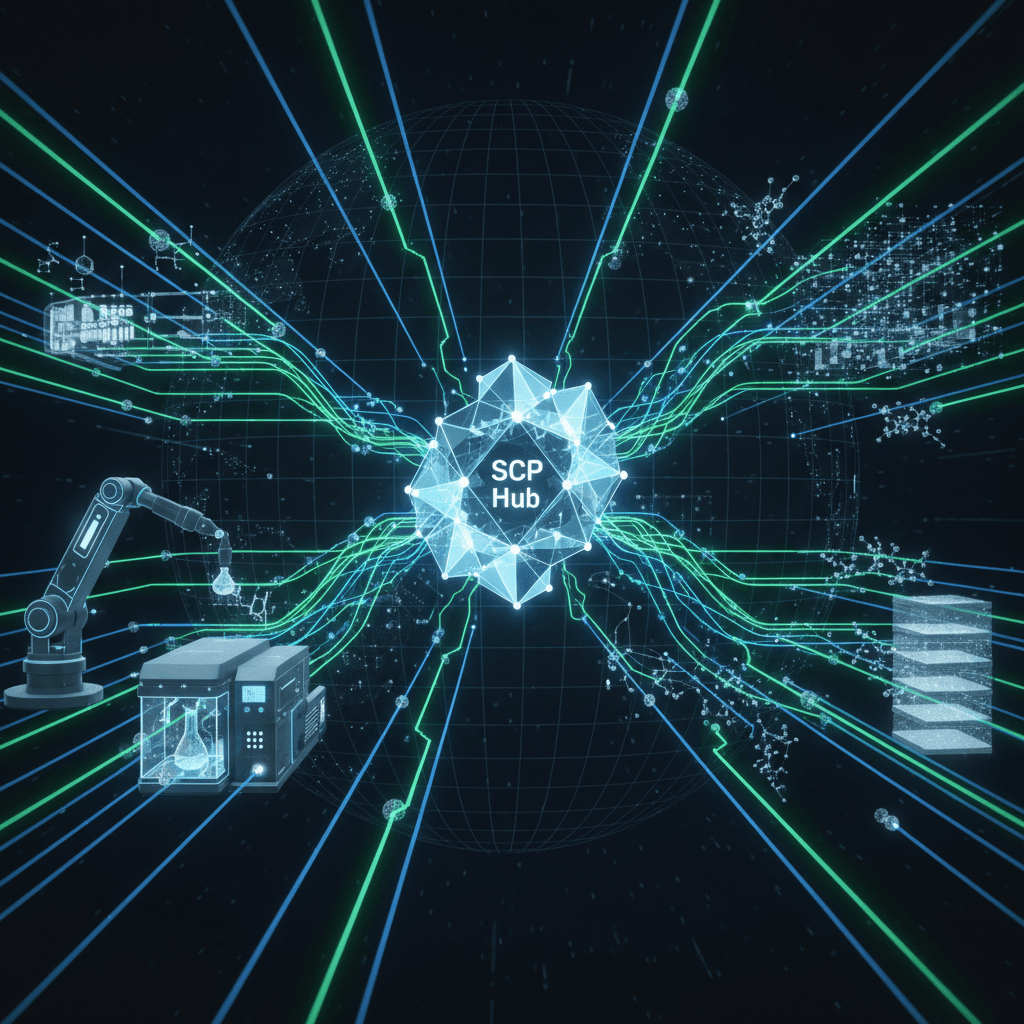
A new open-source standard, the Science Context Protocol, or SCP, is emerging from the Shanghai Artificial Intelligence Laboratory with the ambitious goal of forging a global, collaborative network of autonomous scientific research agents. This initiative aims to address a critical bottleneck in modern discovery: the fragmentation of data, computational models, and physical laboratory equipment across disparate institutions and proprietary systems[1][2]. Inspired by the success of Anthropic's universal Model Context Protocol, the SCP proposes a foundational connectivity layer designed specifically for the unique, complex demands of the scientific ecosystem, promising to unify what are currently isolated silos into a single, cohesive, and intelligent workflow[3][2]. By creating a universal interface for everything from genomic databases to physical lab robots, researchers are laying the groundwork for a new era of "hybrid dry-wet" agent-driven science that transcends institutional boundaries[2].
The conceptual foundation of SCP is rooted in the architecture of the Model Context Protocol, or MCP, an open standard introduced by Anthropic that has quickly become a pivotal framework in the commercial AI sector[4][5]. MCP was conceived to solve the "N x M integration problem," the unmanageable complexity of requiring custom integrations between every AI application (N) and every external data source or tool (M)[6][7]. By establishing a standardized "language" based on a client-server architecture, MCP allows large language models (LLMs) to securely access real-time data, business applications, and development environments, acting as a "USB-C port for AI applications"[8]. Major AI providers, including OpenAI and Google DeepMind, have adopted the standard, validating its utility for connecting generative AI to the real-world context it needs to function reliably[5]. However, the existing Model Context Protocol was predominantly designed for *dry-lab*, software-centric tasks, such as accessing customer records or querying enterprise databases[9]. The challenges of scientific research—which involve coordinating physical experiments, ensuring strict reproducibility, and managing high-value, institutionally protected intellectual property—required a far more robust and domain-specific extension.
The Scientific Intelligence Context Protocol takes the core client-server and context-sharing principles of MCP but deeply integrates features necessary for high-stakes, multi-disciplinary research, making a sharp pivot towards bridging the gap between computational science and the physical world[2]. Its design is built on two primary pillars: Unified Resource Integration and Orchestrated Experiment Lifecycle Management[3]. Unified Resource Integration provides a universal specification for all scientific assets, standardizing the description and invocation of computational models, large-scale datasets, specialized software tools, and, crucially, physical instruments and wet-lab equipment[2]. This standardization is the critical step in making laboratory robots and instruments discoverable and callable by an autonomous AI agent in the same manner as a database API, facilitating the trivial composition of dry-wet hybrid experiments across different institutional networks[2]. The vision is to enable an AI agent in Shanghai to seamlessly task an automated chemical synthesis robot in a lab thousands of miles away, all through a standardized, context-aware call structure.
To manage the complexity and security inherent in global, multi-institution scientific work, SCP introduces a secure service architecture centered around an **SCP Hub** and federated **SCP Servers**[3]. The SCP Hub functions as the central orchestrator, managing the entire experiment lifecycle, which spans registration, multi-agent planning, execution, monitoring, and final archival[3]. This centralized management layer is vital for ensuring the reproducibility and traceability of scientific findings, a major pain point in contemporary research[2]. By assigning uniform identifiers for data, results, and the process memories of the agents involved, the protocol ensures that every step of a complex, multi-institution experiment is fully documented and verifiable[2]. Furthermore, the Hub is designed to enforce sophisticated governance, implementing per-experiment access control policies and scoped permissions to safeguard confidentiality and ensure fair resource allocation for high-demand assets, a non-negotiable requirement when sharing proprietary data or expensive physical lab time[3].
The implications of SCP for the future of scientific discovery are profound, moving beyond mere augmentation to full automation and a paradigm of collaborative, agent-driven research[3]. By standardizing tool orchestration at the protocol level, SCP significantly reduces the integration overhead that currently plagues bespoke agentic science systems, which are often tightly coupled to single-lab workflows[3]. This open-source standard supports a broad range of scientific disciplines, including molecular biology, chemistry, materials science, protein engineering, and medical research, providing a common infrastructure for autonomous AI scientists[3]. Already, a scientific discovery platform based on SCP has been established, offering an ecosystem of over 1,600 tool resources for researchers and agents to leverage[3]. By enabling AI agents to discover, call, and compose these capabilities across disparate platforms, the protocol is establishing the essential infrastructure for scalable, multi-institution, agent-driven science, shifting the focus of human researchers from routine, repetitive tasks to high-level hypothesis generation and interpretation[2]. The success of this protocol will ultimately determine the pace at which AI-powered agents can transition from theoretical assistants to fully autonomous, collaborative scientists operating on a global scale.
Sources
[1]
[2]
[3]
[4]
[6]
[7]