
Nvidia's NitroGen Unlocks Universal AI: Gaming Foundation Model Learns 1,000 Games.
Nvidia’s NitroGen AI, trained on 40,000 hours of gameplay, transfers universal skills across 1,000 diverse video games.
December 21, 2025
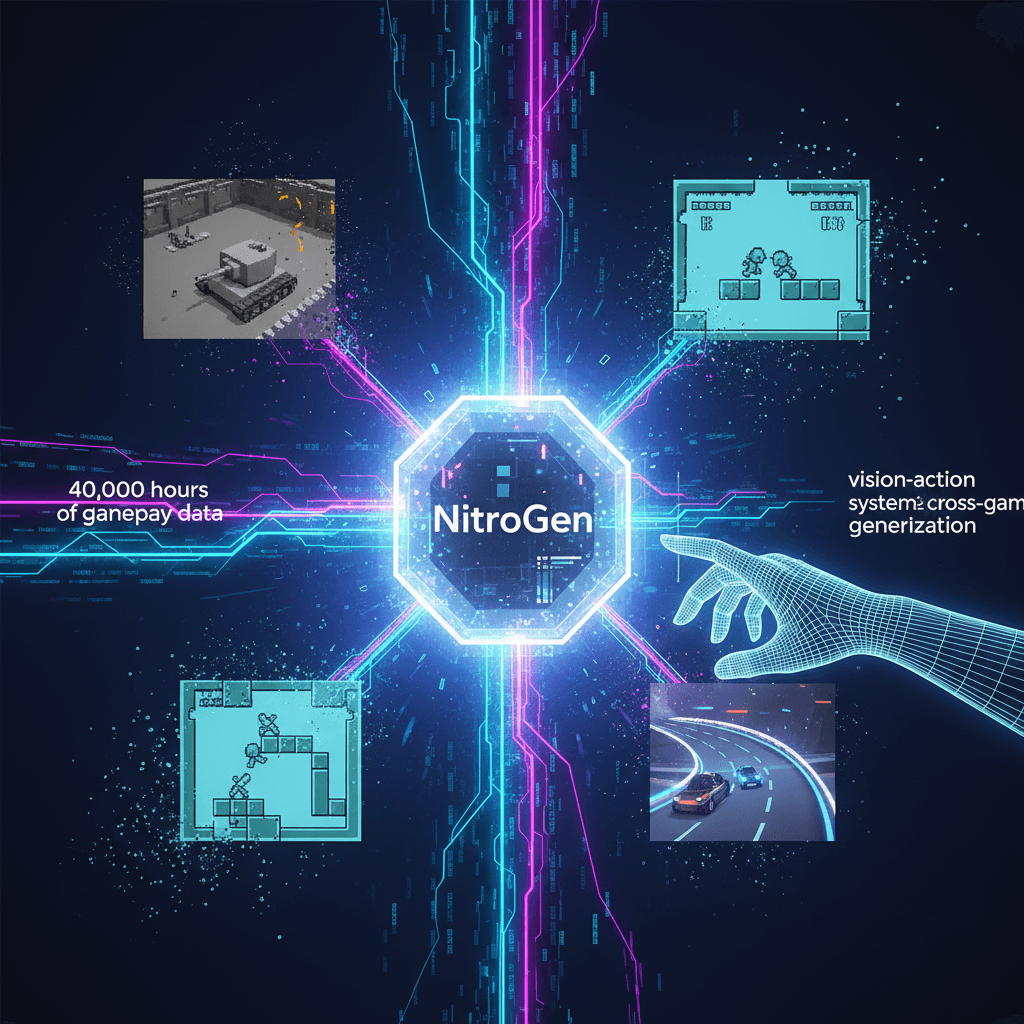
The release of Nvidia's new foundation model for generalist gaming agents, NitroGen, signals a pivotal moment in the development of truly universal artificial intelligence, extending the "scaling is all you need" paradigm from large language models to embodied AI. The model, a vision-action system, has been trained on an unprecedented 40,000 hours of gameplay videos spanning more than 1,000 diverse games, positioning it as a foundational step toward agents capable of operating across disparate virtual and potentially real worlds[1][2][3]. NitroGen's core objective is to move beyond AI specialized for a single task or environment, instead creating a single agent with skills transferable across games with wildly different mechanics, physics engines, and visual styles[4][5].
The key technical breakthrough lies in the creation of an internet-scale, labeled dataset, which has historically been a significant bottleneck for embodied AI research[3][6]. Researchers from Nvidia, in collaboration with institutions including Stanford and Caltech, successfully developed a method to automatically extract player actions from publicly available gameplay videos, specifically targeting streams that included on-screen controller input overlays[4][2]. This innovative data curation pipeline bypasses the slow and expensive manual labeling process, effectively harvesting high-quality action labels at scale[2][6]. The resulting dataset, containing 40,000 hours of video, is considered the largest and most diverse open-source gaming dataset with extracted action labels, enabling the large-scale behavior cloning used to train NitroGen[1][3].
NitroGen demonstrates a strong competence across a wide range of virtual challenges, including combat encounters in 3D action games, high-precision control in 2D platformers, and exploration within procedurally generated worlds[1][2][5]. Crucially, the model exhibits significant cross-game generalization, a key metric for universal AI[1]. In experiments, NitroGen showed its ability to transfer learned skills to previously unseen games, achieving up to a 52 percent relative improvement in task success rates compared to models trained from scratch[4][3]. This zero-shot gameplay capability, where the agent is dropped into an unfamiliar environment and can immediately perform tasks, validates the team's hypothesis that large-scale pre-training on diverse human data can unlock general-purpose embodied abilities[6][7]. The model's success is particularly pronounced in games designed for gamepad controls, such as action, platformer, and racing genres, though it is less effective with mouse and keyboard-centric genres like Real-Time Strategy or Multiplayer Online Battle Arena games[7].
The implications of this research extend far beyond the gaming world and represent a significant stride for the entire AI industry, particularly in the domain of robotics and general embodied intelligence[8][5]. NitroGen is built on Nvidia's GROOT N1.5 architecture, which was originally designed for generalist humanoid robots[4][5]. This architectural lineage and the model's success in navigating diverse virtual physics and mechanics suggest that the same principles can be applied to create robots capable of operating in diverse or unpredictable real-world environments[8][5]. The ability of the agent to learn "gamer instinct," or fast motor control directly from visual input, translates conceptually into the kind of real-time, fluid decision-making required for autonomous systems like robots or vehicles[8][5]. Potential applications for NitroGen itself include next-generation game AI, which could lead to more realistic and dynamic non-player characters, and automated quality assurance (QA) for video games, where an agent could test and identify bugs across hundreds of titles[7].
The decision to open-source the dataset, evaluation suite, and the model weights themselves is a powerful move intended to accelerate general embodied AI research across the global community[1][6]. By providing this massive, pre-trained foundation, Nvidia is lowering the barrier to entry, allowing researchers and developers to fine-tune the agent for new tasks without the considerable computational overhead of training a model from the ground up[6]. This open approach positions NitroGen as a new standard benchmark for measuring cross-game generalization, fostering a competitive and collaborative environment for the development of even more powerful and universal agents[1][3]. The work effectively validates a scalable, internet-data-driven pipeline for constructing general-purpose agents that can operate in unknown environments, moving the AI field closer to the long-sought-after goal of universally capable artificial intelligence[2].