
Nvidia Unveils Vera Rubin AI Supercomputer, Cutting Inference Cost Tenfold.
Nvidia unveils Vera Rubin, open-sourcing autonomy, to architect and own the entire global AI infrastructure.
January 6, 2026
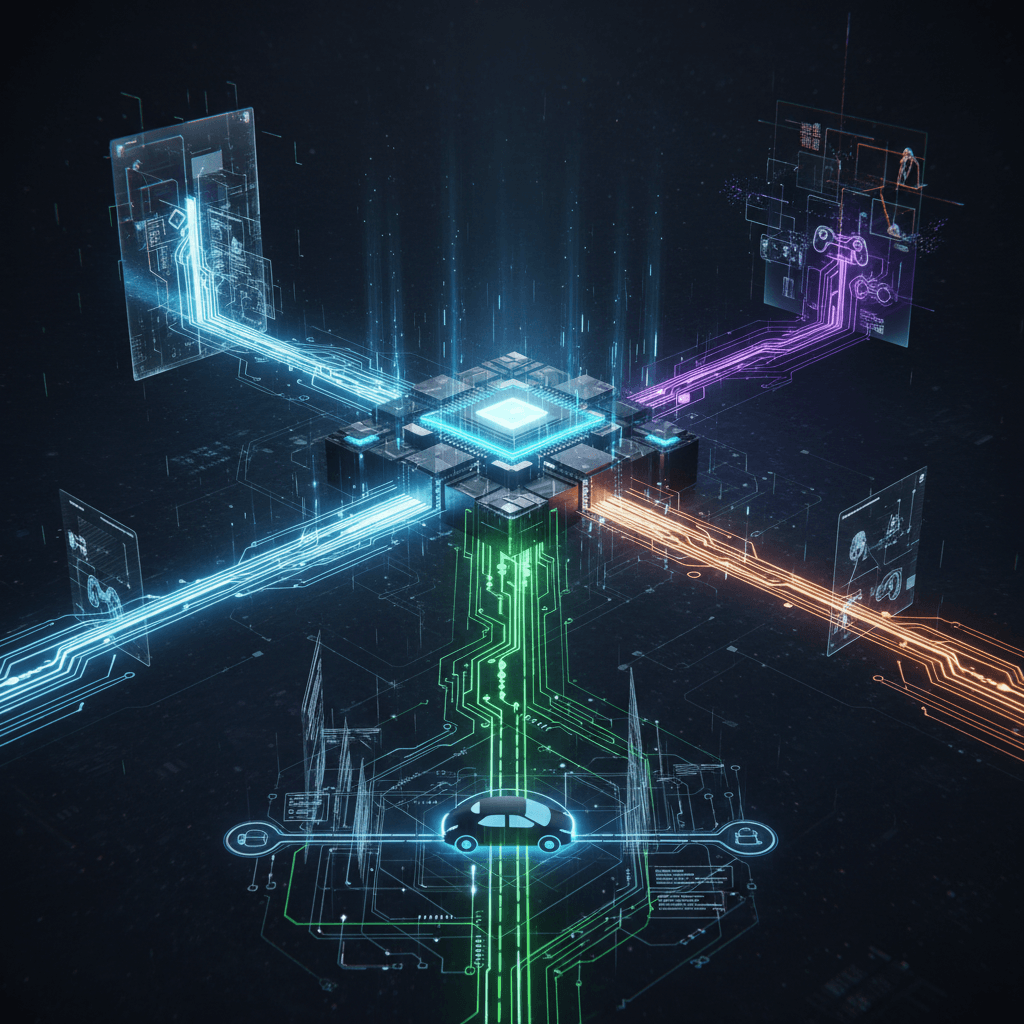
The Consumer Electronics Show (CES) 2026 served as a pivotal stage for Nvidia, which leveraged the global technology forum not just to announce a new generation of hardware, but to clearly articulate a strategy for comprehensive domination of the entire Artificial Intelligence value chain, from the data center to the end-user device. Central to this bold declaration was the unveiling of the Vera Rubin platform, a next-generation AI supercomputer architecture that promises to dramatically reshape the economics and capabilities of large-scale AI deployment. This massive new system, named after the pioneering American astronomer, is engineered to deliver up to five times the AI inference performance and a ten times lower cost per token for inference on Mixture-of-Experts (MoE) models compared to its predecessor, Blackwell[1][2][3]. The company confirmed that the Vera Rubin platform is already in full production, with initial availability through major cloud providers, including AWS, Google Cloud, and Microsoft, slated for the second half of 2026[1][2][3].
The technical specifications of the Vera Rubin platform underscore its ambition as an integrated, rack-scale AI factory rather than just a collection of faster chips. The architecture is a co-designed system comprised of six core chips: the Vera CPU, Rubin GPU, NVLink 6 Switch, ConnectX-9 SuperNIC, BlueField-4 DPU, and Spectrum-6 Ethernet Switch[1][2][3]. The new Rubin GPU features a third-generation Transformer Engine with hardware-accelerated adaptive compression, which is the engine behind the massive jump in performance[1][4][3]. The chip delivers 50 petaflops of NVFP4 compute for AI inferencing and a 3.5 times boost in training performance compared to Blackwell[2][5][6]. The platform also significantly reduces the training burden for MoE models, requiring four times fewer GPUs than the Blackwell platform to achieve the same results, a major factor in the claimed cost reduction[1][3]. Furthermore, the system addresses the growing bottleneck of memory for large language models with a new tier of memory, the Inference Context Memory Storage Platform, facilitated by the BlueField-4 DPU, designed to efficiently manage and reuse the key-value cache data that holds the history of AI interactions[2][5]. This holistic approach, from GPU compute to high-speed interconnects like the 3.6 TB/s NVLink 6, signifies a deep commitment to not only pushing raw performance but optimizing the entire data center stack for the realities of modern agentic and large-scale AI[1][2][3][5].
Beyond the data center, Nvidia's CES announcements extended its AI influence into the realm of physical world applications, specifically autonomous driving, by making a significant push toward an open-source model. The company unveiled a family of open-source AI models and tools for autonomous vehicles under the name Alpamayo[7][8][4]. Touting this as the "ChatGPT moment for physical AI," CEO Jensen Huang positioned Alpamayo to tackle the notoriously difficult "long tail" problem of rare and complex driving scenarios that often cause traditional self-driving stacks to fail[7][9][8]. The flagship is Alpamayo 1, a 10-billion-parameter Vision-Language-Action (VLA) model that uses "chain-of-thought" reasoning, enabling it to not only process video input and generate a path but also to output the logical explanation behind its driving decisions, a crucial step for building trust and safety in autonomous systems[7][9][8]. Nvidia is open-sourcing the Alpamayo 1 model weights on Hugging Face, alongside AlpaSim, an open-source end-to-end simulation framework, and a large open dataset containing over 1,700 hours of complex driving data[7][8]. This move is a calculated attempt to make Nvidia the "Android of Autonomy," providing a foundational, open stack that automotive developers can fine-tune, distill, and test, accelerating industry-wide Level 4 autonomy development[7][9][8]. The effort is already seeing commercial deployment, with the new Mercedes-Benz CLA model set to be the first production vehicle to ship with Nvidia’s advanced driver-assistance features in the first quarter of 2026[7][10][11].
The third pillar of Nvidia’s CES presentation focused on the consumer-facing intersection of AI and gaming with the announcement of Deep Learning Super Sampling (DLSS) 4.5. This graphics upscaling technology, powered by a second-generation Super Resolution transformer model, continues the company's dominance in PC gaming performance[12][13][14]. DLSS 4.5 aims to improve image fidelity by increasing temporal stability, which reduces flickering on static surfaces, and by minimizing "ghosting," or the appearance of ghostly trails behind fast-moving objects[12][13][15]. The new model was developed using five times the compute power of its first-generation predecessor and has been trained on a much larger dataset[16][14]. Furthermore, the company introduced Dynamic Multi Frame Generation, which extends the capability of frame-generation from a maximum of 4x to 6x, dynamically adjusting the frame generation multiplier to maximize frames per second (FPS) to a monitor’s refresh rate[13][16][14][15]. While the second-generation Super Resolution model is immediately available across all RTX GPUs, the new 6x Multi Frame Generation mode will be exclusive to the new RTX 50-series GPUs[13][14]. These advancements reinforce the message that the AI supercomputing power being developed for the data center—the Vera Rubin platform—has a direct, beneficial, and performance-enhancing impact on the consumer gaming market, completing the loop of Nvidia's hardware and software ecosystem.
The scale of the Vera Rubin platform and the move toward open-source models for autonomous driving mark a decisive step in Nvidia’s strategy to not just participate in, but to architect and own the future of AI infrastructure. By offering an integrated supercomputer that dramatically cuts the cost of running inference—the main operational expense for deployed AI models—Nvidia is removing a major economic barrier to the widespread adoption of larger, more powerful AI applications[1][3]. The commitment from cloud providers and leading AI companies like OpenAI and Meta to embrace Rubin-based systems validates the platform as the foundational technology for the next wave of large language models and agentic AI[1][3][5]. Simultaneously, by open-sourcing Alpamayo, Nvidia is attempting to standardize the software layer for physical AI on its hardware, ensuring its chips remain indispensable as AI moves from the digital cloud into the real world. The CES 2026 announcements are less about incremental upgrades and more about a strategic full-stack takeover, solidifying Nvidia’s position as the essential engine for global AI innovation.
Sources
[1]
[3]
[6]
[7]
[8]
[10]
[11]
[12]
[13]
[14]
[15]
[16]